







Question: Operations Management: Problem Set 2 Q.1 Use the following data to answer questions i to iii (10 points) A repairman is to be hired
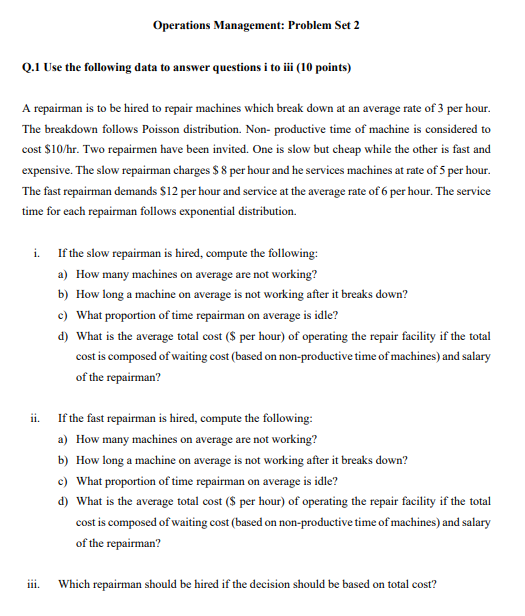
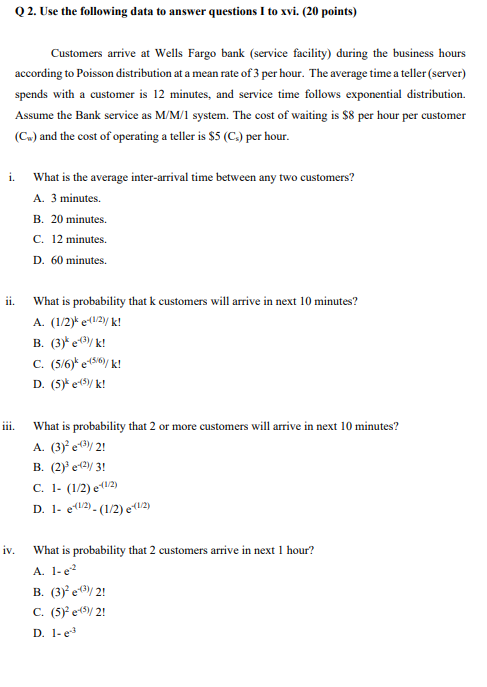
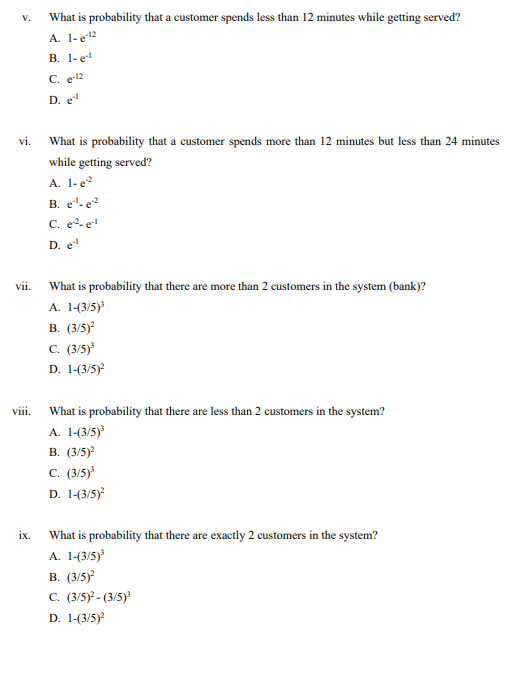
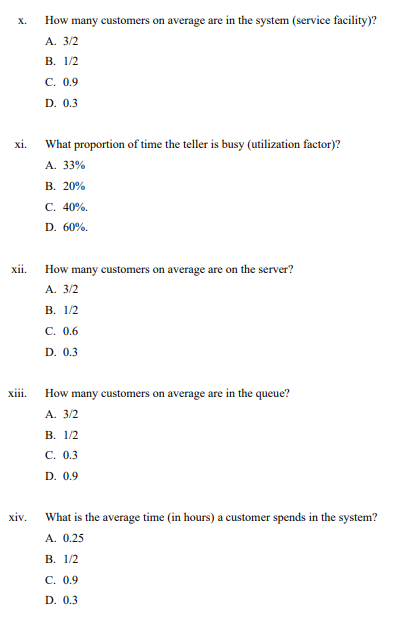
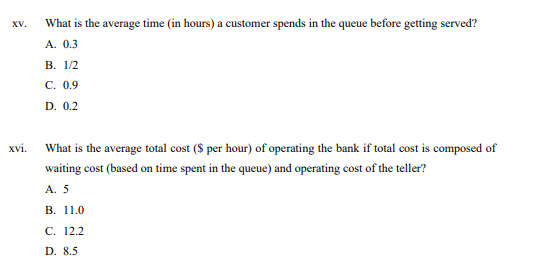
Operations Management: Problem Set 2 Q.1 Use the following data to answer questions i to iii (10 points) A repairman is to be hired to repair machines which break down at an average rate of 3 per hour. The breakdown follows Poisson distribution. Non- productive time of machine is considered to cost $10/hr. Two repairmen have been invited. One is slow but cheap while the other is fast and expensive. The slow repairman charges $8 per hour and he services machines at rate of 5 per hour. The fast repairman demands $12 per hour and service at the average rate of 6 per hour. The service time for each repairman follows exponential distribution. i. If the slow repairman is hired, compute the following: ii. a) How many machines on average are not working? b) How long a machine on average is not working after it breaks down? c) What proportion of time repairman on average is idle? d) What is the average total cost ($ per hour) of operating the repair facility if the total cost is composed of waiting cost (based on non-productive time of machines) and salary of the repairman? If the fast repairman is hired, compute the following: a) How many machines on average are not working? b) How long a machine on average is not working after it breaks down? c) What proportion of time repairman on average is idle? d) What is the average total cost ($ per hour) of operating the repair facility if the total cost is composed of waiting cost (based on non-productive time of machines) and salary of the repairman? Which repairman should be hired if the decision should be based on total cost? i. Q2. Use the following data to answer questions I to xvi. (20 points) Customers arrive at Wells Fargo bank (service facility) during the business hours according to Poisson distribution at a mean rate of 3 per hour. The average time a teller (server) spends with a customer is 12 minutes, and service time follows exponential distribution. Assume the Bank service as M/M/1 system. The cost of waiting is $8 per hour per customer (C) and the cost of operating a teller is $5 (Cs) per hour. What is the average inter-arrival time between any two customers? A. 3 minutes. B. 20 minutes. C. 12 minutes. D. 60 minutes. ii. What is probability that k customers will arrive in next 10 minutes? 111. iv. A. (1/2)k e-(1/2)/k! B. (3)*e)/k! C. (5/6)* e-(5/6)/k! D. (5) e-(5)/k! What is probability that 2 or more customers will arrive in next 10 minutes? A. (3) e)/2! B. (2) e-(2)/3! C. 1- (1/2) e(1/2) D. 1-1/2) (1/2) (1/2) What is probability that 2 customers arrive in next 1 hour? A. 1-e B. (3) (3)/2! C. (5) +(5)/2! D. 1-e-3 V. What is probability that a customer spends less than 12 minutes while getting served? A. 1-e-12 B. 1-e C. e-12 D. e vi. vii. VIII. ix. What is probability that a customer spends more than 12 minutes but less than 24 minutes while getting served? A. 1-e B. e-e C. ee-l D. e What is probability that there are more than 2 customers in the system (bank)? A. 1-(3/5) B. (3/5) C. (3/5) D. 1-(3/5) What is probability that there are less than 2 customers in the system? A. 1-(3/5) B. (3/5) C. (3/5) D. 1-(3/5) What is probability that there are exactly 2 customers in the system? A. 1-(3/5) B. (3/5) C. (3/5) - (3/5) D. 1-(3/5) x. How many customers on average are in the system (service facility)? A. 3/2 B. 1/2 C. 0.9 D. 0.3 xi. What proportion of time the teller is busy (utilization factor)? A. 33% B. 20% C. 40%. D. 60%. xii. How many customers on average are on the server? A. 3/2 B. 1/2 C. 0.6 D. 0.3 xiii. How many customers on average are in the queue? A. 3/2 B. 1/2 C. 0.3 D. 0.9 xiv. What is the average time (in hours) a customer spends in the system? A. 0.25 B. 1/2 C. 0.9 D. 0.3 xv. What is the average time (in hours) a customer spends in the queue before getting served? A. 0.3 B. 1/2 C. 0.9 D. 0.2 xvi. What is the average total cost ($ per hour) of operating the bank if total cost is composed of waiting cost (based on time spent in the queue) and operating cost of the teller? A. 5 B. 11.0 C. 12.2 D. 8.5
Step by Step Solution
There are 3 Steps involved in it

Get step-by-step solutions from verified subject matter experts
 Study Help