







Question: Operations Question? Scenario: A store has 1 copy machine. It's observed and serves average 16 people/hr on peak periods when it's not at any time
Operations Question?
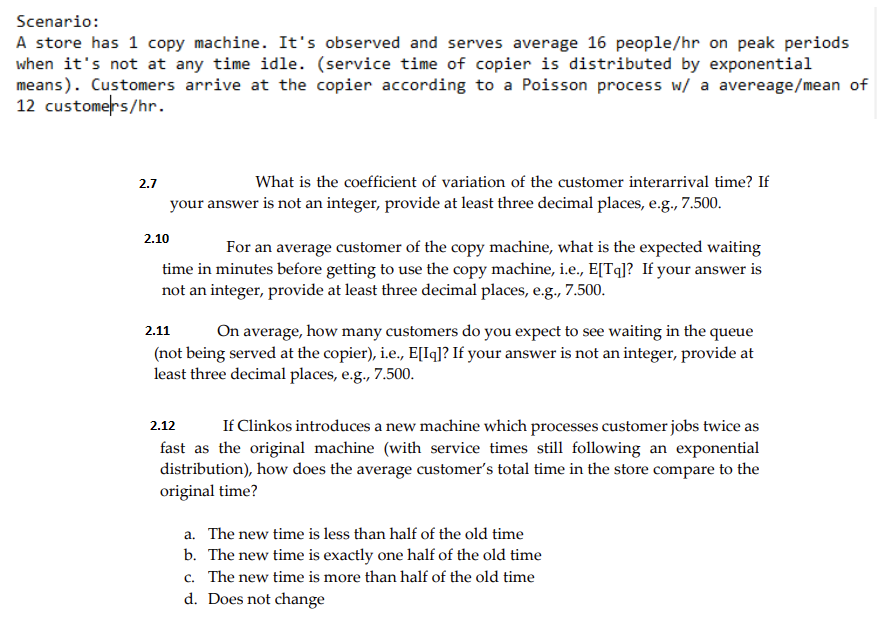
Scenario: A store has 1 copy machine. It's observed and serves average 16 people/hr on peak periods when it's not at any time idle. (service time of copier is distributed by exponential means). Customers arrive at the copier according to a Poisson process w/ a avereage/mean of 12 customets/hr. 2.7 What is the coefficient of variation of the customer interarrival time? If your answer is not an integer, provide at least three decimal places, e.g., 7.500. 2.10 For an average customer of the copy machine, what is the expected waiting time in minutes before getting to use the copy machine, i.e., E[Tq] ? If your answer is not an integer, provide at least three decimal places, e.g., 7.500. 2.11 On average, how many customers do you expect to see waiting in the queue (not being served at the copier), i.e., E[Iq]? If your answer is not an integer, provide at least three decimal places, e.g., 7.500. 2.12 If Clinkos introduces a new machine which processes customer jobs twice as fast as the original machine (with service times still following an exponential distribution), how does the average customer's total time in the store compare to the original time? a. The new time is less than half of the old time b. The new time is exactly one half of the old time c. The new time is more than half of the old time d. Does not change
Step by Step Solution
There are 3 Steps involved in it

Get step-by-step solutions from verified subject matter experts
 Study Help