







Question: operations research Suppose that Example 20.2-2 (Pg 754 in the book) is solved in the following manner. First, use the constraints to express 1 and
operations research 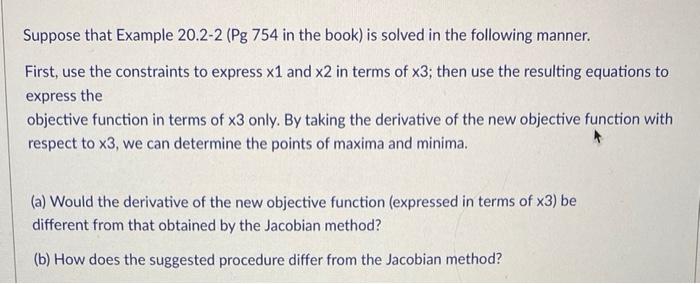
Suppose that Example 20.2-2 (Pg 754 in the book) is solved in the following manner. First, use the constraints to express 1 and 2 in terms of 3; then use the resulting equations to express the objective function in terms of x3 only. By taking the derivative of the new objective function with respect to 3, we can determine the points of maxima and minima. (a) Would the derivative of the new objective function (expressed in terms of x3 ) be different from that obtained by the Jacobian method? (b) How does the suggested procedure differ from the Jacobian method? Suppose that Example 20.2-2 (Pg 754 in the book) is solved in the following manner. First, use the constraints to express 1 and 2 in terms of 3; then use the resulting equations to express the objective function in terms of x3 only. By taking the derivative of the new objective function with respect to 3, we can determine the points of maxima and minima. (a) Would the derivative of the new objective function (expressed in terms of x3 ) be different from that obtained by the Jacobian method? (b) How does the suggested procedure differ from the Jacobian method
Step by Step Solution
There are 3 Steps involved in it
1 Expert Approved Answer
Step: 1 Unlock

Question Has Been Solved by an Expert!
Get step-by-step solutions from verified subject matter experts
Step: 2 Unlock
Step: 3 Unlock
 Study Help