Question: OPINION BY CIRCUIT JUDGE CLIFTON: ... 1. Background Plaintiff Zenia Chavarria completed an employment application seeking work with Defendant Ralphs Grocery Company. Chavarria obtained a
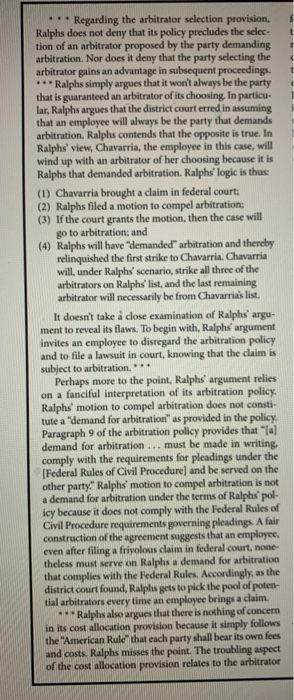
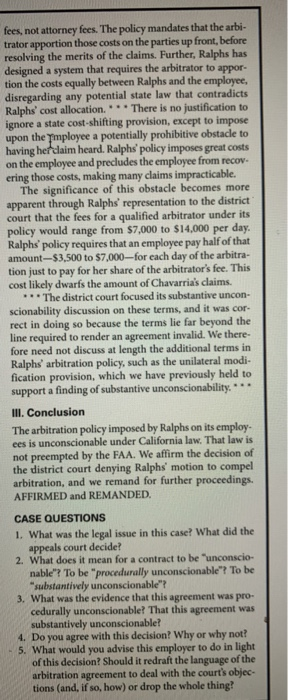
OPINION BY CIRCUIT JUDGE CLIFTON: ... 1. Background Plaintiff Zenia Chavarria completed an employment application seeking work with Defendant Ralphs Grocery Company. Chavarria obtained a position as a deli clerk with Ralphs and worked in that capacity for roughly six months. After leaving her employment with Ralphs, Chavarria filed this action, alleging on behalf of herself and all similarly situated employees that Ralphs violated various provisions of the California Labor Code and California Business and Professions Code. Ralphs moved to compel arbitration of her individual claim pursuant to an arbitration policy incorporated into the employment application. Chavarria opposed the motion, arguing that the arbitration agreement was unconscionable under California law. By completing an employment application with Ralphs, all potential employees agree to be bound by Ralphs' arbitration policy. The application contains an acknowledgment that the terms of the mandatory and binding arbitration policy have been provided for the applicant's review. Ralphs' policy contains several provisions central to this appeal. Paragraph 7 governs the selection of the single arbi- trator who will decide the dispute. It provides that, unless the parties agree otherwise, the arbitrator must be a retired state or federal judge. It explicitly prohibits the use of an administrator from either the American Arbitration Association ("AAA") or the Judicial Arbitration and Mediation Service (JAMS"). If the parties do not agree on an arbitrator, the policy provides for the following procedure: (1) Each party proposes a list of three arbitrators; (2) The parties alternate striking one name from the other party's list of arbitrators until only one name remains; (3) The party "who has not demanded arbitration" makes the first strike from the respective lists; and (4) The lone remaining arbitrator decides the claims. In practice, the arbitrator selected through this pro cess will invariably be one of the three candidates nomi- nated by the party that did not demand arbitration Paragraph 10 concerns attorney and arbitration fees and costs. It specifies that each party must pay its own attorney fees, subject to a later claim for reimbursement under applicable law. The provision regarding arbitra- tion fees, including the amount to be paid to the arbi trator, is more than a little convoluted. Ultimately, it provides that the arbitrator's fees must be apportioned at the outset of the arbitration and must be split evenly between Ralphs and the employee unless a decision of the U.S. Supreme Court directly addressing the issue requires that they be apportioned differently. Paragraph 13 of the policy permits Ralphs to unilat erally modify the policy without notice to the employee. The employee's continued employment constitutes acceptance of any modification. The district court held that Ralphs' arbitration pol- icy was unconscionable under California law, and it accordingly denied Ralphs' motion to compel arbitra tion. Ralphs appeals the district court's denial under the Federal Arbitration Act). II. Discussion ... The FAA provides that any contract to settle a dispute by arbitration shall be valid and enforceable, "save upon such grounds as exist at law or in equity for the revocation of any contract." This provision reflects both that (a) arbitration is fundamentally a matter of contract, and (b) Congress expressed a "liberal fed eral policy favoring arbitration." Arbitration agree. ments, therefore, must be placed on equal footing with other contracts. Like other contracts, arbitration agreements can be invalidated for fraud, duress, or unconscionability A defense such as unconscionability, however, can not justify invalidating an arbitration agreement if the defense applies "only to arbitration or (derives its] meaning from the fact that an agreement to arbitrate is at issue." . . No single rule of unconscionability uniquely applicable to arbitration is at issue in this case. We must therefore apply California's general principle of contract unconscionability. *** 0- i A. Unconscionability under California Law Under California law, a contract must be both proce- durally and substantively unconscionable to be ren- dered invalid. California law utilizes a sliding scale to determine unconscionability-greater substantive unconscionability may compensate for lesser procedural unconscionability. 1. Procedural Unconscionability Procedural unconscionability concerns the manner in which the contract was negotiated and the respective cir cumstances of the parties at that time, focusing on the level of oppression and surprise involved in the agree- ment. Oppression addresses the weaker party's absence of choice and unequal bargaining power that results in "no real negotiation." Surprise involves the extent to which the contract clearly discloses its terms as well as the reasonable expectations of the weaker party. The district court held that Ralphs' arbitration policy was procedurally unconscionable for several reasons. The court found that agreeing to Ralphs' policy was a condition of applying for employment and that the policy was presented on a "take it or leave it" basis with no opportunity for Chavarria to negotiate its terms. It further found that the terms of the policy were not pro- vided to Chavarria until three weeks after she had agreed to be bound by it. This additional defect, the court held. multiplied the degree of procedural unconscionability. Ralphs argues that the policy is not procedurally uncon- scionable because Chavarria was not even required to agree to its terms. Ralphs bases this contention on a provision in the employment application that provides, "Please sign and date the employment application ... to acknowledge you have read, understand & agree to the following statements." The word "please." Ralphs con tends, belies any suggestion of a requirement. Ralphs argues that Chavarria could have been hired without signing the agreement. Ralphs' argument ignores the terms of the policy itself, which bound Chavarria regardless of whether she signed the application. The policy provides that "Indo signature by an Employee or the Company is required for this Arbitration Policy to apply to Covered Disputes." That Ralphs asked nicely fora signature is irrelevant. The policy bound Chavarrith and all other potential employees upon submission of their applications These circumstances are similar to others where we have held agreements to be procedurally unconscio- nable. In an earlier case). we held that an arbitration agreement was procedurally unconscionable under California law because it was imposed upon employ- ees as a condition of their continued employment. We explained, "where ... the employee is facing an employer with overwhelming bargaining power' who drafted the contract and presented it to the employee] on a take-it-or-leave-it basis, the clause is procedurally unconscionable." Likewise, in (another prior case), we held that "a contract is procedurally unconscionable under California law if it is 'a standardized contract. drafted by the party of superior bargaining strength, that relegates to the subscribing party only the oppor tunity to adhere to the contract or reject it." Chavarria could only agree to be bound by the policy or seek work elsewhere. Ralphs' policy meets the standard under which we have previously found arbitration provisions in employment contracts to be procedurally unconscio nable. Further, we have held that the degree of proce- dural unconscionability is enhanced when a contract binds an individual to later provided terms. Ralphs did not provide Chavarria the terms of the arbitration policy until her employment orientation, three weeks after the policy came into effect regarding any dispute related to her employment. The employment application merely contains a one-paragraph "notice of the policy. The policy itself is a four-page, single-spaced document with several complex terms.... [The district court did not err when it held that the policy was procedurally unconscionable. 2. Substantive Unconscionability Chavarria must also demonstrate that Ralphs' arbi- tration policy is substantively unconscionable under California law. A contract is substantively unconscio- nable when it is unjustifiably one-sided to such an extent that it shocks the conscience." The district court found that several terms rendered Ralphs' arbitration policy substantively unconscionable. First, the court noted that Ralphs' arbitrator selection provision would always produce an arbitrator proposed by Ralphs in employee-initiated arbitration proceedings. Second, the court cited the preclusion of institutional arbitration administrators, namely AAA or JAMS, which have established rules and procedures to select a neutral arbitrator. Third, the court was troubled by the policy's requirement that the arbitrator must, at the outset of the arbitration proceedings, apportion the arbitrator's fees between Ralphs and the employee regardless of the merits of the claim. The court identified this provision as a model of how employers can draft fee provisions to price almost any employee out of the dispute resolution process. The combination of these terms created a pol- icy, according to the court, that "lacks any semblance of fairness and eviscerates the right to seek civil redres. ... To condone such a policy would be a disservice to the legitimate practice of arbitration and a stain on the cred- ibility of our justice system." Regarding the arbitrator selection provision. Ralphs does not deny that its policy precludes the selec. tion of an arbitrator proposed by the party demanding arbitration. Nor does it deny that the party selecting the arbitrator gains an advantage in subsequent proceedings. *** Ralphs simply argues that it won't always be the party that is guaranteed an arbitrator of its choosing. In particu- lar, Ralphs argues that the district court erred in assuming that an employee will always be the party that demands arbitration. Ralphs contends that the opposite is true. In Ralphs' view, Chavarria, the employee in this case, will wind up with an arbitrator of her choosing because it is Ralphs that demanded arbitration. Ralphs' logic is thus: (1) Chavarria brought a claim in federal court; (2) Ralphs filed a motion to compel arbitration; (3) If the court grants the motion, then the case will go to arbitration; and (4) Ralphs will have demanded" arbitration and thereby relinquished the first strike to Chavarria. Chavarria will, under Ralphs' scenario, strike all three of the arbitrators on Ralphs' list, and the last remaining arbitrator will necessarily be from Chavarrias list. It doesn't take a close examination of Ralphs' argu- ment to reveal its flaws. To begin with, Ralphs' argument invites an employee to disregard the arbitration policy and to file a lawsuit in court, knowing that the claim is subject to arbitration." Perhaps more to the point, Ralphs' argument relies on a fanciful interpretation of its arbitration policy. Ralphs' motion to compel arbitration does not consti- tute a "demand for arbitration" as provided in the policy. Paragraph 9 of the arbitration policy provides that "la) demand for arbitration ... must be made in writing, comply with the requirements for pleadings under the (Federal Rules of Civil Procedure) and be served on the other party." Ralphs' motion to compel arbitration is not a demand for arbitration under the terms of Ralphs' pol- icy because it does not comply with the Federal Rules of Civil Procedure requirements governing pleadings. A fair construction of the agreement suggests that an employee, even after filing a friyolous claim in federal court, none- theless must serve on Ralphs a demand for arbitration that complies with the Federal Rules. Accordingly, as the district court found, Ralphs gets to pick the pool of poten- tial arbitrators every time an employee brings a claim. *** Ralphs also argues that there is nothing of concern in its cost allocation provision because it simply follows the "American Rule" that each party shall bear its own fees and costs. Ralphs misses the point. The troubling aspect of the cost allocation provision relates to the arbitrator fees, not attorney fees. The policy mandates that the arbi trator apportion those costs on the parties up front, before resolving the merits of the claims. Further, Ralphs has designed a system that requires the arbitrator to appor tion the costs equally between Ralphs and the employee, disregarding any potential state law that contradicts Ralphs' cost allocation. There is no justification to ignore a state cost-shifting provision, except to impose upon the Imployee a potentially prohibitive obstacle to having her claim heard. Ralphs' policy imposes great costs on the employee and precludes the employee from recov. ering those costs, making many claims impracticable. The significance of this obstacle becomes more apparent through Ralphs' representation to the district court that the fees for a qualified arbitrator under its policy would range from $7,000 to $14,000 per day. Ralphs policy requires that an employee pay half of that amount-$3,500 to $7,000--for each day of the arbitra- tion just to pay for her share of the arbitrator's fee. This cost likely dwarfs the amount of Chavarria's claims. *** The district court focused its substantive uncon- scionability discussion on these terms, and it was cor- rect in doing so because the terms lie far beyond the line required to render an agreement invalid. We there- fore need not discuss at length the additional terms in Ralphs' arbitration policy, such as the unilateral modi- fication provision, which we have previously held to support a finding of substantive unconscionability. *** III. Conclusion The arbitration policy imposed by Ralphs on its employ. ees is unconscionable under California law. That law is not preempted by the FAA. We affirm the decision of the district court denying Ralphs' motion to compel arbitration, and we remand for further proceedings. AFFIRMED and REMANDED. CASE QUESTIONS 1. What was the legal issue in this case? What did the appeals court decide? 2. What does it mean for a contract to be "unconscio- nable"? To be procedurally unconscionable"? To be substantively unconscionable"? 3. What was the evidence that this agreement was pro- cedurally unconscionable? That this agreement was substantively unconscionable? 4. Do you agree with this decision? Why or why not? 5. What would you advise this employer to do in light of this decision? Should it redraft the language of the arbitration agreement to deal with the court's objec- tions (and, if so, how) or drop the whole thing









 Study Help