



Question: Optimal Growth The model differs from the classic one sector optimal growth model by the nesumptions on the preferences of the agents. The infinitely-lived representative
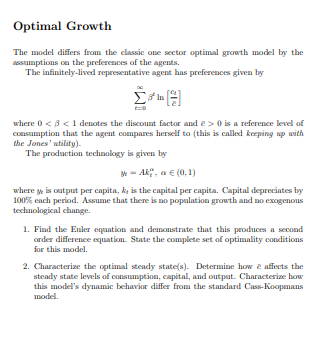
Optimal Growth The model differs from the classic one sector optimal growth model by the nesumptions on the preferences of the agents. The infinitely-lived representative agent has preferences given by o In where 0 O is a reference level of consumption that the agent compares herself to this is called keeping up with the Jones'utility). The production technology is given by M-A, a (0,1) where we is output per capita, ke is the capital per capita. Capital depreciates by 100% ench period. Assume that there is no population growth and no exogenous technological change. 1. Find the Euler equation and demonstrate that this produces a second order difference equation. State the complete set of optimality conditions for this model. 2. Characterize the optimal steady state(s). Determine how affects the steady state levels of consumption, capital, and output. Characterize how this model's dynamic behavior differ from the standard Cass-Koopmans model. Optimal Growth The model differs from the classic one sector optimal growth model by the nesumptions on the preferences of the agents. The infinitely-lived representative agent has preferences given by o In where 0 O is a reference level of consumption that the agent compares herself to this is called keeping up with the Jones'utility). The production technology is given by M-A, a (0,1) where we is output per capita, ke is the capital per capita. Capital depreciates by 100% ench period. Assume that there is no population growth and no exogenous technological change. 1. Find the Euler equation and demonstrate that this produces a second order difference equation. State the complete set of optimality conditions for this model. 2. Characterize the optimal steady state(s). Determine how affects the steady state levels of consumption, capital, and output. Characterize how this model's dynamic behavior differ from the standard Cass-Koopmans model
Step by Step Solution
There are 3 Steps involved in it

Get step-by-step solutions from verified subject matter experts