







Question: Optimality Range Objectives: 1. For a given change in objective coefficient, to conclude if the optimal solution will change. 2. To calculate for the total
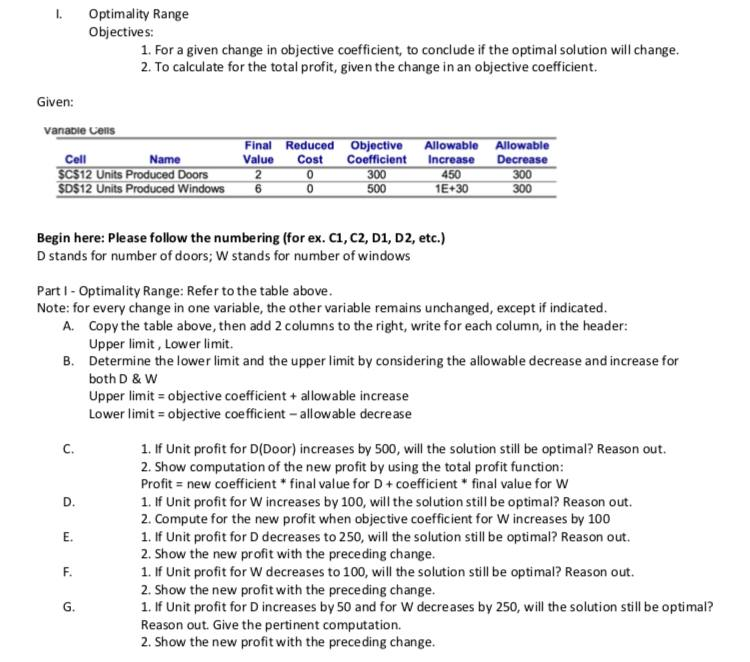
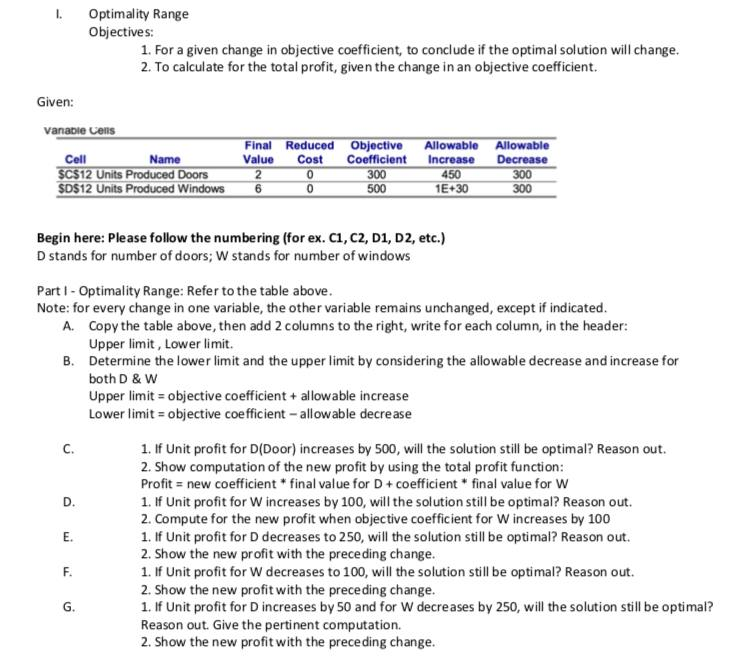
Optimality Range Objectives: 1. For a given change in objective coefficient, to conclude if the optimal solution will change. 2. To calculate for the total profit, given the change in an objective coefficient. Given: vanable Cens Final Reduced Objective Allowable Allowable Cell Name Value Cost Coefficient Increase Decrease SC$12 Units Produced Doors 2 300 450 300 SD$12 Units Produced Windows 6 500 1E+30 300 Begin here: Please follow the numbering (for ex. C1, C2, D1, D2, etc.) D stands for number of doors; W stands for number of windows Part I - Optimality Range: Refer to the table above. Note: for every change in one variable, the other variable remains unchanged, except if indicated. A. Copy the table above, then add 2 columns to the right, write for each column, in the header: Upper limit , Lower limit. B. Determine the lower limit and the upper limit by considering the allowable decrease and increase for both D & W Upper limit = objective coefficient + allowable increase Lower limit = objective coefficient - allowable decrease C. 1. If Unit profit for D(Door) increases by 500, will the solution still be optimal? Reason out. 2. Show computation of the new profit by using the total profit function: Profit = new coefficient * final value for D + coefficient * final value for W D. 1. If Unit profit for W increases by 100, will the solution still be optimal? Reason out. 2. Compute for the new profit when objective coefficient for W increases by 100 E. 1. If Unit profit for D decreases to 250, will the solution still be optimal? Reason out. 2. Show the new profit with the preceding change. F. 1. If Unit profit for W decreases to 100, will the solution still be optimal? Reason out. 2. Show the new profit with the preceding change. G. 1. If Unit profit for D increases by 50 and for W decreases by 250, will the solution still be optimal? Reason out. Give the pertinent computation. 2. Show the new profit with the preceding change
Step by Step Solution
There are 3 Steps involved in it

Get step-by-step solutions from verified subject matter experts
 Study Help