







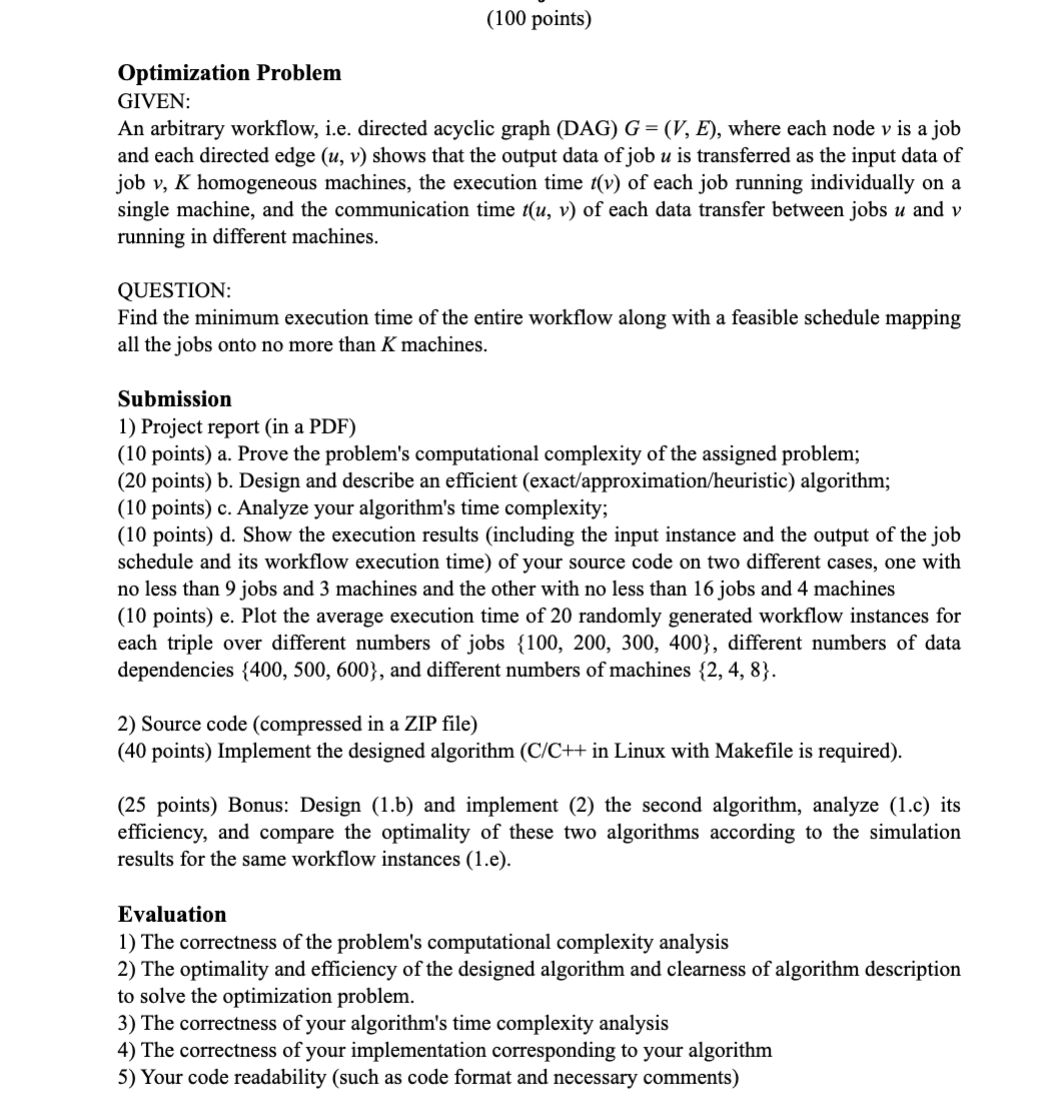
Question: Optimization Problem GIVEN: An arbitrary workflow, i . e . directed acyclic graph ( DAG ) G = ( V , E ) , where
Optimization Problem
GIVEN:
An arbitrary workflow, ie directed acyclic graph DAG where each node is a job
and each directed edge shows that the output data of job is transferred as the input data of
job homogeneous machines, the execution time of each job running individually on a
single machine, and the communication time of each data transfer between jobs and
running in different machines.
QUESTION:
Find the minimum execution time of the entire workflow along with a feasible schedule mapping
all the jobs onto no more than machines.
Submission
Project report in a PDF
points a Prove the problem's computational complexity of the assigned problem;
points b Design and describe an efficient exactapproximationheuristic algorithm;
points c Analyze your algorithm's time complexity;
points d Show the execution results including the input instance and the output of the job
schedule and its workflow execution time of your source code on two different cases, one with
no less than jobs and machines and the other with no less than jobs and machines
points e Plot the average execution time of randomly generated workflow instances for
each triple over different numbers of jobs different numbers of data
dependencies and different numbers of machines
Source code compressed in a ZIP file
points Implement the designed algorithm in Linux with Makefile is required
points Bonus: Design b and implement the second algorithm, analyze c its
efficiency, and compare the optimality of these two algorithms according to the simulation
results for the same workflow instances e
Evaluation
The correctness of the problem's computational complexity analysis
The optimality and efficiency of the designed algorithm and clearness of algorithm description
to solve the optimization problem.
The correctness of your algorithm's time complexity analysis
The correctness of your implementation corresponding to your algorithm
Your code readability such as code format and necessary comments
Step by Step Solution
There are 3 Steps involved in it
1 Expert Approved Answer
Step: 1 Unlock

Question Has Been Solved by an Expert!
Get step-by-step solutions from verified subject matter experts
Step: 2 Unlock
Step: 3 Unlock
 Study Help