







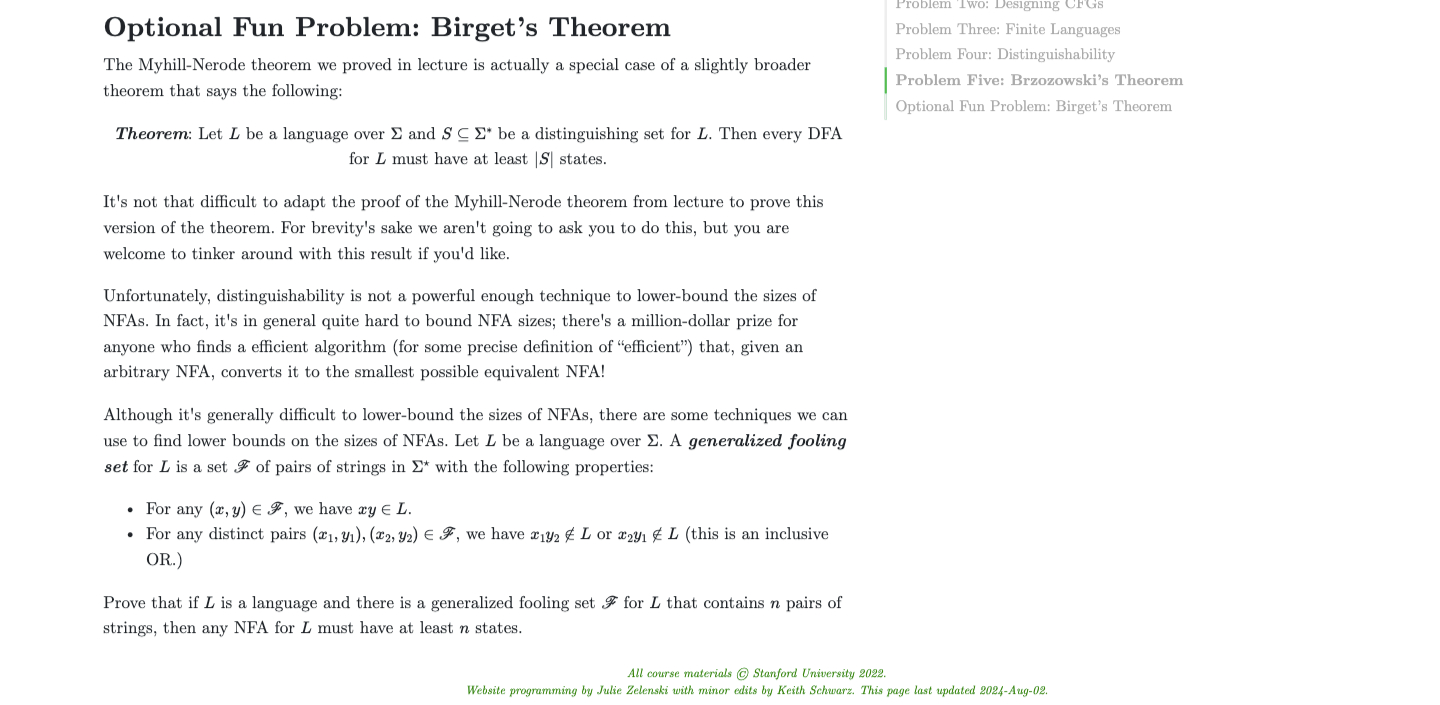
Question: Optional Fun Problem: Birget's Theorem The Myhill - Nerode theorem we proved in lecture is actually a special case of a slightly broader theorem that
Optional Fun Problem: Birget's Theorem
The MyhillNerode theorem we proved in lecture is actually a special case of a slightly broader
theorem that says the following:
Theorem: Let be a language over and Ssube be a distinguishing set for Then every DFA
for must have at least states.
It's not that difficult to adapt the proof of the MyhillNerode theorem from lecture to prove this
version of the theorem. For brevity's sake we aren't going to ask you to do this, but you are
welcome to tinker around with this result if you'd like.
Unfortunately, distinguishability is not a powerful enough technique to lowerbound the sizes of
NFAs. In fact, it's in general quite hard to bound NFA sizes; there's a milliondollar prize for
anyone who finds a efficient algorithm for some precise definition of "efficient" that, given an
arbitrary NFA, converts it to the smallest possible equivalent NFA!
Although it's generally difficult to lowerbound the sizes of NFAs, there are some techniques we can
use to find lower bounds on the sizes of NFAs. Let be a language over A generalized fooling
set for is a set of pairs of strings in with the following properties:
For any we have xyinL.
For any distinct pairs we have inL or inL this is an inclusive
OR
Prove that if is a language and there is a generalized fooling set for that contains pairs of
strings, then any NFA for must have at least states.
Optional Fun Problem: Birget's Theorem
Step by Step Solution
There are 3 Steps involved in it
1 Expert Approved Answer
Step: 1 Unlock

Question Has Been Solved by an Expert!
Get step-by-step solutions from verified subject matter experts
Step: 2 Unlock
Step: 3 Unlock
 Study Help