







Question: options: a. 6 integer variables and 12 nonnegative variables b. 3 integer variables and 12 nonnegative variables c. 12 integer variables and 3 nonnegative variables
options:
a.
6 integer variables and 12 nonnegative variables
b.
3 integer variables and 12 nonnegative variables
c.
12 integer variables and 3 nonnegative variables
d.
3 integer variables and 6 nonnegative variables
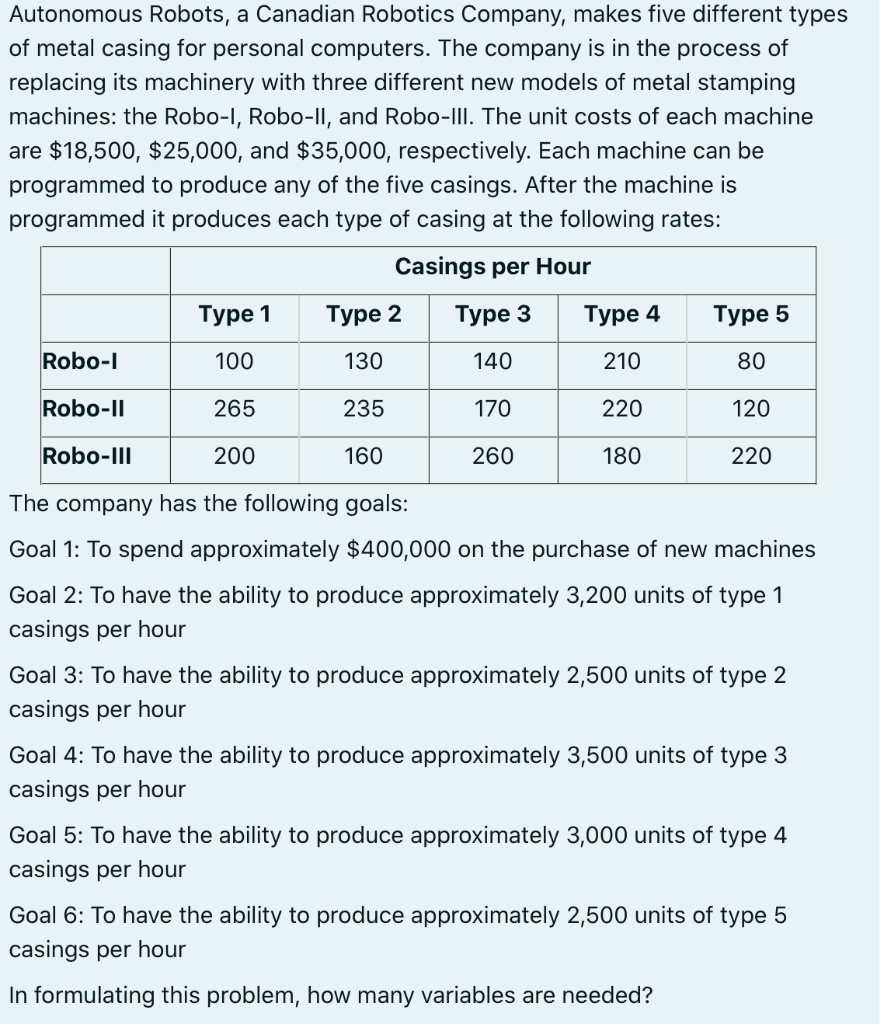
Autonomous Robots, a Canadian Robotics Company, makes five different types of metal casing for personal computers. The company is in the process of replacing its machinery with three different new models of metal stamping machines: the Robo-I, Robo-II, and Robo-III. The unit costs of each machine are $18,500, $25,000, and $35,000, respectively. Each machine can be programmed to produce any of the five casings. After the machine is programmed it produces each type of casing at the following rates: Casings per Hour Type 1 Type 2 Type 3 Type 4 Type 5 Robo-1 100 130 140 210 80 Robo-11 265 235 170 220 120 Robo-111 200 160 260 180 220 The company has the following goals: Goal 1: To spend approximately $400,000 on the purchase of new machines Goal 2: To have the ability to produce approximately 3,200 units of type 1 casings per hour Goal 3: To have the ability to produce approximately 2,500 units of type 2 casings per hour Goal 4: To have the ability to produce approximately 3,500 units of type 3 casings per hour Goal 5: To have the ability to produce approximately 3,000 units of type 4 casings per hour Goal 6: To have the ability to produce approximately 2,500 units of type 5 casings per hour In formulating this problem, how many variables are neededStep by Step Solution
There are 3 Steps involved in it
1 Expert Approved Answer
Step: 1 Unlock

Question Has Been Solved by an Expert!
Get step-by-step solutions from verified subject matter experts
Step: 2 Unlock
Step: 3 Unlock
 Study Help