



Question: Options for the blanks: 1. maximizes/minimizes 2. lower/higher/ equal to 3.increase/dcrease 3. lowers/raises 4.lowers/raises 5. Gordon/CAPM/Hamata 6. is/isnt 7. company actions/market forces/ investor actions 8.
Options for the blanks:
1. maximizes/minimizes
2. lower/higher/ equal to
3.increase/dcrease
3. lowers/raises
4.lowers/raises
5. Gordon/CAPM/Hamata
6. is/isnt
7. company actions/market forces/ investor actions
8. Gordon/CAPM/Hamata
9. Financial/Business/Market
10. T/F
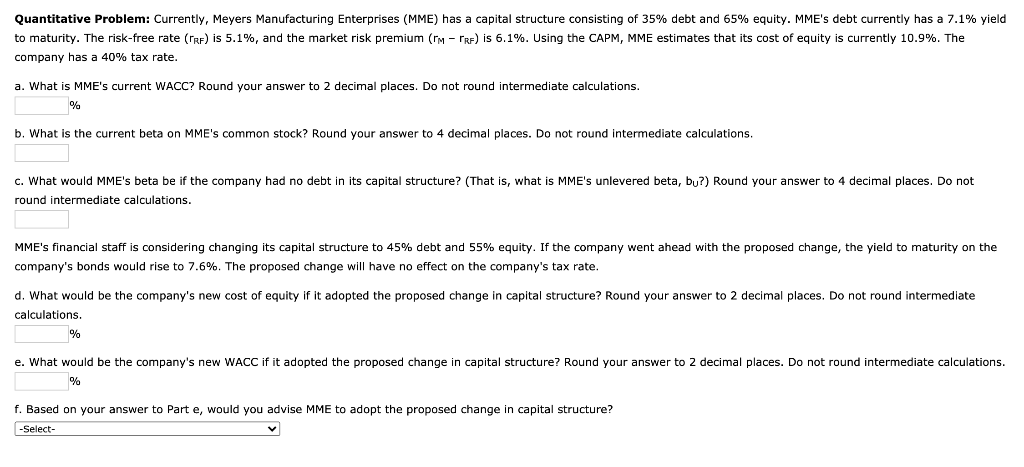
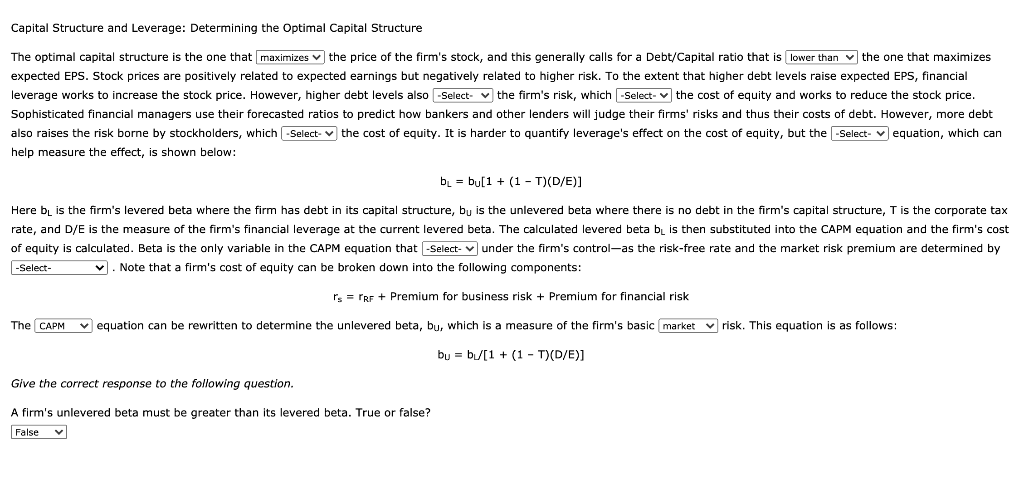
Quantitative Problem: Currently, Meyers Manufacturing Enterprises (MME) has a capital structure consisting of 35% debt and 65% equity. MME's debt currently has a 7.1% yield to maturity. The risk-free rate (TRF) is 5.1%, and the market risk premium (rM - PRF) is 6.1%. Using the CAPM, MME estimates that its cost of equity is currently 10.9%. The company has a 40% tax rate. a. What is MME's current WACC? Round your answer to 2 decimal places. Do not round intermediate calculations. % b. What is the current beta on MME's common stock? Round your answer to 4 decimal places. Do not round intermediate calculations, c. What would MME's beta be if the company had no debt in its capital structure? (That is, what is MME's unlevered beta, bu?) Round your answer to 4 decimal places. Do not round intermediate calculations. MME's financial staff is considering changing its capital structure to 45% debt and 55% equity. If the company went ahead with the proposed change, the yield to maturity on the company's bonds would rise to 7.6%. The proposed change will have no effect on the company's tax rate d. What would be the company's new cost of equity if it adopted the proposed change in capital structure? Round your answer to 2 decimal places. Do not round intermediate calculations. % decimal places. Do not round intermediate calculations. e. What would be the company's new WACC if it adopted the proposed change in capital structure? Round your answer to % f. Based on your answer to Part e, would you advise MME to adopt the proposed change in capital structure? -Select- Capital Structure and Leverage: Determining the optimal Capital Structure The optimal capital structure is the one that maximizes the price of the firm's stock, and this generally calls for a Debt/Capital ratio that is lower than the one that maximizes expected EPS. Stock prices are positively related to expected earnings but negatively related to higher risk. To the extent that higher debt levels raise expected EPS, financial leverage works to increase the stock price. However, higher debt levels also Select the firm's risk, which - Select the cost of equity and works to reduce the stock price. Sophisticated financial managers use their forecasted ratios to predict how bankers and other lenders will judge their firms' risks and thus their costs of debt. However, more debt also raises the risk borne by stockholders, which - Select the cost of equity. It is harder to quantify leverage's effect on the cost of equity, but the -Select- equation, which can help measure the effect, is shown below: bu = bu[1 + (1 - 1)(D/E)] Here bu is the firm's levered beta where the firm has debt in its capital structure, bu is the unlevered beta where there is no debt in the firm's capital structure, T is the corporate tax rate, and D/E is the measure of the firm's financial leverage at the current levered beta. The calculated levered beta BL is then substituted into the CAPM equation and the firm's cost of equity is calculated. Beta is the only variable in the CAPM equation that -Select- under the firm's control-as the risk-free rate and the market risk premium are determined by -Select V. Note that a firm's cost of equity can be broken down into the following components: r's = PRF + Premium for business risk + Premium for financial risk The CAPM equation can be rewritten to determine the unlevered beta, bu, which is a measure of the firm's basic market v risk. This equation is as follows: bu = b[1 + (1 - T)(D/E)] Give the correct response to the following question. A firm's unlevered beta must be greater than its levered beta. True or false? False
Step by Step Solution
There are 3 Steps involved in it

Get step-by-step solutions from verified subject matter experts