







Question: *organizational behavior* PLEASE HELP ANSWER ALL 5, thank you for yout time and will rate accordingly! *please only attempt if you can answer all 5,
*organizational behavior* 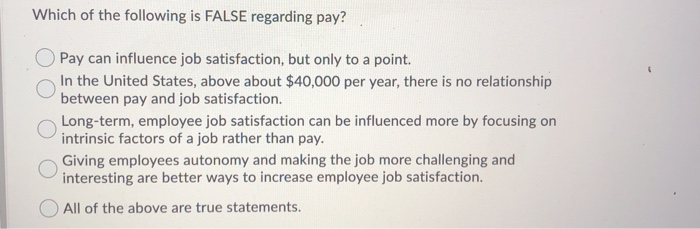
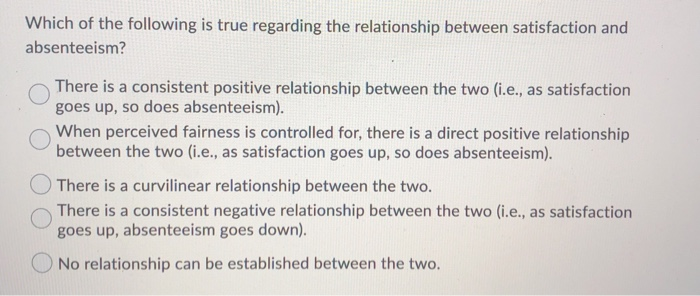
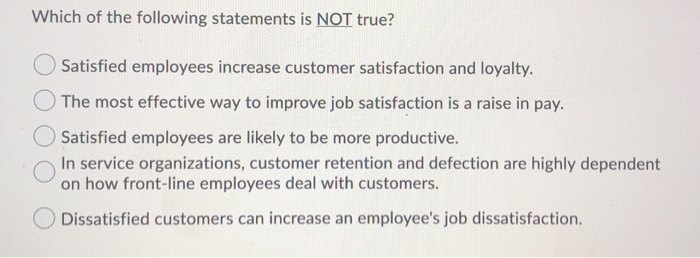
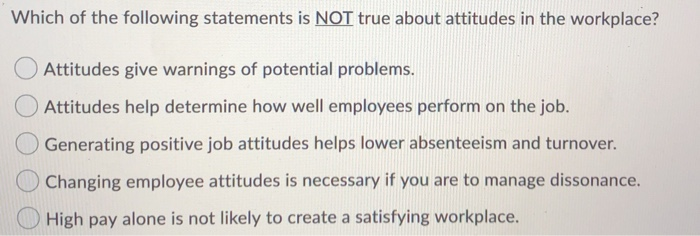
Which of the following is NOT one of the ways to measure employee job satisfaction? Summation score of many questions and one average Individual job "facet" satisfaction scores Single global rating (one question/one answer) Single employee empowerment question Which of the following is FALSE regarding pay? Pay can influence job satisfaction, but only to a point. In the United States, above about $40,000 per year, there is no relationship between pay and job satisfaction. Long-term, employee job satisfaction can be influenced more by focusing on intrinsic factors of a job rather than pay. Giving employees autonomy and making the job more challenging and interesting are better ways to increase employee job satisfaction. All of the above are true statements. Which of the following is true regarding the relationship between satisfaction and absenteeism? There is a consistent positive relationship between the two (i.e., as satisfaction goes up, so does absenteeism). When perceived fairness is controlled for, there is a direct positive relationship between the two (i.e., as satisfaction goes up, so does absenteeism). There is a curvilinear relationship between the two. There is a consistent negative relationship between the two (i.e., as satisfaction goes up, absenteeism goes down). No relationship can be established between the two. Which of the following statements is NOT true? Satisfied employees increase customer satisfaction and loyalty. The most effective way to improve job satisfaction is a raise in pay. Satisfied employees are likely to be more productive. In service organizations, customer retention and defection are highly dependent on how front-line employees deal with customers. Dissatisfied customers can increase an employee's job dissatisfaction. Which of the following statements is NOT true about attitudes in the workplace? Attitudes give warnings of potential problems. Attitudes help determine how well employees perform on the job. Generating positive job attitudes helps lower absenteeism and turnover. Changing employee attitudes is necessary if you are to manage dissonance. High pay alone is not likely to create a satisfying workplace
PLEASE HELP ANSWER ALL 5, thank you for yout time and will rate accordingly!
*please only attempt if you can answer all 5, THANK YOU so much* 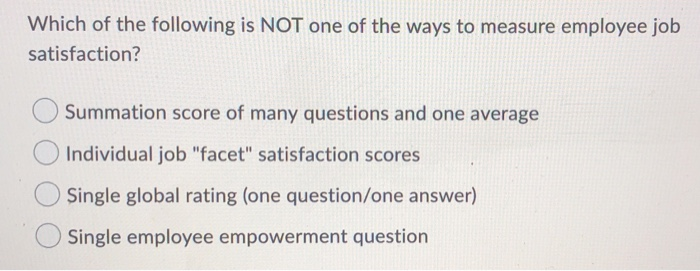
Step by Step Solution
There are 3 Steps involved in it
1 Expert Approved Answer
Step: 1 Unlock

Question Has Been Solved by an Expert!
Get step-by-step solutions from verified subject matter experts
Step: 2 Unlock
Step: 3 Unlock
 Study Help