







Question: origin. (As in 1D, (r)d3r=1, provided that the integral includes r=0.) Noting that 2G(r)=((G(r))), convert the integral of this to a surface integral of (G)
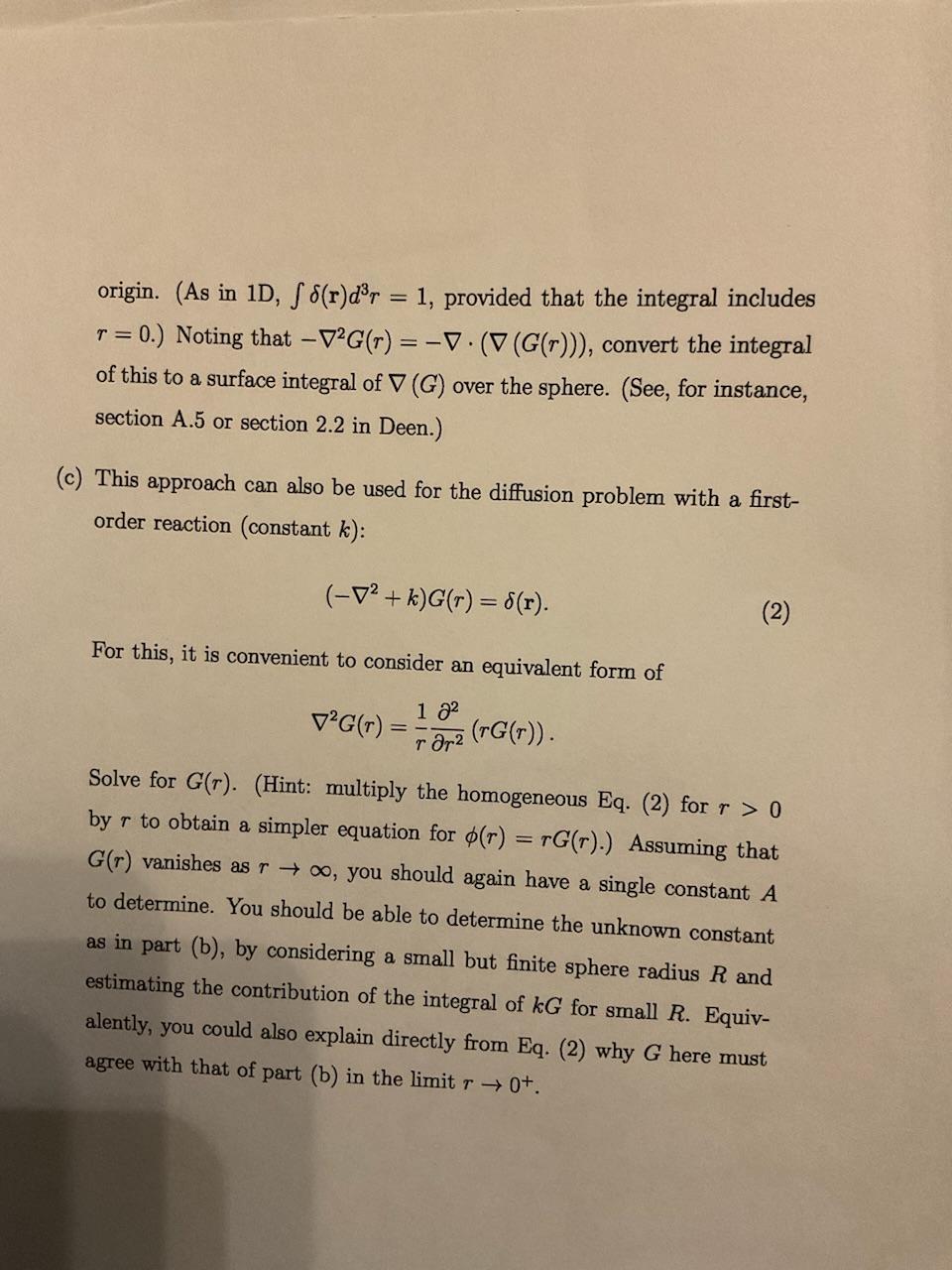
origin. (As in 1D, (r)d3r=1, provided that the integral includes r=0.) Noting that 2G(r)=((G(r))), convert the integral of this to a surface integral of (G) over the sphere. (See, for instance, section A.5 or section 2.2 in Deen.) (c) This approach can also be used for the diffusion problem with a firstorder reaction (constant k ): (2+k)G(r)=(r). For this, it is convenient to consider an equivalent form of 2G(r)=r1r22(rG(r)). Solve for G(r). (Hint: multiply the homogeneous Eq. (2) for r>0 by r to obtain a simpler equation for (r)=rG(r).) Assuming that G(r) vanishes as r, you should again have a single constant A to determine. You should be able to determine the unknown constant as in part (b), by considering a small but finite sphere radius R and estimating the contribution of the integral of kG for small R. Equivalently, you could also explain directly from Eq. (2) why G here must agree with that of part (b) in the limit r0+
Step by Step Solution
There are 3 Steps involved in it

Get step-by-step solutions from verified subject matter experts
 Study Help