







Question: OSCM M4 ASSIGNMENT 1. NEED EDD AV. FLOW TIME & AV. PAST DUE HOURS & FCFS AV. FLOW TIME & AV. PAST DUE HOURS FOR
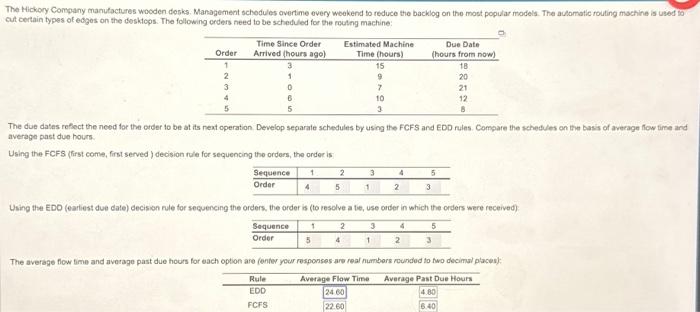
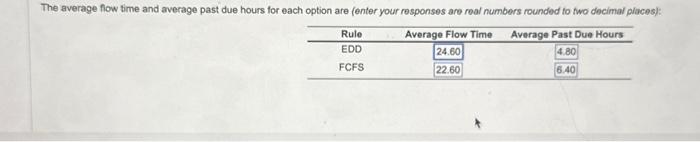
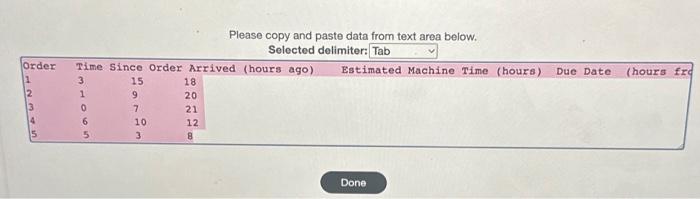
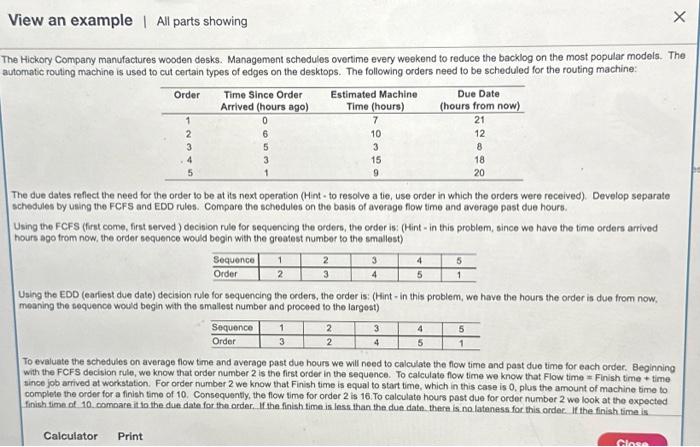
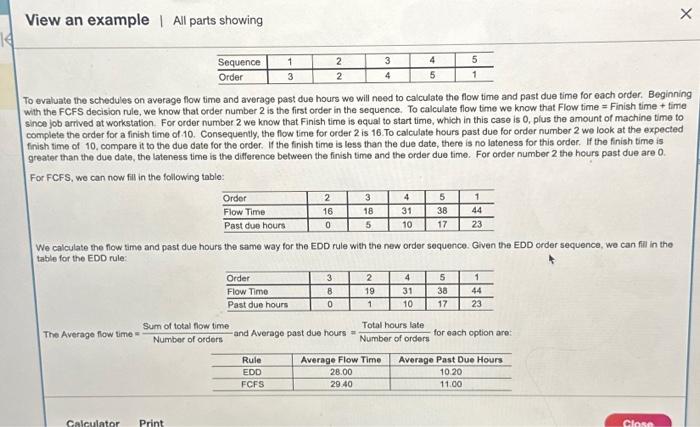
The average flow time and average past due hours for each option are (enter your responses are real numbers rounded to two decimal places): \begin{tabular}{ccc} \hline Rule & Average Flow Time & Average Past Due Hours \\ \hline EDD & 24.60 & 4.80 \\ FCFS & 22.60 & 6.40 \\ \hline \end{tabular} Please copy and paste data from text area below. Selected delimiter: o evaluate the schedules on average flow time and average past due hours wo will need to calculate the flow time and past due time for each order. Beginnin wh the FCFS decision rule, we know that order number 2 is the first order in the sequence. To calculate flow time we know that Flow time = Finish time + time ince job arrived at workstation. For order number 2 we know that Finish time is equal to start time, which in this case is 0 , plus the amount of machine time to complete the order for a finish time of 10 . Consequently, the flow time for order 2 is 16 .To calculate hours past due for order number 2 we look at the expected inish time of 10, compare it to the due date for the order. If the finish time is less than the due date, there is no lateness for this order. If the finish time is greater than the due date, the lateness time is the difference between the finish time and the order due time. For order number 2 the hours past due are 0. For FCFS, we can now fill in the following table: We calculate the fiow time and past due hours the same way for the EDD rule with the new order sequence. Given the EDD order sequence, we can fill in the table for the EDD rule: The Average flow time =NumberofordersSumoftotalflowtime and Average past due hours =NumberofordersTotalhourslate for each cption are: The due dates refect the need for the order to be at its next operation. Develop separate schedules by using the FCFS and EDD rules. Compare the schedules on the basis of average fow fime and average past due hours Using the FCFS (first come, first served) decision rule for sequencing the orders, the onder is he Hickory Company manufactures wooden desks. Management schedules overtime every weekend to reduce the backlog on the most popular models. Th. sutomatic routing machine is used to cut certain types of edges on the desktops. The following orders need to be scheduled for the routing machine: The due dates reflect the need for the order to be at its next operation (Hint - to resolve a tie, use order in which the orders were received). Develop separate schedules by using the FCFS and EDD rules. Compare the schedules on the basis of average fow time and average past due hours. Using the FCFS (first come, first served) decision rule for sequencing the orders, the order is: (Hint - in this problem, since we have the time orders arrived hours ago trom now, the order sequence would begin with the greatest number to the smallest) Using the EDD (earfiest due date) decision rule for sequencing the orders, the order is: (Hint - in this problem, wo have the hours the order is due from now, meaning the sequence would begin with the smallest number and proceod to the largest) To evaluate the schedules on average flow time and average past due hours we will need to calculate the flow time and past due time for each order. Beginning with the FCFS decision rule, we know that order number 2 is the first order in the sequence. To calculate flow time we know that Flow time = Finish time + time since job arrived at workstation. For order number 2 we know that Finish time is equal to start time, which in this case is 0 , plus the amount of machine time to complete the order for a finish time of 10. Consequently, the fiow time for order 2 is 16 . To calculate hours past due for order number 2 we look at the expected finish time of 10 . compare it io the due date for the order. If the finish time is inss than the due date. there is no lateness for this ordec. If the finish time is
Step by Step Solution
There are 3 Steps involved in it

Get step-by-step solutions from verified subject matter experts
 Study Help