Question: Other select cost and unit data are presented below. Conversion costs below added in July include only direct labor. Factory overhead from the three processing
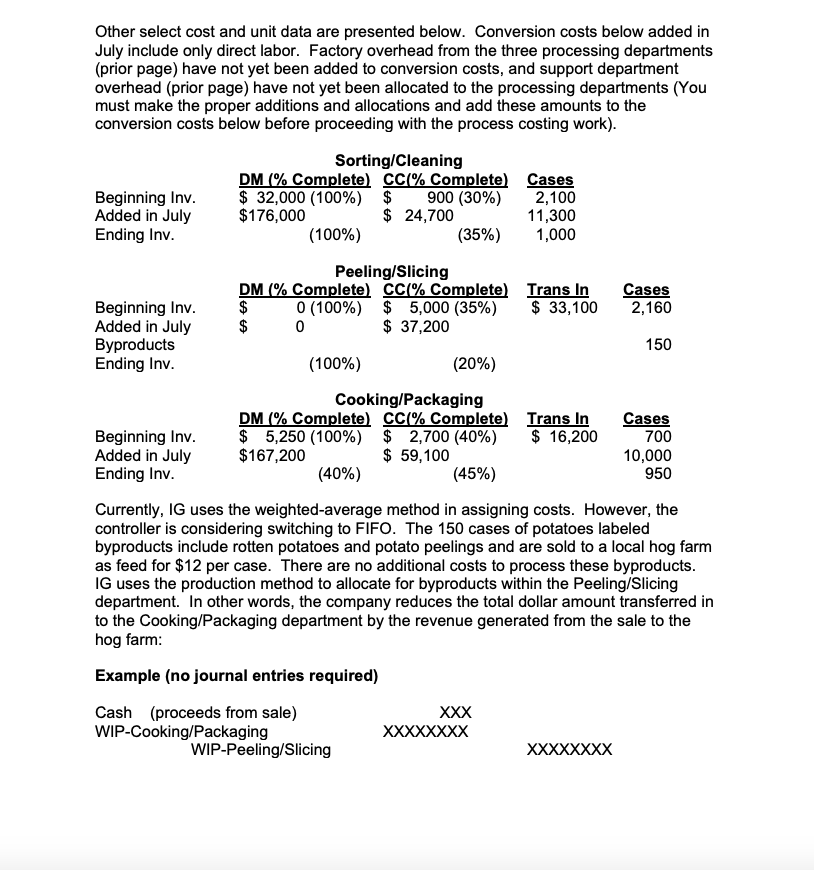
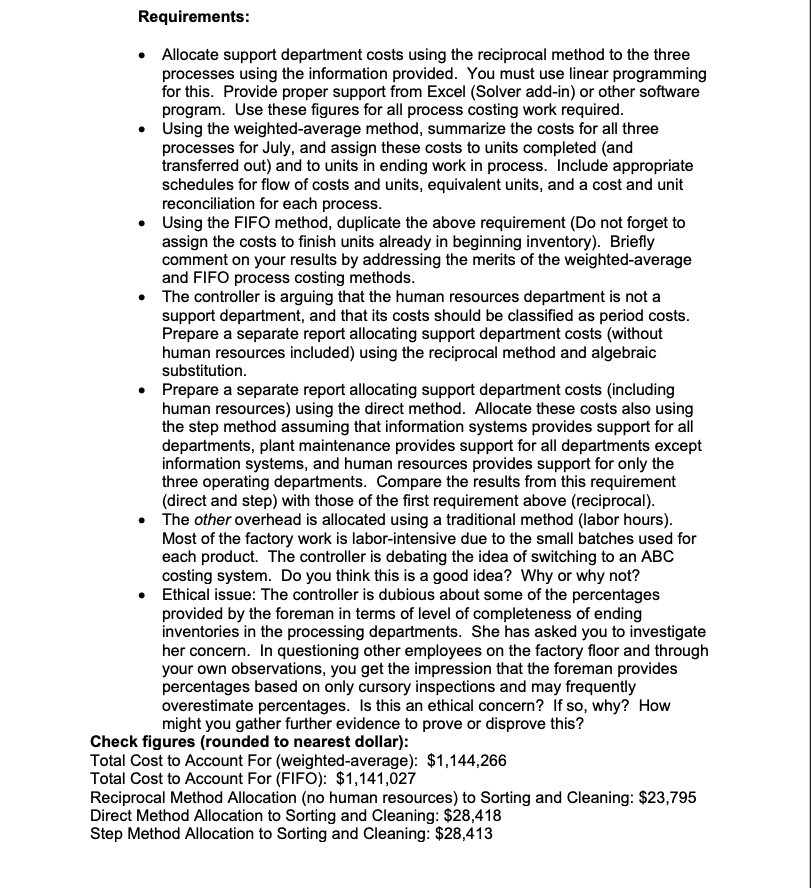
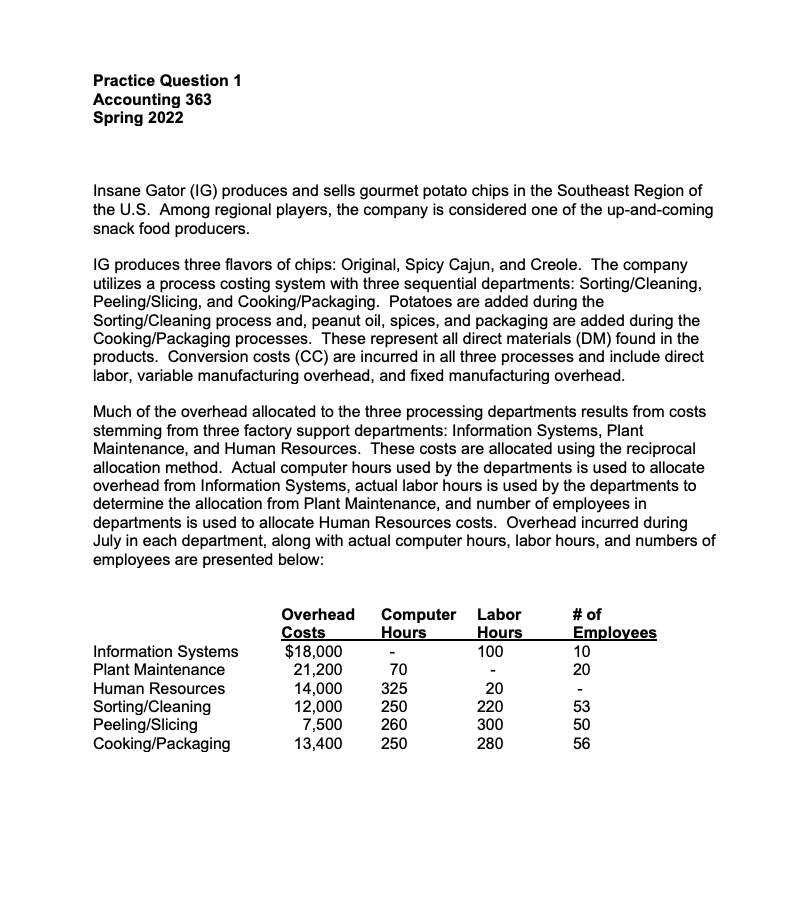
Other select cost and unit data are presented below. Conversion costs below added in July include only direct labor. Factory overhead from the three processing departments (prior page) have not yet been added to conversion costs, and support department overhead (prior page) have not yet been allocated to the processing departments (You must make the proper additions and allocations and add these amounts to the conversion costs below before proceeding with the process costing work). Sorting/Cleaning DM (% Complete) CC(% Complete) Cases Beginning Inv. $ 32,000 (100%) 900 (30%) 2,100 Added in July $176,000 $ 24,700 11,300 Ending Inv. (100%) (35%) 1,000 Peeling/Slicing DM (% Complete) CC(% Complete) Trans In Cases Beginning Inv. 0 (100%) $ 5,000 (35%) $ 33, 100 2,160 Added in July 0 $ 37,200 Byproducts 150 Ending Inv. (100%) (20%) Cooking/Packaging DM (% Complete) CC(% Complete) Trans In Cases Beginning Inv. $ 5,250 (100%) $ 2,700 (40%) $ 16,200 700 Added in July $167,200 $ 59, 100 10,000 Ending Inv. (40%) (45%) 950 Currently, IG uses the weighted-average method in assigning costs. However, the controller is considering switching to FIFO. The 150 cases of potatoes labeled byproducts include rotten potatoes and potato peelings and are sold to a local hog farm as feed for $12 per case. There are no additional costs to process these byproducts. IG uses the production method to allocate for byproducts within the Peeling/Slicing department. In other words, the company reduces the total dollar amount transferred in to the Cooking/Packaging department by the revenue generated from the sale to the hog farm: Example (no journal entries required) Cash (proceeds from sale) XXX WIP-Cooking/Packaging XXXXXXXX WIP-Peeling/Slicing XXXXXXXXRequirements: . Allocate support department costs using the reciprocal method to the three processes using the information provided. You must use linear programming for this. Provide proper support from Excel {Solver add-in) or other software program- Use these gures for all process costing work required. Using the weighted-average method, summarize the costs for all three processes for July, and assign these costs to units completed {and transferred out) and to units in ending work in process. Include appropriate schedules for ow of costs and units, equivalent units, and a cost and unit reconciliation for each process. Using the FIFO method, duplicate the above requirement [Do not forget to assign the costs to nish units already in beginning inventory]. Briey comment on your results by addressing the merits of the weighted-average and FIFO process costing methods. The controller is arguing that the human resources department is not a support department, and that its costs should be classied as period costs. Prepare a separate report allocating support department costs {without human resources included] using the reciprocal method and algebraic substitution. Prepare a separate report allocating support deparb'nent costs {including human resources] using the direct method. Allocate these costs also using the step method assuming that information systems provides support for all departments, plant maintenance provides support for all departments except information systems, and human resources provides support for only the three operating departments. Compare the results from this requirement (direct and step) with those of the rst requirement above {reciprocal}. The other overhead is allocated using a traditional method (labor hours]. Most of the factory work is labor-intensive due to the small batches used for each product. The controller is debating the idea of switching to an ABC costing system. Do you think this is a good idea? 1Why or 1why not? Ethical issue: The controller is dubious about some of the percentages provided by the foreman in terms of level of completeness of ending inventories in the processing departments. She has asked you to investigate her concern. In questioning other employees on the factory oor and through your own observations, you get the impression that the foreman provides percentages based on only cursory inspections and may frequently overestimate percentages. Is this an ethical concern? If so, why? How might you gather further evidence to prove or disprove this? Check gures [rounded to nearest dollar]: Total Cost to Account For {weighted-average): $1,144,233 Total Cost to Account For {FIFO}: $1 ,141,32? Reciprocal Method Allocation (no human resources} to Sorting and Cleaning: $23395 Direct Method Allocation to Sorting and Cleaning: $23,413 Step Method Allocation to Sorting and Cleaning: $23,413 Practice Question 1 Accounting 363 Spring 2022 Insane Gator (IG) produces and sells gourmet potato chips in the Southeast Region of the U.S. Among regional players, the company is considered one of the up-and-coming snack food producers. IG produces three flavors of chips: Original, Spicy Cajun, and Creole. The company utilizes a process costing system with three sequential departments: Sorting/Cleaning, Peeling/Slicing, and Cooking/Packaging. Potatoes are added during the Sorting/Cleaning process and, peanut oil, spices, and packaging are added during the Cooking/Packaging processes. These represent all direct materials (DM) found in the products. Conversion costs (CC) are incurred in all three processes and include direct labor, variable manufacturing overhead, and fixed manufacturing overhead. Much of the overhead allocated to the three processing departments results from costs stemming from three factory support departments: Information Systems, Plant Maintenance, and Human Resources. These costs are allocated using the reciprocal allocation method. Actual computer hours used by the departments is used to allocate overhead from Information Systems, actual labor hours is used by the departments to determine the allocation from Plant Maintenance, and number of employees in departments is used to allocate Human Resources costs. Overhead incurred during July in each department, along with actual computer hours, labor hours, and numbers of employees are presented below: Overhead Computer Labor # of Costs Hours Hours Employees Information Systems $18,000 100 10 Plant Maintenance 21,200 70 20 Human Resources 14,000 325 20 Sorting/Cleaning 12,000 250 220 53 Peeling/Slicing 7,500 260 300 50 Cooking/Packaging 13,400 250 280 56
Step by Step Solution
There are 3 Steps involved in it
1 Expert Approved Answer
Step: 1 Unlock
Question Has Been Solved by an Expert!
Get step-by-step solutions from verified subject matter experts
Step: 2 Unlock
Step: 3 Unlock
Students Have Also Explored These Related Accounting Questions!









 Study Help