







Question: Our Decision - Making Process To decide on the HRIS, our team at La Presa Inc followed a structured decision - making process, aligned with
Our DecisionMaking Process
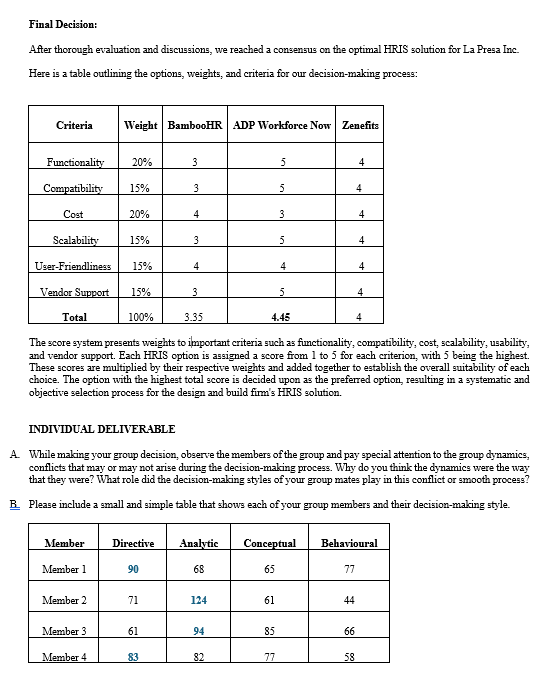
To decide on the HRIS, our team at La Presa Inc followed a structured decisionmaking process, aligned with the eightstep model of Assuming Rationality:
IdentifyUnderstand the ProblemIssue to Resolve:
We identified the need for an HRIS to streamline HR processes, improve employee management, and enhance organizational efficiency.
Identify Decision Criteria:
We determined criteria such as functionality, compatibility, cost, scalability, userfriendliness, and vendor support.
Allocate Weights to the Criteria:
We assigned weights to each criterion based on its importance in meeting our organizational objectives, with input from relevant stakeholders.
Develop Alternatives:
We researched and identified several HRIS options available in the market that met our criteria.
Analyze Alternatives:
We conducted thorough evaluations of each HRIS solution, considering factors such as features, benefits, limitations and potential risks.
Select from Amongst Several Alternatives:
Based on our analysis, we shortlisted the most promising HRIS solutions that best met our criteria and organizational needs.
Implement the Selected Alternative:
We proceeded with implementing the chosen HRIS solution, ensuring effective integration with existing systems and providing necessary training to employees.
Evaluate the Decision's EffectivenessEfficacy:
We continuously monitored and evaluated the performance of the implemented HRIS, assessing its impact on HR operations, employee satisfaction, and overall organizational efficiency. Adjustments were made as necessary to optimize effectiveness.
Criteria:
Functionality: The extent to which the HRIS meets the functional requirements of La Presa Inc., including features like payroll processing, employee records management, performance tracking, and reporting.
Alignment: Critical for streamlining HR processes, managing employees efficiently, and supporting talent development in line with La Presa Inc.s operational goals.
Compatibility: The ability of the HRIS to integrate seamlessly with La Presa Inc.s existing systems and technologies.
Alignment: Important for technological integration, ensuring the HRIS aligns with the firm's aim for market leadership through innovation.
Cost: The total expenditure associated with acquiring, implementing, and maintaining the HRIS, including software licenses, training, and ongoing support.
Alignment: Relevant due to the allocated budget of $ emphasizing the need for costeffectiveness in line with La Presa Inc.s financial performance.
Scalability: The ability of the HRIS to grow and adapt as La Presa Inc. expands its operations, both in terms of workforce size and geographic reach.
Alignment: Supports La Presa Inc.s goals of geographic expansion and market leadership through scalability and adaptability.
UserFriendliness: The ease with which employees and administrators can navigate and use the HRIS, promoting user adoption and reducing training costs.
Alignment: Important for enhancing organizational efficiency and ensuring a positive user experience in the context of La Presa Inc.s commitment to talent development.
Vendor Support: The level of assistance and support provided by the HRIS vendor, including customer service, updates, and troubleshooting.
Alignment: Essential for ongoing system maintenance and aligns with La Presa Inc.s commitment to technological integration and innovation.
Step by Step Solution
There are 3 Steps involved in it
1 Expert Approved Answer
Step: 1 Unlock

Question Has Been Solved by an Expert!
Get step-by-step solutions from verified subject matter experts
Step: 2 Unlock
Step: 3 Unlock
 Study Help