







Question: our task for your third journal entry is to identify a strategic situation from the real world that can be modeled as a static game
our task for your third journal entry is to identify a strategic situation from the real world that can be modeled as a static game of incomplete information. This should be a situation you have personally observed or are familiar with, not just replicating the analysis of an existing game from class or the textbook. Think about strategic interactions you've witnessed in sports, personal relationships, or other domains. Choose one that involves key elements of static games of incomplete information: Once you've identified a suitable real-world situation, model it formally as a static game of incomplete information. Clearly specify the players, their possible types (private information), their available strategies, and the payouts for each combination of player types and actions. Then, find all the Bayes Nash equilibria for this game, focusing on pure strategies. Show your work and thinking process. If there are multiple Bayes Nash equilibria, explain which one you think is the best prediction for how this strategic situation would actually play out in the real world and why. The journal entry should be 3-4 double-spaced pages. Focus on clarity, precision, and insight in your game specification and equilibrium analysis. The goal is to demonstrate your ability to identify static games of incomplete information in the real world and analyze them using the concepts and techniques we've learned in class. Let me know if you have any questions!
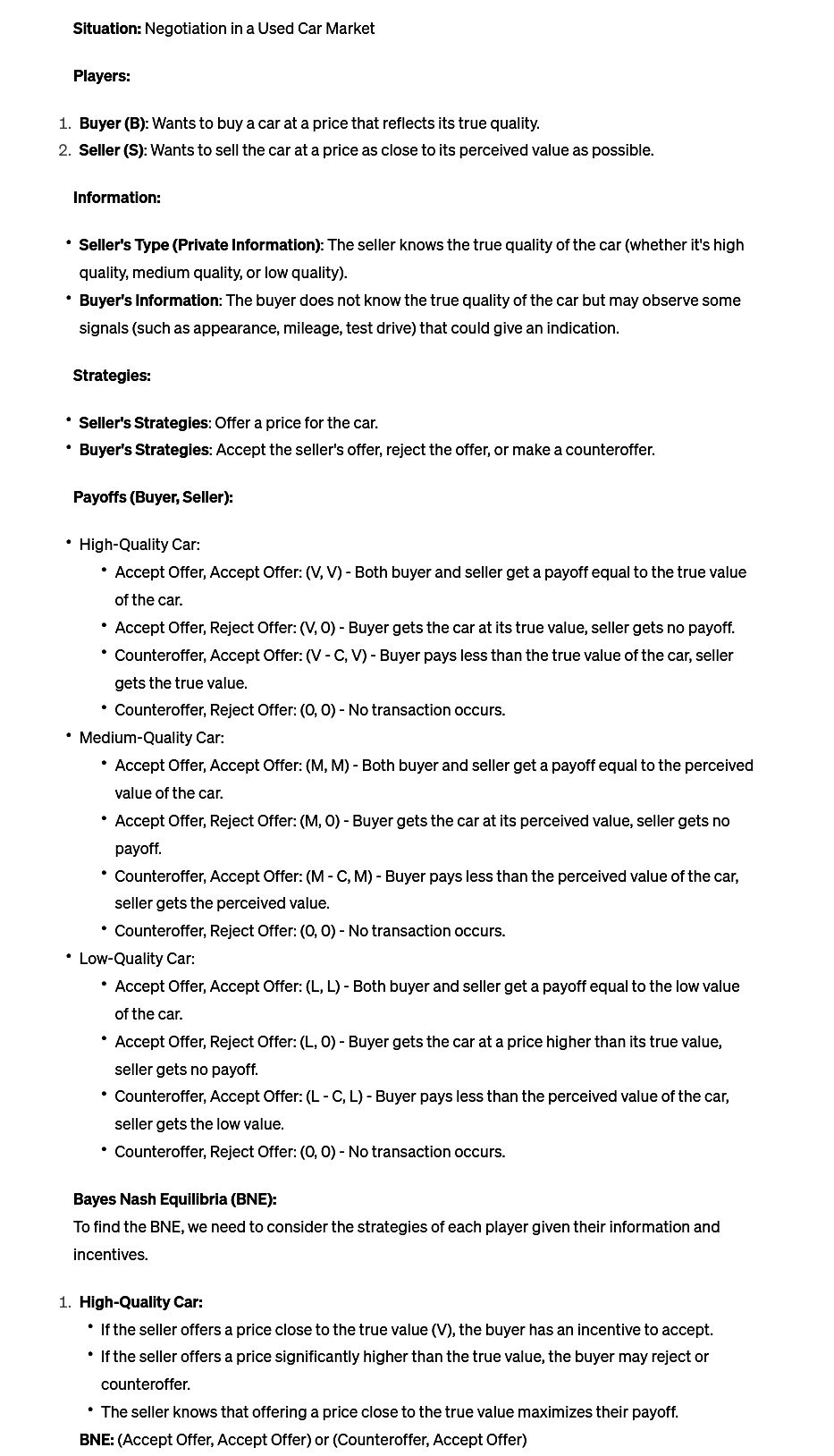
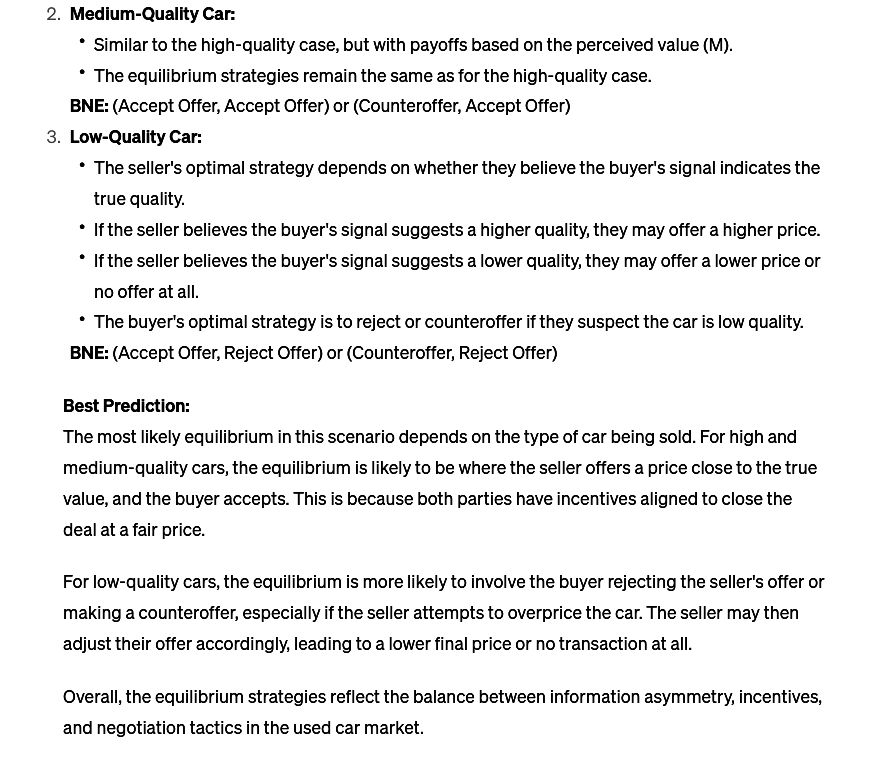
Situation: Negotiation in a Used Car Market Players: 1. Buyer (B): Wants to buy a car at a price that reflects its true quality. 2. Seller {S): Wants to sell the car at a price as close to its perceived value as possible. Information: * Seller's Type (Private Information): The seller knows the true quality of the car (whether it's high quality, medium quality, or low quality). * Buyer's Information: The buyer does not know the true quality of the car but may observe some signals (such as appearance, mileage, test drive) that could give an indication. Strategies: * Seller's Strategies: Offer a price for the car. * Buyer's Strategies: Accept the seller's offer, reject the offer, or make a counteroffer. Payoffs (Buyer, Seller): * High-Quality Car: * Accept Offer, Accept Offer: (V, V) - Both buyer and seller get a payoff equal to the true value of the car. * Accept Offer, Reject Offer: (V, 0) - Buyer gets the car at its true value, seller gets no payoff. * Counteroffer, Accept Offer: (V - C, V) - Buyer pays less than the true value of the car, seller gets the true value. * Counteroffer, Reject Offer: (O, 0) - No transaction occurs. * Medium-Quality Car: * Accept Offer, Accept Offer: (M, M) - Both buyer and seller get a payoff equal to the perceived value of the car. * Accept Offer, Reject Offer: (M, O) - Buyer gets the car at its perceived value, seller gets no payoff. * Counteroffer, Accept Offer: (M - C, M) - Buyer pays less than the perceived value of the car, seller gets the perceived value. * Counteroffer, Reject Offer: (O, ) - No transaction occurs. * Low-Quality Car: * Accept Offer, Accept Offer: (L, L) - Both buyer and seller get a payoff equal to the low value of the car. * Accept Offer, Reject Offer: (L, 0) - Buyer gets the car at a price higher than its true value, seller gets no payoff. * Counteroffer, Accept Offer: (L - C, L) - Buyer pays less than the perceived value of the car, seller gets the low value. * Counteroffer, Reject Offer: (O, 0) - No transaction occurs. Bayes Nash Equilibria (BNE): To find the BNE, we need to consider the strategies of each player given their information and incentives. 1. High-Quality Car: * Ifthe seller offers a price close to the true value (V), the buyer has an incentive to accept. * Ifthe seller offers a price significantly higher than the true value, the buyer may reject or counteroffer. * The seller knows that offering a price close to the true value maximizes their payoff. BNE: (Accept Offer, Accept Offer) or (Counteroffer, Accept Offer) 2. Medium-Quality Car: * Similar to the high-quality case, but with payoffs based on the perceived value (M). * The equilibrium strategies remain the same as for the high-quality case. BNE: (Accept Offer, Accept Offer) or (Counteroffer, Accept Offer) 3. Low-Quality Car: * The seller's optimal strategy depends on whether they believe the buyer's signal indicates the true quality. * If the seller believes the buyer's signal suggests a higher quality, they may offer a higher price. * Ifthe seller believes the buyer's signal suggests a lower quality, they may offer a lower price or no offer at all. * The buyer's optimal strategy is to reject or counteroffer if they suspect the car is low quality. BNE: (Accept Offer, Reject Offer) or (Counteroffer, Reject Offer) Best Prediction: The most likely equilibrium in this scenario depends on the type of car being sold. For high and medium-qguality cars, the equilibrium is likely to be where the seller offers a price close to the true value, and the buyer accepts. This is because both parties have incentives aligned to close the deal at a fair price. For low-quality cars, the equilibrium is more likely to involve the buyer rejecting the seller's offer or making a counteroffer, especially if the seller attempts to overprice the car. The seller may then adjust their offer accordingly, leading to a lower final price or no transaction at all. Overall, the equilibrium strategies reflect the balance between information asymmetry, incentives, and negotiation tactics in the used car market
Step by Step Solution
There are 3 Steps involved in it

Get step-by-step solutions from verified subject matter experts
 Study Help