





Question: out a complete enumeration. So what we do is to select a sample from the population where a sample is a subset of the population
out a complete enumeration. So what we do is to
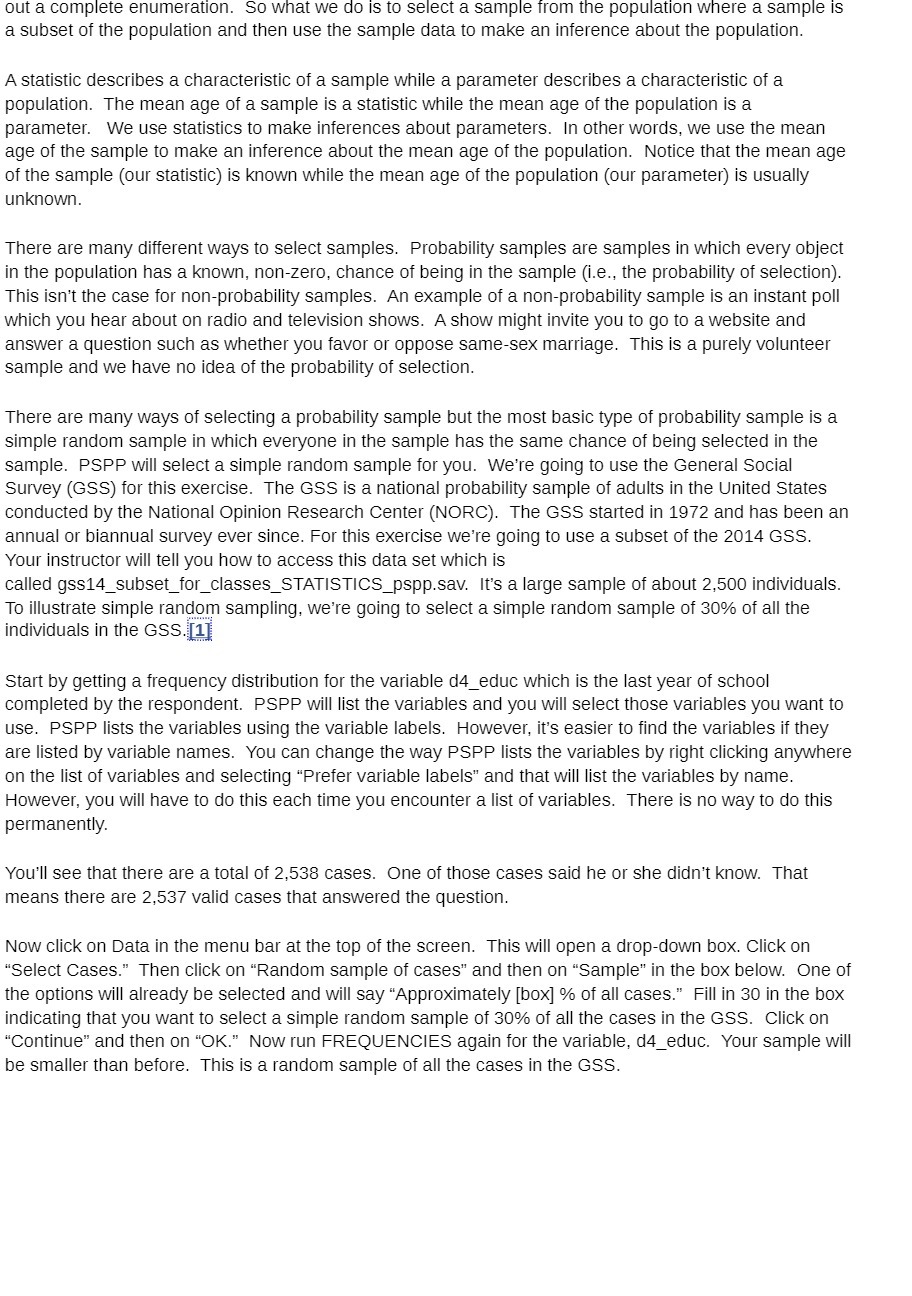
out a complete enumeration. So what we do is to select a sample from the population where a sample is a subset of the population and then use the sample data to make an inference about the population. A statistic describes a characteristic of a sample while a parameter describes a characteristic of a population. The mean age of a sample is a statistic vmile the mean age of the population is a parameter. We use statistics to make inferences about parameters. In other words, we use the mean age of the sample to make an inference about the mean age of the population. Notice that the mean age of the sample (our statistic) is known while the mean age of the population (our parameter) is usually unknown. There are many different ways to select samples. Probability samples are samples in which every object in the population has a known, nonzero, chance of being in the sample e, the probability of selection). This isn't the case for nonprobability samples. An exarnpie of a non-probability sample is an instant poll which you hear about on radio and television shows. A show might invite you to go to a website and answer a question such as whether you favor or oppose samesex marriage. This is a purely volunteer sample and we have no idea of the probability of selection. There are many ways of selecting a probability sample but the most basic type of probability sample is a simple random sample in which everyone in the sample has the same chance of being selected in the sample. PSPP will select a simple random sample for you. We're going to use the General Social Survey {(335} for this exercise. The GSS is a national probability sample of adults in the United States conducted by the National Opinion Research Center (NORC). The GSS started in 19?2 and has been an annual or biannual survey ever since. For this exercise we're going to use a subset of the 2014 GSS. Your instructor will tell you how to access this data set which is called gssl4_subset_for_classes_STATISTlCS_pspp.sav. It's a large sample of about 2,500 individuals. To illustrate simple ranggrn sampling, we're going to select a simple random sample of 30% of all the individuals in the GSS.[;E Start by getting a frequency distribution for the variable d4_educ which is the last year of school completed by the respondent. PSPP will list the variables and you will select those variables you want to use. PSPP lists the variables using the variable labels. However, it's easier to find the variables if they are listed by variable names. You can change the way PSPP lists the variables by right clicking anywhere on the list of variables and selecting \"Prefer variable labels" and that witl list the variables by name. However, you will have to do this each time you encounter a list of variables. There is no way to do this permanently. You'll see that there are a total of 2,538 cases. One of those cases said he or she didn't know. That means there are 2,53? valid cases that answered the question. Now click on Data in the menu bar at the top of the screen. This will open a drop-down box. Click on \"Select Cases." Then click on \"Random sample of cases" and then on \"Sample" in the box below. One of the options will already be selected and will say \"Approximately [box] % of all cases." Fill in 30 in the box indicating that you want to select a simple random sample of 30% of all the cases in the G58. Click on \"Continue" and then on "OK." Now run FREQUENCIES again for the variable, d4_educ. Your sample will be smaller than before. This is a random sample of all the cases in the G55

Step by Step Solution

There are 3 Steps involved in it

1 Expert Approved Answer
Step: 1 Unlock blur-text-image

Question Has Been Solved by an Expert!

Get step-by-step solutions from verified subject matter experts

Step: 2 Unlock
Step: 3 Unlock

Students Have Also Explored These Related Mathematics Questions!