





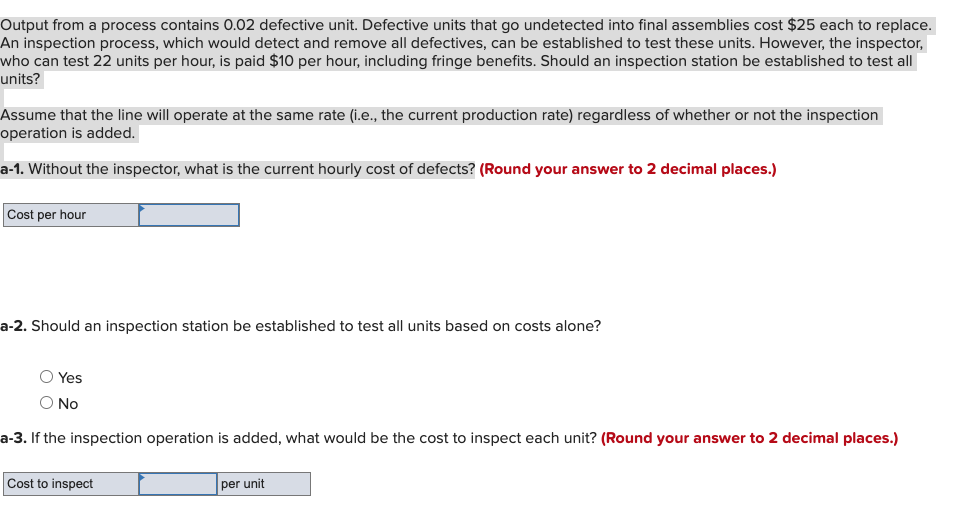
Question: Output from a process contains 0.02 defective unit. Defective units that go undetected into final assemblies cost $25 each to replace. An inspection process, which
Output from a process contains 0.02 defectiveOutput from a process contains 0.02 defectiveOutput from a process contains 0.02 defective

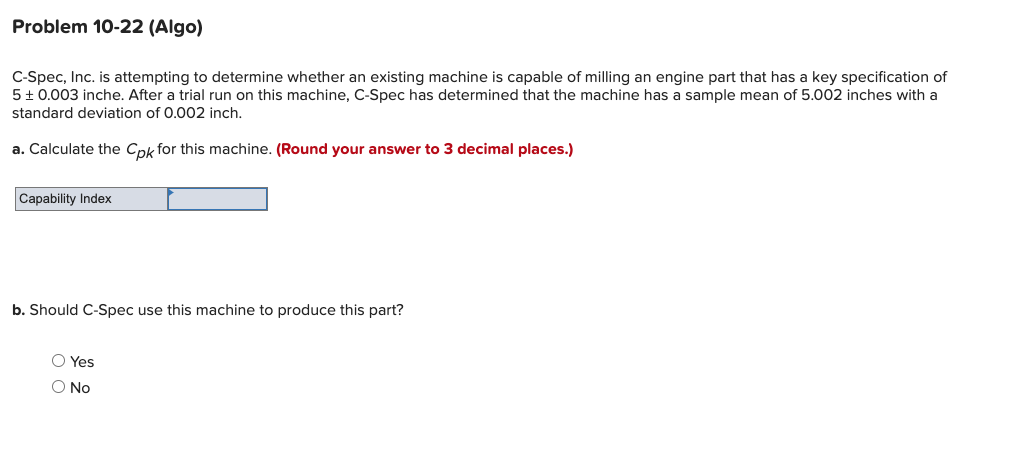
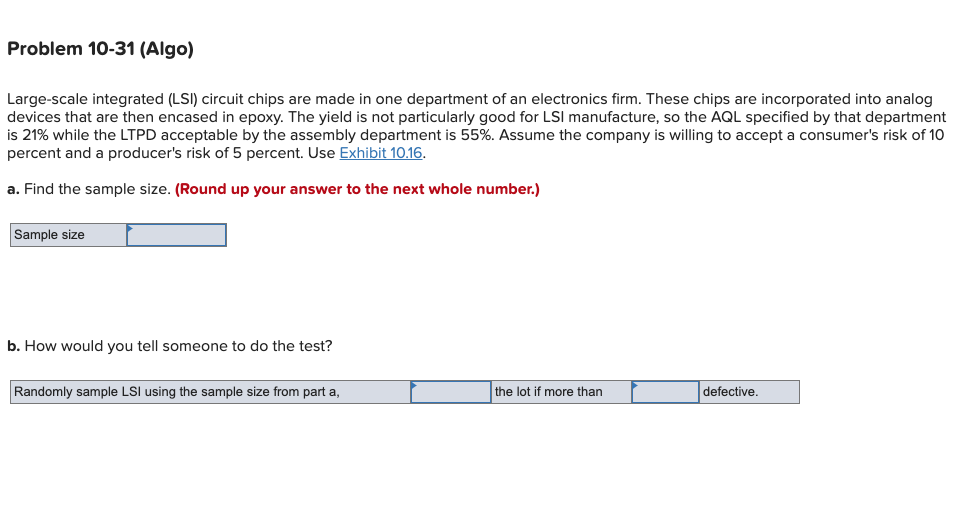
Output from a process contains 0.02 defective unit. Defective units that go undetected into final assemblies cost $25 each to replace. An inspection process, which would detect and remove all defectives, can be established to test these units. However, the inspector, who can test 22 units per hour, is paid $10 per hour, including fringe benefits. Should an inspection station be established to test all units? Assume that the line will operate at the same rate (i.e., the current production rate) regardless of whether or not the inspection operation is added. a-1. Without the inspector, what is the current hourly cost of defects? (Round your answer to 2 decimal places.) Cost per hour a-2. Should an inspection station be established to test all units based on costs alone? Yes O No a-3. If the inspection operation is added, what would be the cost to inspect each unit? (Round your answer to 2 decimal places.) Cost to inspect per unit Problem 10-22 (Algo) C-Spec, Inc. is attempting to determine whether an existing machine is capable of milling an engine part that has a key specification of 5 + 0.003 inche. After a trial run on this machine, C-Spec has determined that the machine has a sample mean of 5.002 inches with a standard deviation of 0.002 inch. a. Calculate the Cpk for this machine. (Round your answer to 3 decimal places.) Capability Index b. Should C-Spec use this machine to produce this part? O Yes O No Problem 10-31 (Algo) Large-scale integrated (LSI) circuit chips are made in one department of an electronics firm. These chips are incorporated into analog devices that are then encased in epoxy. The yield is not particularly good for LSI manufacture, so the AQL specified by that department is 21% while the LTPD acceptable by the assembly department is 55%. Assume the company is willing to accept a consumer's risk of 10 percent and a producer's risk of 5 percent. Use Exhibit 10.16. a. Find the sample size. (Round up your answer to the next whole number.) Sample size b. How would you tell someone to do the test? Randomly sample LSI using the sample size from part a, the lot if more than defective
Step by Step Solution

There are 3 Steps involved in it

1 Expert Approved Answer
Step: 1 Unlock blur-text-image

Question Has Been Solved by an Expert!

Get step-by-step solutions from verified subject matter experts

Step: 2 Unlock
Step: 3 Unlock

Students Have Also Explored These Related General Management Questions!