







Question: Overall Instructions: Please read the case and provide the appropriate Codification citations to support your answers. Please number your responses according to the format set
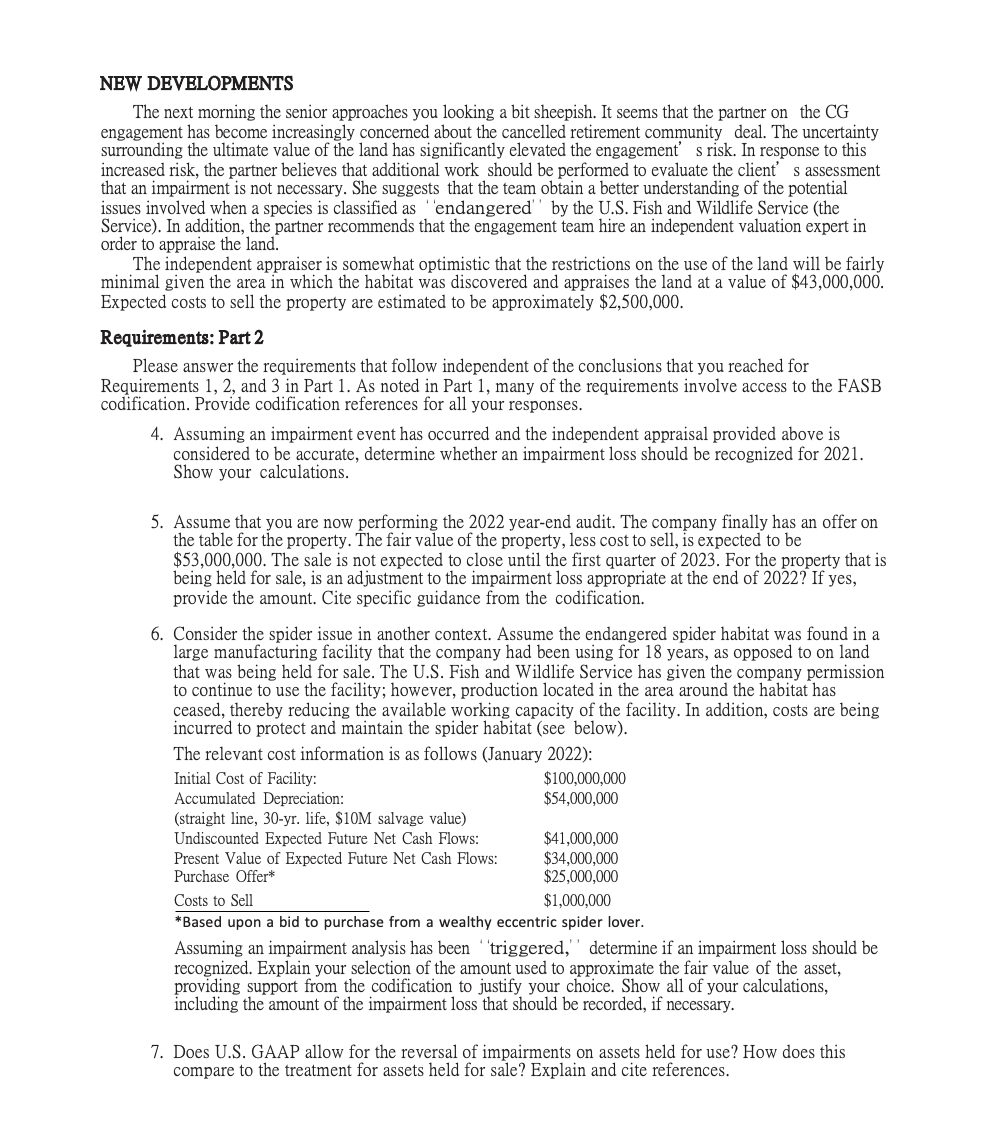
Overall Instructions: Please read the case and provide the appropriate Codification citations to support your answers. Please number your responses according to the format set out below. Full credit will only be given if your responses are supported by a cite from the codification. Qy are a new staff auditor for FBG LLP, a small CPA firm in San Antonio, TX. Your biggest client is CG Corporation, a publicly traded, regional land development company. One of CGs prime holdings is a sizable tract in the northeast part of town, where most of the city' s growth has occurred during the past decade. As 2021 draws to a close, CGs CEO, Mark Kedman, is in negotiations with a group of buyers who are interested in establishing an upscale retirement community in the area. The buyers have obtained approval from the relevant authorities to build 250 homes, a golf course, and an activity center. The land is carried on CGs books at $50 million, but CG believes that it will be able to sell the land to the development group for $80 million. At that value, this particular piece of property comprises roughly 10 percent of CGs overall land holdings. While working on the 2021 year-end audit in early January of 2022, you hear a couple of people at CG having a water cooler conversation about spiders. When you mention that you hate spiders, the following conversation ensues: Employee: I bet you don' t hate them as much as Kedman does. You: Why? Is Kedman allergic to spiders or something? Employee: I guess you could say that ... [laughing] You: I don' t get it. Employee: A couple of surveyors were poking around on the northeast San Antonio site last week and found spiders on the property. You: And? Employee: Fish and Wildlife says they' ve not seen this particular species in 50 years. You: So? Employee: Do you not read the paper? San Antonio has a long history of being held hostage by rare spiders. You: I see ... Intrigued, you return to your cubicle, put on your headphones to drown out the fluorescent bulb that is buzzing and flickering over your head, and run a quick Internet search for ' 'San Antonio rare spiders.' The first few articles that pop up are from San Antonio' s major newspaper, the Express- News. One piece from October 2, 2020 describes a \$15.1 million highway underpass project that was put on hold 'indefinitely' when a Bracken Bat Cave meshureaver spider was found in the excavation area. Another from February 25 , 2021 notes that with only 1,500 feet to go, a six-mile, \$11 million water pipeline project had to be halted because the same type of spider was found in a recently exposed underground cave. The second article also states that even if the construction companies are granted approval from federal authorities to find solutions and build in areas such as these, securing a permit can take up to two years. Who would have thought that a spider could wreak such havoc? After reading the articles carefully and thinking about things a bit, you approach the senior on the engagement and ask him what he thinks. As it turns out, the senior has already heard about the spider issue. Kedwan called the lead partner that morning and told her that the retirement community deal was off. When Kedman told the potential buyers about the spiders, they told him that they would re-evaluate things over the weekend and get back with him. On Monday' s conference call, the buyers told Kedman that their valuation team had reduced their appraisal of the property to $10 million, based on its potential as an eco-friendly hill country golf club. The buyers are convinced that they can work around the spider issue by minimizing excavation and strategically placing greens and fairways on the golf course such that the spider areas' would remain unmolested. Kedman declined, indicating that he would just "wait for the right buyer. When the senior finishes his story, you have the following conversation: You: So do you think the land is still worth $80 million? Or even $50 million? Senior: Right now? Probably not. Why? You: Well, don' t you think we should consider recommending impairment? Senior: Impairment? On land? You: Does FAS 144 not apply to land? Senior: Very funny. Look, nobody impairs land. Land has an infinite life. You: I realize that, but these guys just had a $10 million offer on property they were on the verge of selling for $80 million because the buyers know that you can' t really build on it. I mean, you can' t dig. Period. If you can' tdig, you can' t build houses. If you can' t build houses, you can' t sell houses. And if you can' 't sell houses and charge outrageous community fees and all that, the potential revenue stream is seriously compromised. That' s why the new appraisal is so much lower. Basically, CG is now holding a big chunk of land that has to be converted into a nature preserve or maybe-just maybe-a golf course. I think this probably is the best offer they' re going to get. Senior: Relax, will you? You can' t build houses on the land right now. At some point those spiders will be gone and everything will be fine. Impairing land ... wow ... [walks away] Being annoyed rather than satisfied, you head back to your cube, open a spreadsheet, and look at some numbers. What you find is both interesting and discouraging. First, if the land really is impaired and if it is really only worth $10 million, CG obviously is looking at a pre-tax impairment loss of $40 million. That would turn their preliminary earnings estimate of $7 million into a big red number. Collateral damage here would include the employee bonus plan, which covers all nowsalaried workers. It has been a while since the employees have gotten much in the way of bonuses and they are hoping for a good year. Second, if that loss is booked, CG' s debt-to-total- equity ratio spikes and one of their loan covenants is triggered. Before the housing market collapse that started in 2007 - 2008 this would not have been that big of a deal, but the past years have been rough and CG' s lenders have expressed serious concerns about both earnings and cash flows. Armed with these data, you meekly approach the senior and present your findings. His response? Well, that' s even more evidence that you should leave this alone, now isn' t it? Like I said before, nobody impairs land. Besides, that particular investor group is just one vote where valuation is concerned. I heard that an independent appraiser valued the land at $60 million and the client believes they should at least be able to recover the carrying value. Their analysis suggests that no impairment has occurred. I know that you are fresh out of school and are wearing your conquer-theworld hat and all, but seriously ... this is real life. Think of all the people who are affected here. If the spider problem goes away and they can unload the land for closer to $50 million, everybody wins. With your doomsday scenario, everybody loses. As you head back down the hall, you admit to yourself that the senior may be right about the relative infrequency of land impairment. You also know that the accounting treatment of this situation affects a lot of people. With various ideas buzzing around in your head-impairments, land, virtues, consequences, stakeholders, ethical decision making - you briefly ponder a career as a small- town librarian. Welcome to public accounting. Requirements: Part 1 Many of the requirements below involve use of the FASB codification. You will need to provide the username and password supplied to you above. Provide codification references for all your responses that warrant a reference. Based on U.S. GAAP, what triggering events or changes in circumstances should be evaluated in testing for the recoverability of long-lived assets? Which of these factors are particularly relevant to the circumstances presented in this case? Based on this information, do you believe that an impairment analysis is required (i.e., that an impairment event has occurred)? 1. Are the impairment guidelines different for assets held for sale versus assets held for use? 2. Does the fact that land is involved as opposed to another type of long-lived asset alter the situation? Evaluate your answers using specific guidelines from the standards. 3. As the auditor on this engagement, what concerns (if any) might you have about using the $10,000,000 purchase price offered by the potential buyer as fair value when you determine whether an impairment loss should be recognized? What alternatives might you have to determine fair value? NEW DEVELOPMENTS The next morning the senior approaches you looking a bit sheepish. It seems that the partner on the CG engagement has become increasingly concerned about the cancelled retirement community deal. The uncertainty surrounding the ultimate value of the land has significantly elevated the engagement' s risk. In response to this increased risk, the partner believes that additional work should be performed to evaluate the client' s assessment that an impairment is not necessary. She suggests that the team obtain a better understanding of the potential issues involved when a species is classified as 'endangered' ' by the U.S. Fish and Wildlife Service (the Service). In addition, the partner recommends that the engagement team hire an independent valuation expert in order to appraise the land. The independent appraiser is somewhat optimistic that the restrictions on the use of the land will be fairly minimal given the area in which the habitat was discovered and appraises the land at a value of $43,000,000. Expected costs to sell the property are estimated to be approximately $2,500,000. Requirements: Part 2 Please answer the requirements that follow independent of the conclusions that you reached for Requirements 1, 2, and 3 in Part 1. As noted in Part 1, many of the requirements involve access to the FASB codification. Provide codification references for all your responses. 4. Assuming an impairment event has occurred and the independent appraisal provided above is considered to be accurate, determine whether an impairment loss should be recognized for 2021. Show your calculations. 5. Assume that you are now performing the 2022 year-end audit. The company finally has an offer on the table for the property. The fair value of the property, less cost to sell, is expected to be $53,000,000. The sale is not expected to close until the first quarter of 2023 . For the property that is being held for sale, is an adjustment to the impairment loss appropriate at the end of 2022? If yes, provide the amount. Cite specific guidance from the codification. 6. Consider the spider issue in another context. Assume the endangered spider habitat was found in a large manufacturing facility that the company had been using for 18 years, as opposed to on land that was being held for sale. The U.S. Fish and Wildlife Service has given the company permission to continue to use the facility; however, production located in the area around the habitat has ceased, thereby reducing the available working capacity of the facility. In addition, costs are being incurred to protect and maintain the spider habitat (see below). Based upon a bid to purchase from a wealthy eccentric spider lover. Assuming an impairment analysis has been 'triggered,' determine if an impairment loss should be recognized. Explain your selection of the amount used to approximate the fair value of the asset, providing support from the codification to justify your choice. Show all of your calculations, including the amount of the impairment loss that should be recorded, if necessary. 7. Does U.S. GAAP allow for the reversal of impairments on assets held for use? How does this compare to the treatment for assets held for sale? Explain and cite references
Step by Step Solution
There are 3 Steps involved in it

Get step-by-step solutions from verified subject matter experts
 Study Help