Question: Overview: Case analysis is one method by which you demonstrate in written form that you have mastered and can apply course concepts in a real-world
Overview: Case analysis is one method by which you demonstrate in written form that you have mastered and can apply course concepts in a real-world context. Each chapter in the text has a closing case. Students are assigned 2 of these cases through the course of the semester.
Case Analysis: Read the end of the chapter case assigned several times carefully and take notes about important events and facts mentioned in the case. Use these facts and events (casedata) and concepts from the relevant text chapter to answer all discussion questions at the end of the case. A well thoughtout and complete response to each case question applies concepts from the text woven in with case data to fully support the analysis. Expected length for responses is 2-3 complete paragraphs per question.
Respond to Discussion Questions 1a, 1b, and 2 at the end of the case in the text.
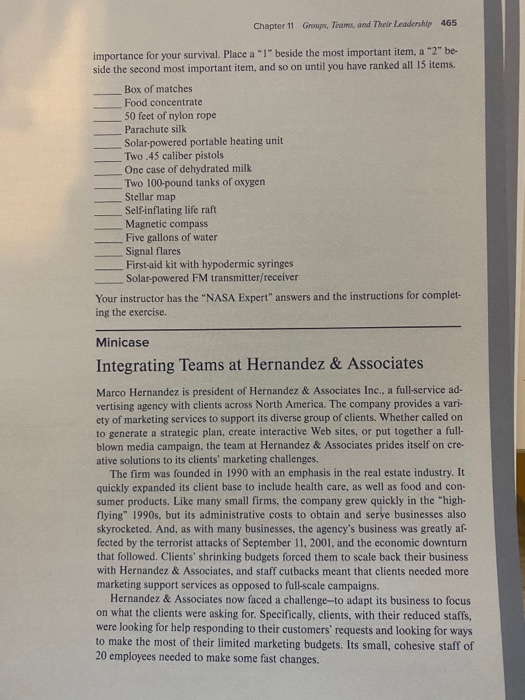
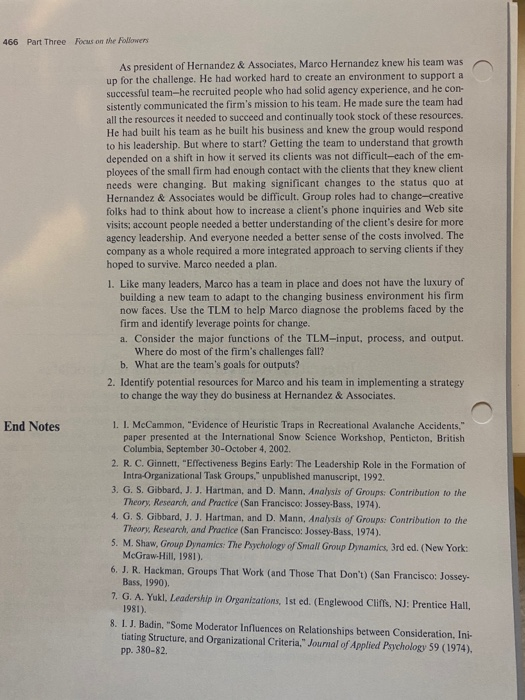
Chapter 11 Groups, Teams, and Their Leadership 465 importance for your survival. Place a "1" beside the most important item, a "2" be- side the second most important item, and so on until you have ranked all 15 items. Box of matches Food concentrate 50 feet of nylon rope Parachute silk Solar-powered portable heating unit Two .45 caliber pistols One case of dehydrated milk Two 100-pound tanks of oxygen Stellar map Self-inflating life raft Magnetic compass Five gallons of water Signal flares First-aid kit with hypodermic syringes Solar-powered FM transmitter/receiver Your instructor has the "NASA Expert" answers and the instructions for complet- ing the exercise. Minicase Integrating Teams at Hernandez & Associates Marco Hernandez is president of Hernandez & Associates Inc., a full-service ad- vertising agency with clients across North America. The company provides a vari ety of marketing services to support its diverse group of clients. Whether called on to generate a strategic plan, create interactive Web sites, or put together a full- blown media campaign, the team at Hernandez & Associates prides itself on cre- ative solutions to its clients' marketing challenges. The firm was founded in 1990 with an emphasis in the real estate industry. It quickly expanded its client base to include health care, as well as food and con- sumer products. Like many small firms, the company grew quickly in the "high- flying" 1990s, but its administrative costs to obtain and serve businesses also skyrocketed. And, as with many businesses, the agency's business was greatly af- fected by the terrorist attacks of September 11, 2001, and the economic downturn that followed. Clients' shrinking budgets forced them to scale back their business with Hernandez & Associates, and staff cutbacks meant that clients needed more marketing support services as opposed to full-scale campaigns. Hernandez & Associates now faced a challenge-to adapt its business to focus on what the clients were asking for. Specifically, clients, with their reduced staffs, were looking for help responding to their customers' requests and looking for ways to make the most of their limited marketing budgets. Its small, cohesive staff of 20 employees needed to make some fast changes. 466 Part Three Focus on the Followers As president of Hernandez & Associates, Marco Hernandez knew his team was up for the challenge. He had worked hard to create an environment to support a successful team-he recruited people who had solid agency experience, and he con- sistently communicated the firm's mission to his team. He made sure the team had all the resources it needed to succeed and continually took stock of these resources. He had built his team as he built his business and knew the group would respond to his leadership. But where to start? Getting the team to understand that growth depended on a shift in how it served its clients was not difficult-cach of the em ployees of the small firm had enough contact with the clients that they knew client needs were changing. But making significant changes to the status quo at Hernandez & Associates would be difficult. Group roles had to change-creative folks had to think about how to increase a client's phone inquiries and Web site visits, account people needed a better understanding of the client's desire for more agency leadership. And everyone needed a better sense of the costs involved. The company as a whole required a more integrated approach to serving clients if they hoped to survive. Marco needed a plan. 1. Like many leaders, Marco has a team in place and does not have the luxury of building a new team to adapt to the changing business environment his firm now faces. Use the TLM to help Marco diagnose the problems faced by the firm and identify leverage points for change. a. Consider the major functions of the TLM-input, process, and output. Where do most of the firm's challenges fall? b. What are the team's goals for outputs? 2. Identify potential resources for Marco and his team in implementing a strategy to change the way they do business at Hernandez & Associates. End Notes 1. I. McCammon, "Evidence of Heuristic Traps in Recreational Avalanche Accidents," paper presented at the International Snow Science Workshop, Penticton, British Columbia, September 30-October 4, 2002 2. R. C. Ginnett, "Effectiveness Begins Early: The Leadership Role in the Formation of Intra-Organizational Task Groups," unpublished manuscript. 1992. 3. G. S. Gibbard, J. J. Hartman, and D. Mann, Analysis of Groups: Contribution to the Theory, Research, and Practice (San Francisco: Jossey-Bass, 1974). 4. G. S. Gibbard, J. J. Hartman, and D. Mann, Analysis of Groups: Contribution to the Theory, Research, and Practice (San Francisco: Jossey-Bass, 1974). 5. M. Shaw, Group Dynamics: The Psychology of Small Group Dynamics, 3rd ed. (New York: McGraw-Hill, 1981). 6. J. R. Hackman, Groups That Work (and Those That Don't) (San Francisco: Jossey- Bass, 1990). 7. G. A. Yukl, Leadership in Organizations, Ist ed. (Englewood Cliffs, NJ: Prentice Hall, 1981). 8. 1. J. Badin. "Some Moderator Influences on Relationships between Consideration, Ini- tiating Structure, and Organizational Criteria." Journal of Applied Psychology 59 (1974), pp. 380-82









 Study Help