







Question: Overview For this project, you will focus on performing due diligence to determine the viability of a client before deciding to engage with them. Sound
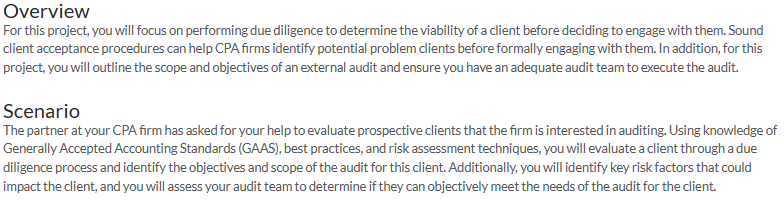
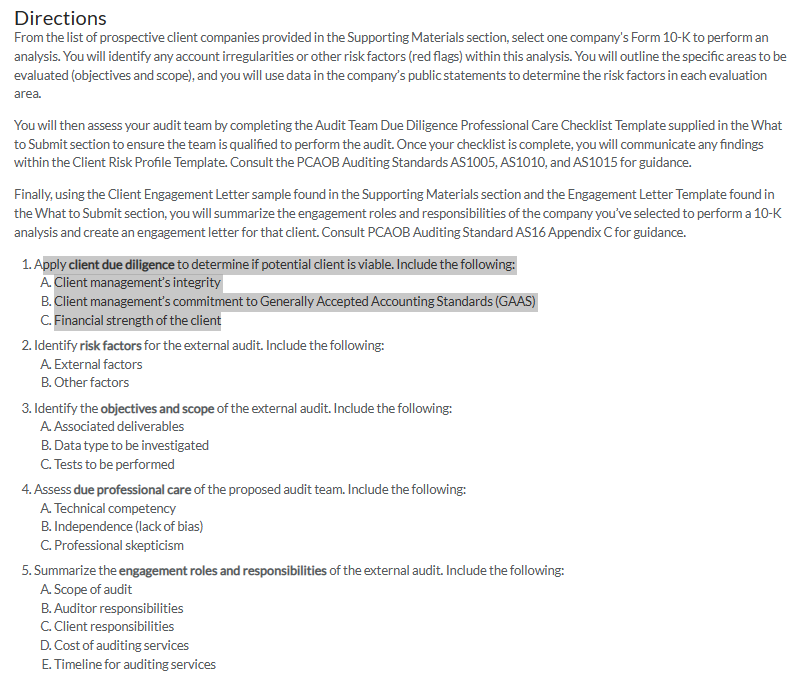
Overview For this project, you will focus on performing due diligence to determine the viability of a client before deciding to engage with them. Sound client acceptance procedures can help CPA firms identify potential problem clients before formally engaging with them. In addition, for this project, you will outline the scope and objectives of an external audit and ensure you have an adequate audit team to execute the audit. Scenario The partner at your CPA firm has asked for your help to evaluate prospective clients that the firm is interested in auditing. Using knowledge o Generally Accepted Accounting Standards (GAAS), best practices, and risk assessment techniques, you will evaluate a client through a due diligence process and identify the objectives and scope of the audit for this client. Additionally, you will identify key risk factors that could impact the client, and you will assess your audit team to determine if they can objectively meet the needs of the audit for the client. Directions From the list of prospective client companies provided in the Supporting Materials section, select one company's Form 10-K to perform an analysis. You will identify any account irregularities or other risk factors (red flags) within this analysis. You will outline the specific areas to be evaluated (objectives and scope), and you will use data in the company's public statements to determine the risk factors in each evaluation area. You will then assess your audit team by completing the Audit Team Due Diligence Professional Care Checklist Template supplied in the What to Submit section to ensure the team is qualified to perform the audit. Once your checklist is complete, you will communicate any findings within the Client Risk Profile Template. Consult the PCAOB Auditing Standards AS1005, AS1010, and AS1015 for guidance. Finally, using the Client Engagement Letter sample found in the Supporting Materials section and the Engagement Letter Template found in the What to Submit section, you will summarize the engagement roles and responsibilities of the company you've selected to perform a 10K analysis and create an engagement letter for that client. Consult PCAOB Auditing Standard AS16 Appendix C for guidance. 1. Apply client due diligence to determine if potential client is viable. Include the following: A. Client management's integrity B. Client management's commitment to Generally Accepted Accounting Standards (GAAS) C. Financial strength of the client 2. Identify risk factors for the external audit. Include the following: A. External factors B. Other factors 3. Identify the objectives and scope of the external audit. Include the following: A. Associated deliverables B. Data type to be investigated C. Tests to be performed 4. Assess due professional care of the proposed audit team. Include the following: A. Technical competency B. Independence (lack of bias) C. Professional skepticism 5. Summarize the engagement roles and responsibilities of the external audit. Include the following: A. Scope of audit B. Auditor responsibilities C. Client responsibilities D. Cost of auditing services E. Timeline for auditing services
Step by Step Solution
There are 3 Steps involved in it

Get step-by-step solutions from verified subject matter experts
 Study Help