







Question: Overview In this project you theoretically model a physical system and calculate its parameters using experimental data. System You will examine the motion of a
Overview
In this project you theoretically model a physical system and calculate its parameters using experimental data.
System
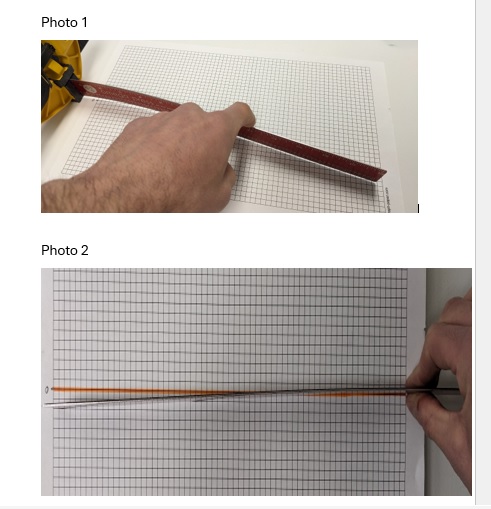
You will examine the motion of a ruler that oscillates back and forth after it is let go This exhibits damped oscillations also known as decaying oscillationsSee the attached photo
Theoretical Modeling
Model Selection pts
We first have to pick a model for our beam to allow us to analyze the system. For this project, I will be selecting the Lumped parameter model for my system dynamic analysis.
Given the setup of the experiment shown in the image and video above, pick a model for the beam ie what are the boundary conditions and loads applied to the beam Justify your choice based on observations.
Mass pts
We saw in our work on lumped parameter modeling that we can find the equivalent mass of a beam based on the beam model and the parameters of the beam. In particular, the equivalent mass depends on the mass density of the material rho the cross sectional area of the beam A and the length of the beam L Calculating these values requires us to know the exact geometry and material properties of the ruler, which are difficult to obtain especially since this ruler has two materials, a metal layer and a cork layer Instead, we can use a simple experiment to get these values.
Note that rho A is the linear density of the beam ie mass per unit length We can easily get this value by finding the total mass m and dividing by the total length L ierho AmL As measured, our ruler has a total mass m g and a total length L in The length of the beam that moves is L in ie the portion of the beam that is not clamped is L
Calculate the value of rho A using the measured data.
Using the beam model from above, find the equivalent mass me of the portion of the beam that is moving.
Spring Coefficient pts
We saw in our work on lumped parameter modeling that we can also find the equivalent spring coefficient for a cantilever beam, which depends on the Young's modulus of the material E the area moment of inertia of the beam I and the other parameters from above. Again, calculating these values requires us to know the exact geometry and material properties of the ruler, which are difficult to obtain. To get the parameters EI we can instead perform a second simple experiment. We can see that the ruler is flexible enough that it bends under its own weight see below In other words, there is a distributed load w with units Nm acting along the length of the beam due to gravity. From solid mechanics, we can find an equation for the deflection at the free end of the beam Vmax depending on the boundary and loading conditions.
The grid paper behind the beam has steps of mm and the orange line is horizontal. In the attached Photo above, L inPlease see the attached photo
Report the measured value of Vmax.
Calculate the values of the distributed load w
Calculate the value of EI
Calculate the equivalent spring coefficient ke
Step by Step Solution
There are 3 Steps involved in it
1 Expert Approved Answer
Step: 1 Unlock

Question Has Been Solved by an Expert!
Get step-by-step solutions from verified subject matter experts
Step: 2 Unlock
Step: 3 Unlock
 Study Help