







Question: OZ Programming Language Exercise 3: The tatement X-a # b # c abbreviates X- #. (a b c), which con5trucc3 a tuple with label ,
OZ Programming Language
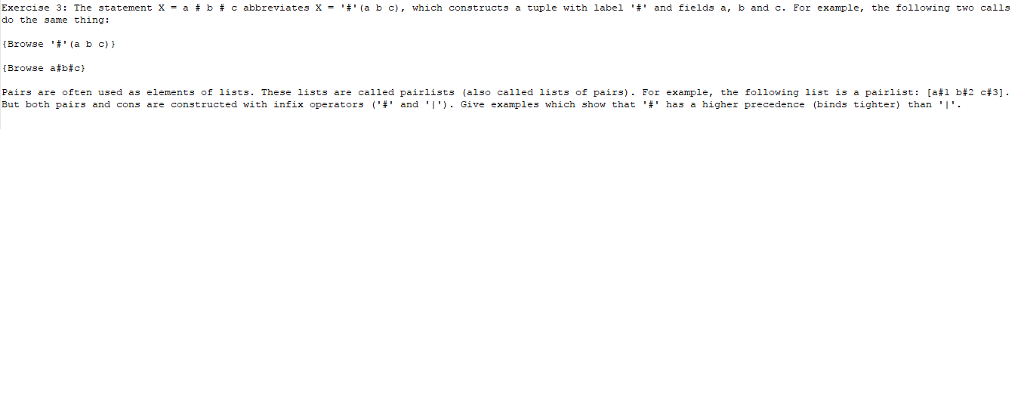
Exercise 3: The tatement X-a # b # c abbreviates X- #. (a b c), which con5trucc3 a tuple with label , and fields a, b and c. For example, the following two calls dlo the same thing: {Browse '#' (a b c} } Browse a#b#c) Pairs are often used as elements of lists. These lists are called pairlists (also called lists of pairs). For example, the following list is a pairlist: [a#1 b#2 c#3] But both pairs and cons are constructed with infix operators ('' and ' l'). Give examples which show that " has a higher precedence (binds tighter) than "I" Exercise 3: The tatement X-a # b # c abbreviates X- #. (a b c), which con5trucc3 a tuple with label , and fields a, b and c. For example, the following two calls dlo the same thing: {Browse '#' (a b c} } Browse a#b#c) Pairs are often used as elements of lists. These lists are called pairlists (also called lists of pairs). For example, the following list is a pairlist: [a#1 b#2 c#3] But both pairs and cons are constructed with infix operators ('' and ' l'). Give examples which show that " has a higher precedence (binds tighter) than "I
Step by Step Solution
There are 3 Steps involved in it

Get step-by-step solutions from verified subject matter experts
 Study Help