







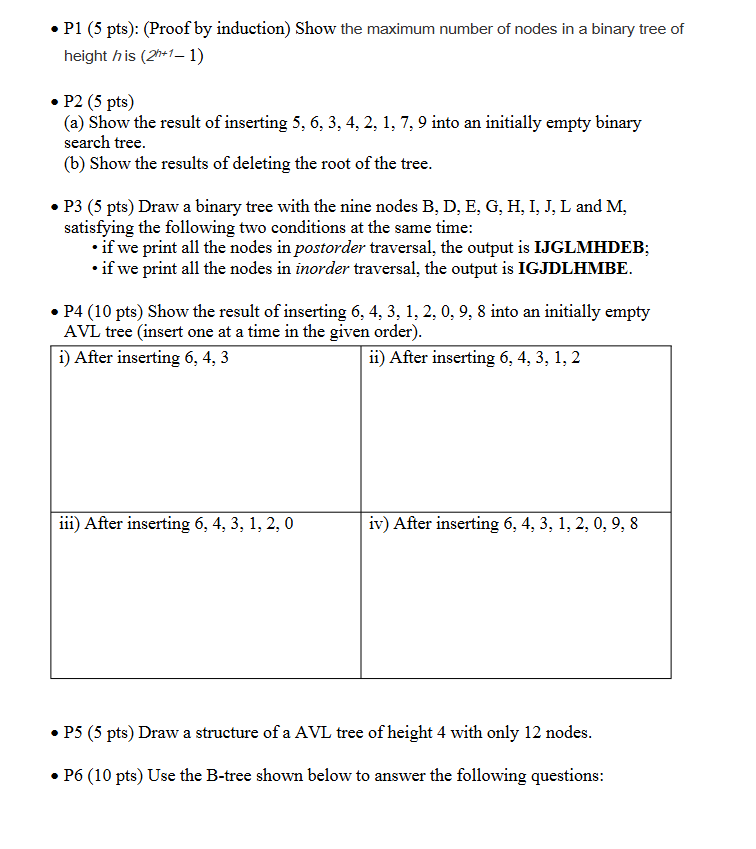
Question: - P 1 ( 5 pts ) : ( Proof by induction ) Show the maximum number of nodes in a binary tree of height
P pts: Proof by induction Show the maximum number of nodes in a binary tree of height h is lefthright
P pts
a Show the result of inserting into an initially empty binary search tree.
b Show the results of deleting the root of the tree.
P pts Draw a binary tree with the nine nodes B D E G H I, J L and M satisfying the following two conditions at the same time:
if we print all the nodes in postorder traversal, the output is IJGLMHDEB;
if we print all the nodes in inorder traversal, the output is IGJDLHMBE.
P pts Show the result of inserting into an initially empty AVL tree insert one at a time in the given order
P pts Draw a structure of a AVL tree of height with only nodes.
P pts Use the Btree shown below to answer the following questions:
Step by Step Solution
There are 3 Steps involved in it
1 Expert Approved Answer
Step: 1 Unlock

Question Has Been Solved by an Expert!
Get step-by-step solutions from verified subject matter experts
Step: 2 Unlock
Step: 3 Unlock
 Study Help