







Question: P 4.3 What Are the Differences Between Freon 12 and Its Replacement HFC-134a? (From Roberts, 1995) Hydrofluorocarbon 134a (1,1,1,2-tetrafluoroethane) is used as a replacement for
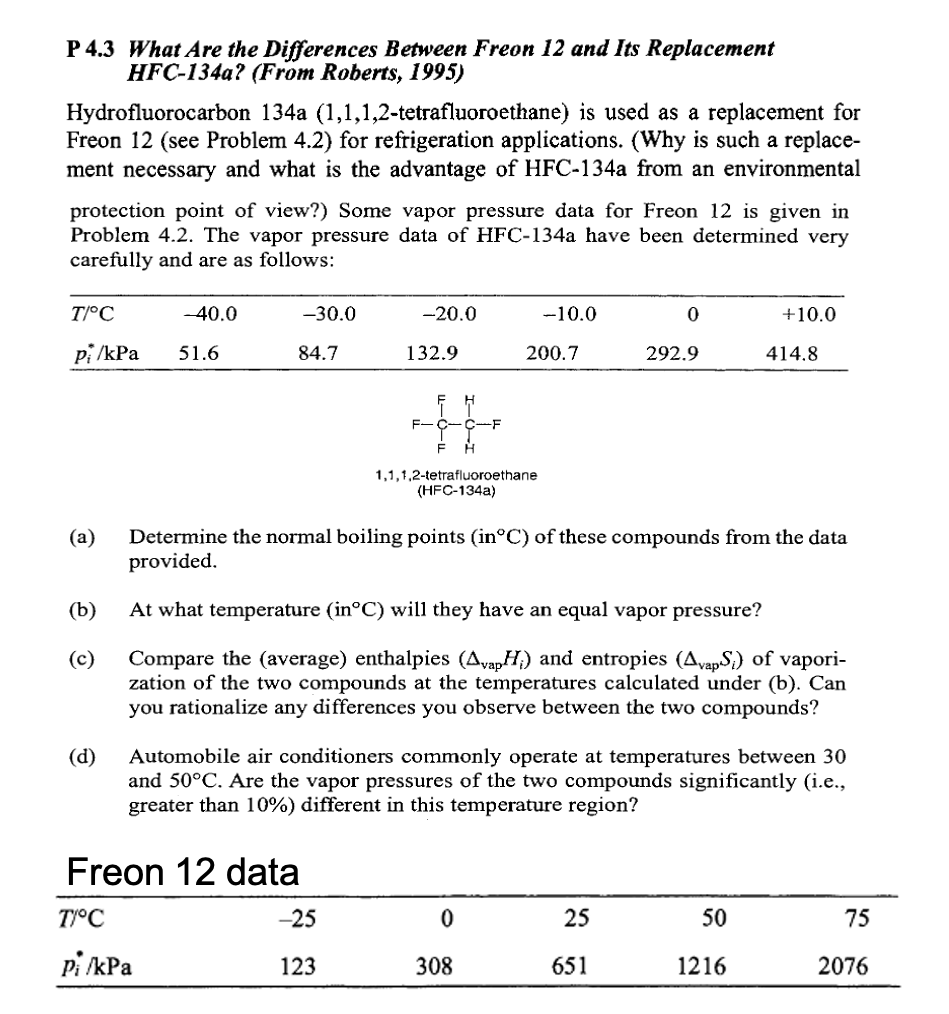
P 4.3 What Are the Differences Between Freon 12 and Its Replacement HFC-134a? (From Roberts, 1995) Hydrofluorocarbon 134a (1,1,1,2-tetrafluoroethane) is used as a replacement for Freon 12 (see Problem 4.2) for refrigeration applications. (Why is such a replace- ment necessary and what is the advantage of HFC-134a from an environmental protection point of view?) Some vapor pressure data for Freon 12 is given in Problem 4.2. The vapor pressure data of HFC-134a have been determined very carefully and are as follows: T/C -40.0 -30.0 -20.0 -10.0 0 +10.0 pi/kPa 51.6 84.7 132.9 200.7 292.9 414.8 -F 1,1,1,2-tetrafluoroethane (HFC-134a) (a) Determine the normal boiling points (inC) of these compounds from the data provided (b) At what temperature (inC) will they have an equal vapor pressure? (c) Compare the (average) enthalpies (AyapH:) and entropies (Avap Si) of vapori- zation of the two compounds at the temperatures calculated under (b). Can you rationalize any differences you observe between the two compounds? (d) Automobile air conditioners commonly operate at temperatures between 30 and 50C. Are the vapor pressures of the two compounds significantly (i.e., greater than 10%) different in this temperature region? TEUTZuala T/C -25 0 25 50 75 pi/kPa 123 308 651 1216 2076
Step by Step Solution
There are 3 Steps involved in it

Get step-by-step solutions from verified subject matter experts
 Study Help