







Question: P 6 - 3 ( Algo ) Determining Bad Debt Expense Based on Aging Analysis LO 6 - 2 Skip to question [ The following
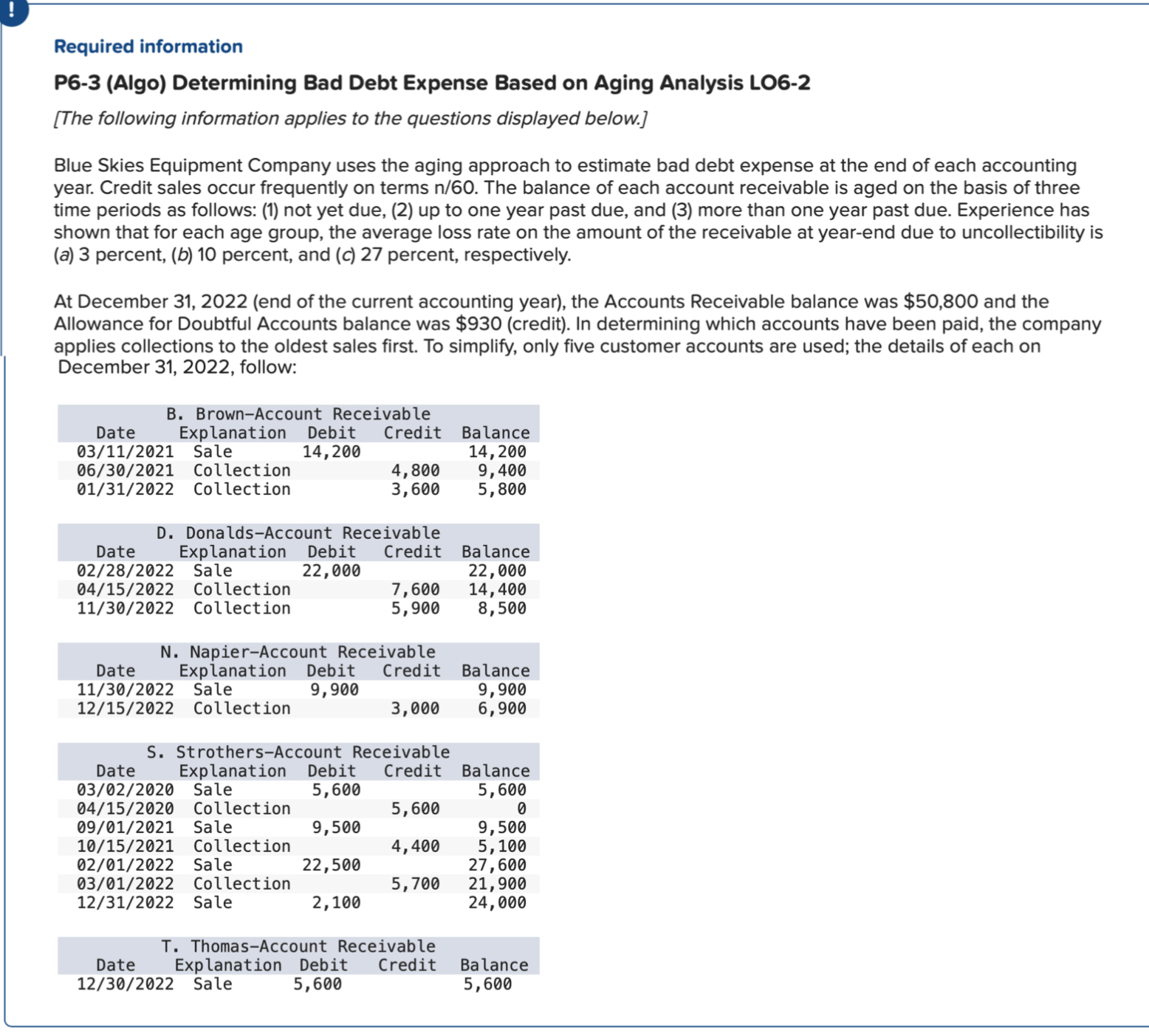
PAlgo Determining Bad Debt Expense Based on Aging Analysis LOSkip to questionThe following information applies to the questions displayed below.Blue Skies Equipment Company uses the aging approach to estimate bad debt expense at the end of each accounting year. Credit sales occur frequently on terms n The balance of each account receivable is aged on the basis of three time periods as follows: not yet due, up to one year past due, and more than one year past due. Experience has shown that for each age group, the average loss rate on the amount of the receivable at yearend due to uncollectibility is a percent, b percent, and c percent, respectively.At December end of the current accounting year the Accounts Receivable balance was $ and the Allowance for Doubtful Accounts balance was $credit In determining which accounts have been paid, the company applies collections to the oldest sales first. To simplify, only five customer accounts are used; the details of each on December follow:B BrownAccount ReceivableDateExplanationDebitCreditBalanceSaleCollection Collection D DonaldsAccount ReceivableDateExplanationDebitCreditBalanceSaleCollection Collection N NapierAccount ReceivableDateExplanationDebitCreditBalanceSaleCollection S StrothersAccount ReceivableDateExplanationDebitCreditBalanceSaleCollection SaleCollection SaleCollection SaleT ThomasAccount ReceivableDateExplanationDebitCreditBalanceSaleP Part and Required:Compute the total accounts receivable in each age category.Compute the estimated uncollectible amount for each age category and in total.
Required information
PAlgo Determining Bad Debt Expense Based on Aging Analysis LO
The following information applies to the questions displayed below.
Blue Skies Equipment Company uses the aging approach to estimate bad debt expense at the end of each accounting year. Credit sales occur frequently on terms The balance of each account receivable is aged on the basis of three time periods as follows: not yet due, up to one year past due, and more than one year past due. Experience has shown that for each age group, the average loss rate on the amount of the receivable at yearend due to uncollectibility is a percent, b percent, and c percent, respectively.
At December end of the current accounting year the Accounts Receivable balance was $ and the Allowance for Doubtful Accounts balance was $credit In determining which accounts have been paid, the company applies collections to the oldest sales first. To simplify, only five customer accounts are used; the details of each on December follow:
tableB BrownAccount ReceivableDateExplanation,Debit,Credit Balance
tableD DonaldsAccount Receivable,DateExplanation,Debit,Credit,BalanceSale,Collection,Collection,
tableN NapierAccount Receivable,DateExplanation,Debit,Credit,BalanceSale,Collection,,
tableS StrothersAccount ReceivableDateExplanation,Debit,Credit,BalanceSale,Collection,,Sale,Collection,,Sale,Collection,,Sale,
tableT ThomasAccount ReceivableDateExplanation Debit,Credit,Balance Sale,
Required:
Compute the total accounts receivable in each age category.
Compute the estimated uncollectible amount for each age category and in total.
Complete this question by entering your answers in the tabs below.
Compute the total accounts receivable in each age category.
tableAgeAmountNot yet due,$Up to one year past due,,More than one year past due,,Total accounts receivable,$
Required:
Compute the total accounts receivable in e
Step by Step Solution
There are 3 Steps involved in it
1 Expert Approved Answer
Step: 1 Unlock

Question Has Been Solved by an Expert!
Get step-by-step solutions from verified subject matter experts
Step: 2 Unlock
Step: 3 Unlock
 Study Help