







Question: P11-50A Comprehensive standards and variances problem (Learning Objectives 1, 2, 3, 4, 5, & 6) Amber Manufacturing produces ceramic teapots. Amber allocates overhead based on
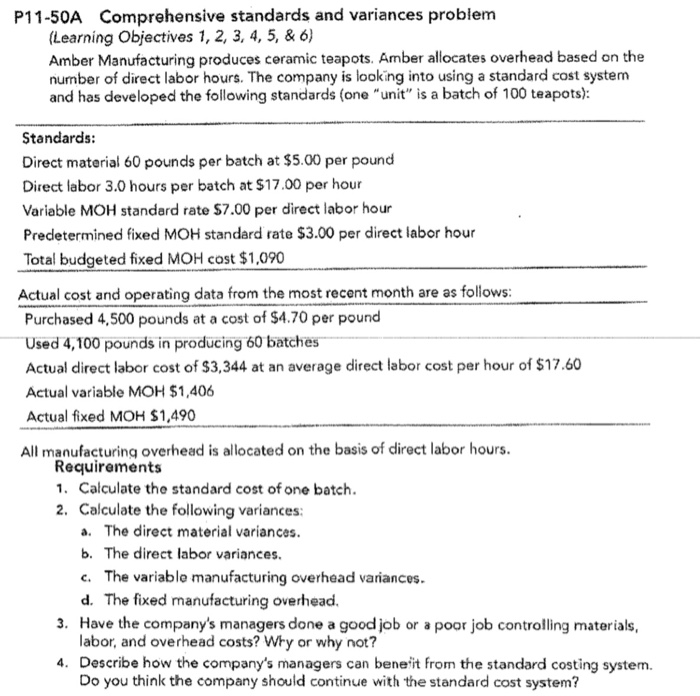
P11-50A Comprehensive standards and variances problem (Learning Objectives 1, 2, 3, 4, 5, & 6) Amber Manufacturing produces ceramic teapots. Amber allocates overhead based on the number of direct labor hours. The company is looking into using a standard cost system and has developed the following standards (one "unit" is a batch of 100 teapots); Standards Direct material 60 pounds per batch at $5.00 per pound Direct labor 3.0 hours per batch at $17.00 per hour Variable MOH standard rate $7.00 per direct labor hour Predetermined fixed MOH standard rate $3.00 per direct labor hour Total budgeted fixed MOH cost $1,090 Actual cost and operating data from the most recent month are as follows Purchased 4,500 pounds at a cost of $4.70 per pound Used 4,100 pounds in producing 60 batches Actual direct labor cost of $3,344 at an average direct labor cost per hour of $17.60 Actual variable MOH $1,406 Actual fixed MOH $1,490 All manufacturing overhead is allocated on the basis of direct labor hours. Requirements 1. Calculate the standard cost of one batch. 2. Calculate the following variances: a. The direct material variances. b. The direct labor variances. c. The variable manufacturing overhead variances. d. The fixed manufacturing overhead 3. Have the company's managers done a good job or a poor job controlling materials, labor, and overhead costs? Why or why not? 4. Describe how the company's managers can beneit from the standard costing system. Do you think the company should continue with the standard cost system
Step by Step Solution
There are 3 Steps involved in it

Get step-by-step solutions from verified subject matter experts
 Study Help