







Question: P1.6.9 In an islander problem 25, we are given a set of statements that are about one another. Each of a set of islanders makes
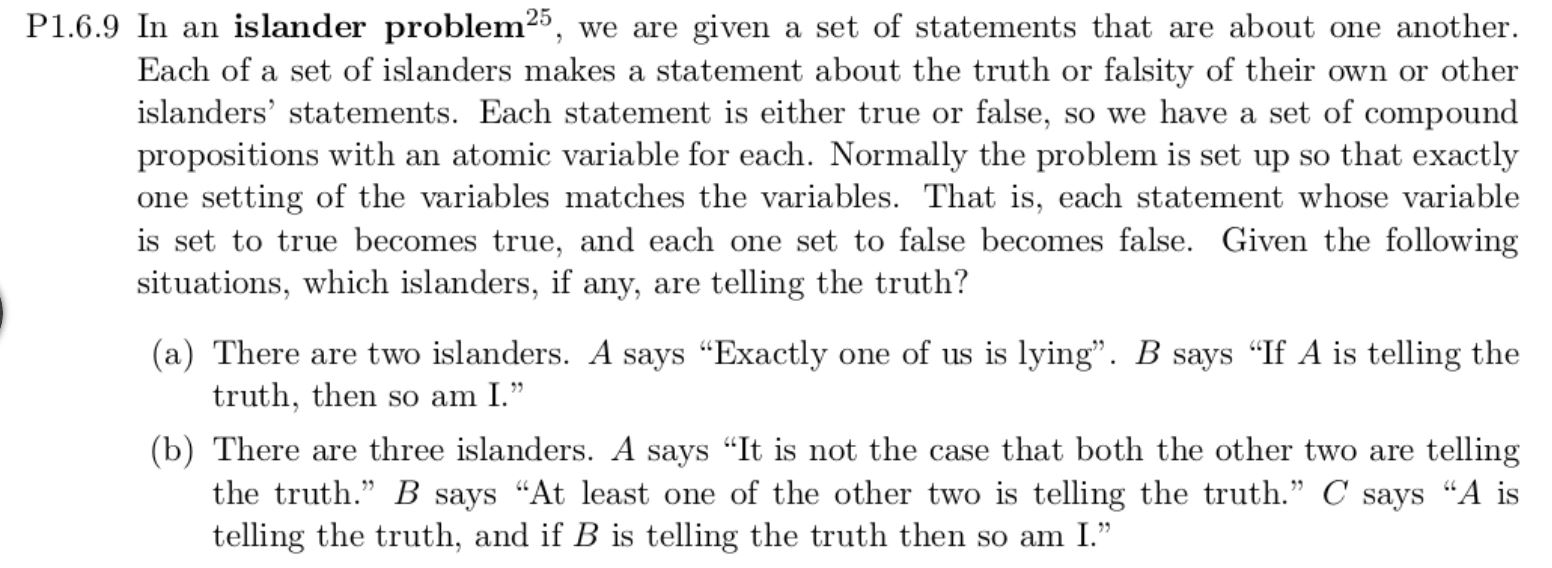
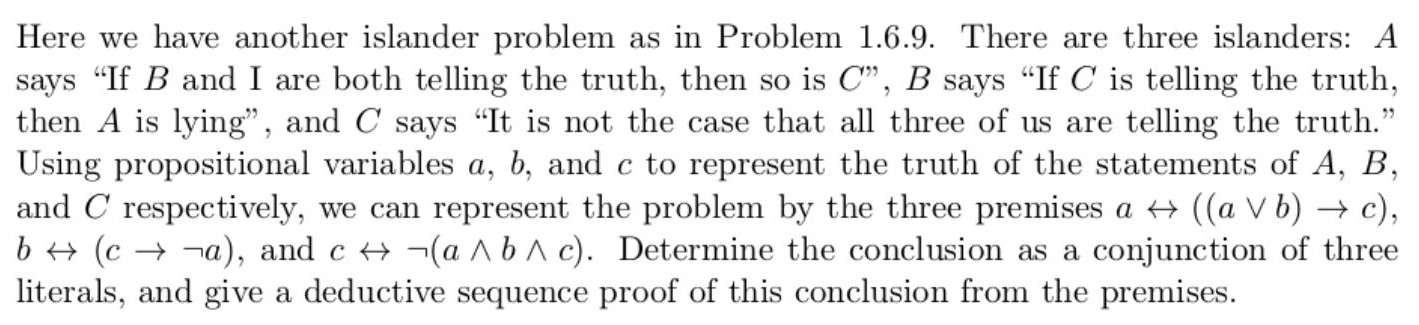
P1.6.9 In an islander problem 25, we are given a set of statements that are about one another. Each of a set of islanders makes a statement about the truth or falsity of their own or other islanders' statements. Each statement is either true or false, so we have a set of compound propositions with an atomic variable for each. Normally the problem is set up so that exactly one setting of the variables matches the variables. That is, each statement whose variable is set to true becomes true, and each one set to false becomes false. Given the following situations, which islanders, if any, are telling the truth? (a) There are two islanders. A says "Exactly one of us is lying". B says "If A is telling the truth, then so am I." (b) There are three islanders. A says It is not the case that both the other two are telling the truth. B says "At least one of the other two is telling the truth. C says A is telling the truth, and if B is telling the truth then so am I." Here we have another islander problem as in Problem 1.6.9. There are three islanders: A says "If B and I are both telling the truth, then so is C", B says "If C is telling the truth, then A is lying", and C says "It is not the case that all three of us are telling the truth. Using propositional variables a, b, and c to represent the truth of the statements of A, B, and C respectively, we can represent the problem by the three premises a H ((a vb) + c), bH (c + a), and c H -(a Ab Ac). Determine the conclusion as a conjunction of three literals, and give a deductive sequence proof of this conclusion from the premises
Step by Step Solution
There are 3 Steps involved in it

Get step-by-step solutions from verified subject matter experts
 Study Help