







Question: P6-7B HO Anode (-) Catalyst Load Electrolyte Catalyst Fuel Cells Rationale. With the focus on alternative clean-energy Fuel Cell sources, we are moving toward an
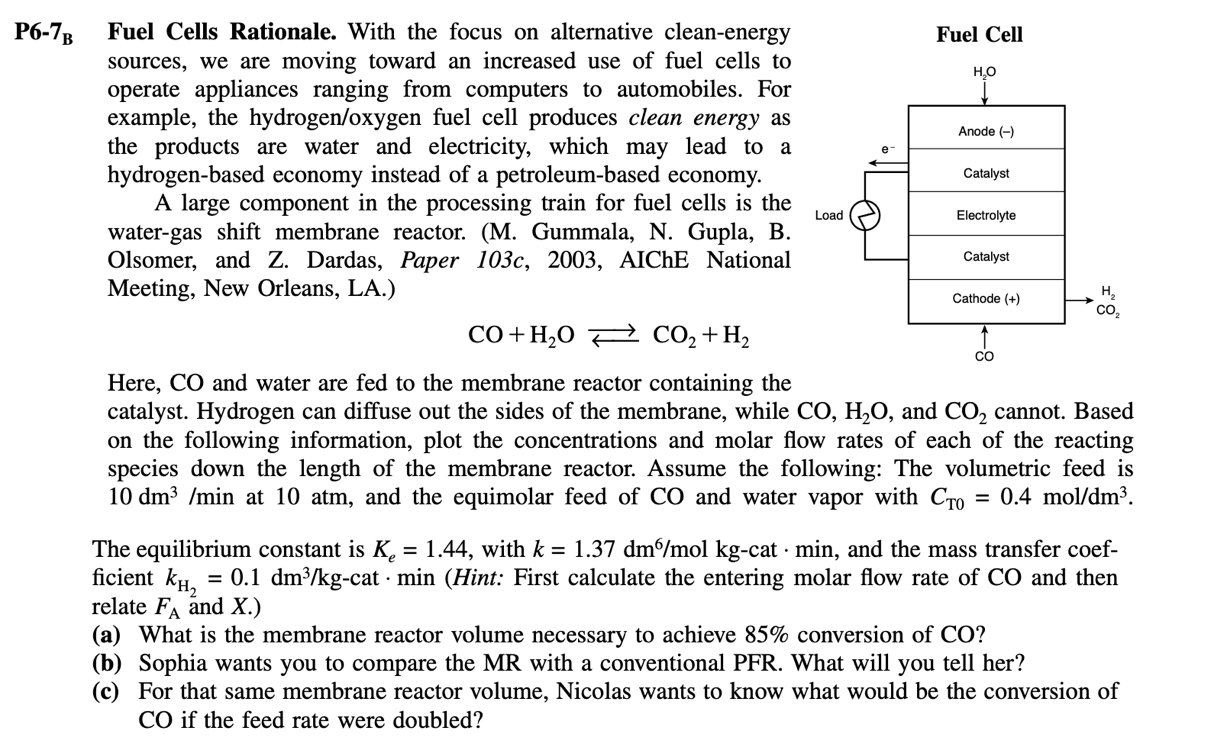
P6-7B HO Anode (-) Catalyst Load Electrolyte Catalyst Fuel Cells Rationale. With the focus on alternative clean-energy Fuel Cell sources, we are moving toward an increased use of fuel cells to operate appliances ranging from computers to automobiles. For example, the hydrogen/oxygen fuel cell produces clean energy as the products are water and electricity, which may lead to a hydrogen-based economy instead of a petroleum-based economy. A large component in the processing train for fuel cells is the water-gas shift membrane reactor. (M. Gummala, N. Gupla, B. Olsomer, and Z. Dardas, Paper 103c, 2003, AICHE National Meeting, New Orleans, LA.) CO+H2O ACO2 + H2 Here, CO and water are fed to the membrane reactor containing the catalyst. Hydrogen can diffuse out the sides of the membrane, while CO, H2O, and CO2 cannot. Based on the following information, plot the concentrations and molar flow rates of each of the reacting species down the length of the membrane reactor. Assume the following: The volumetric feed is 10 dm3 /min at 10 atm, and the equimolar feed of CO and water vapor with Cro = 0.4 mol/dm3. Cathode (+) H CO2 CO ficient kn, The equilibrium constant is Ke = 1.44, with k = 1.37 dm/mol kg-cat min, and the mass transfer coef- = 0.1 dm3/kg-cat min (Hint: First calculate the entering molar flow rate of CO and then relate FA and X.) (a) What is the membrane reactor volume necessary to achieve 85% conversion of CO? (b) Sophia wants you to compare the MR with a conventional PFR. What will you tell her? (c) For that same membrane reactor volume, Nicolas wants to know what would be the conversion of CO if the feed rate were doubled
Step by Step Solution
There are 3 Steps involved in it

Get step-by-step solutions from verified subject matter experts
 Study Help