







Question: package ds; public class Stack { public int size; public int top; public int[] array; public Stack () { size = 0; top = -1;
package ds;
public class Stack {
public int size;
public int top;
public int[] array;
public Stack () {
size = 0;
top = -1;
array = null;
}
public Stack (int _size) {
size = _size;
top = -1;
array = new int[size];
}
/*
* Implement the Stack-Empty(S) function
*/
public boolean empty () {
}
/*
* Implement the Push(S, x) function
*/
public void push (int x) {
}
/*
* Implement the Pop(S) function
* Return -1 if the stack is empty
*/
public int pop () {
}
/*
* Convert stack to string in the format of #size, [#elements]
*/
public String toString () {
String str;
str = size + ", [";
for (int i = 0; i
str += array[i] + ", ";
str += "]";
return str;
}
/**
* @param args
*/
public static void main(String[] args) {
// TODO Auto-generated method stub
Stack s;
s = new Stack(10);
for (int i = 0; i
s.push(i);
System.out.println(s.toString());
for (int i = 0; i
s.pop();
System.out.println(s.toString());
}
}
package ds;
public class Queue {
public int size;
public int[] array;
public int head;
public int tail;
public Queue () {
size = 0;
array = null;
head = -1;
tail = 0;
}
public Queue (int _size) {
size = _size;
array = new int[size];
head = -1;
tail = 0;
}
/*
* Implement the ENQUEUE(Q, x) function
*/
public void enqueue (int x) {
}
/*
* Implement the DEQUEUE(Q) function
*/
public int dequeue () {
}
/*
* Convert queue to string in the format of #size, head, tail,
[#elements]
*/
public String toString () {
String str;
str = size + ", " + head + ", " + tail + ", [";
for (int i = head; i%size
str += array[i] + ",";
str += "]";
return str;
}
/**
* @param args
*/
public static void main(String[] args) {
// TODO Auto-generated method stub
Queue q;
q = new Queue(10);
for (int i = 0; i
q.enqueue(i);
System.out.println(q.toString());
for (int i = 0; i
q.dequeue();
System.out.println(q.toString());
}
}
package ds;
public class LinkedList {
public ListNode head;
public LinkedList () {
head = null;
}
/*
* Implement the LIST-SEARCH(L, k) function
*/
public ListNode search (int k) {
}
/*
* Implement the LIST-INSERT(L, x) function
* Note that x is a integer value, not a ListNode
*/
public void insert (int x) {
}
/*
* Implement the LIST-DELETE(L, x) function
*/
public void delete (ListNode x) {
}
/*
* Convert a LinkedList to a string in the format of [#elements]
*/
public String toString () {
String str;
ListNode n;
str = "[";
n = this.head;
while (n != null) {
str += n.key + ",";
n = n.next;
}
str += "]";
return str;
}
/**
* @param args
*/
public static void main(String[] args) {
// TODO Auto-generated method stub
LinkedList l;
l = new LinkedList();
for (int i = 0; i
l.insert(i);
System.out.println(l.toString());
for (int i = 0; i
l.delete(l.head.next);
System.out.println(l.toString());
}
}
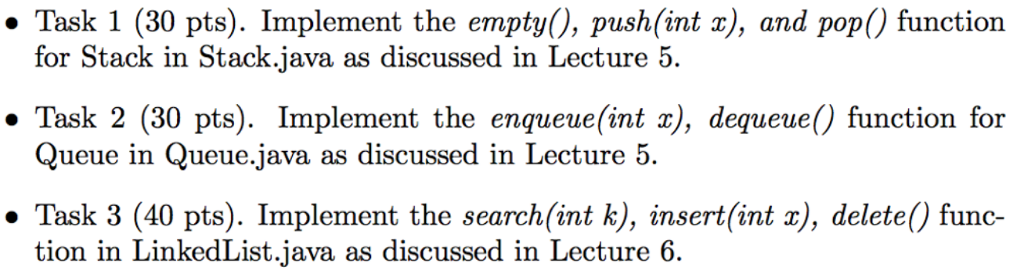
for Stack in Stack.java as discussed in Lecture 5. Queue in Queue.java as discussed in Lecture 5. tion in LinkedList.java as discussed in Lecture 6. .Task 2 (30 pts). Implement the enqueue(int v), dequeue() function for . Task 3 (40 pts). Implement the search(int k), insert(int x), delete) func
Step by Step Solution
There are 3 Steps involved in it

Get step-by-step solutions from verified subject matter experts
 Study Help