







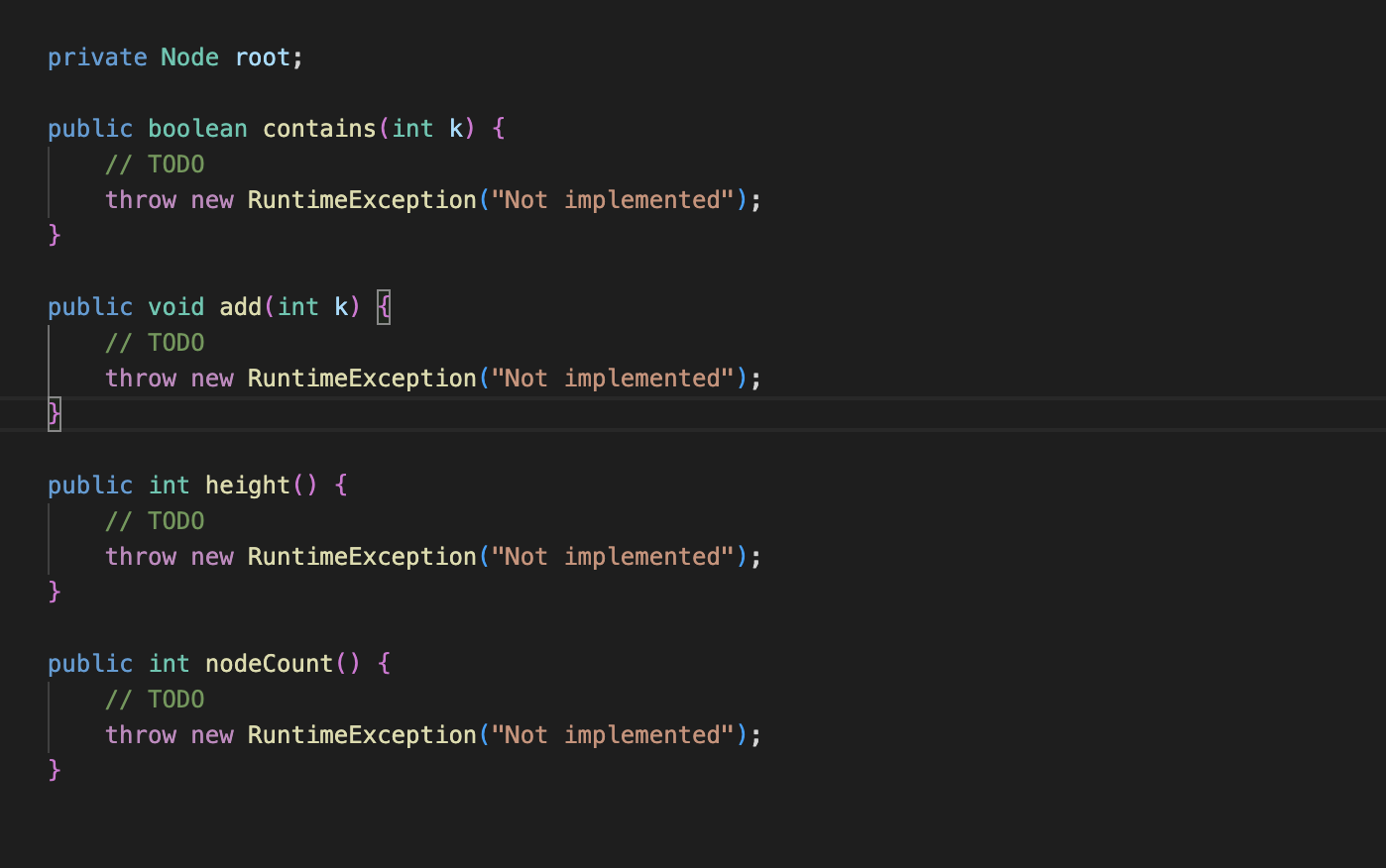
Question: package hw5; import edu.princeton.cs.algs4.Queue; public class TwoThreeTree { private class Node { private int type; // the node type. Should be 2, 3, or 4
package hw5;
import edu.princeton.cs.algs4.Queue;
public class TwoThreeTree {
private class Node {
private int type; // the node type. Should be 2, 3, or 4
private int[] keys; // the keys in this node. Only slots 0 .. type 2 are valid
private Node[] subtrees; // the children of this node. Only slots 0 .. type -1 are valid
/**
* Construct a new 2-node
* @param k0 the key for the node
* @param st0 the left child (subtree) for the node
* @param st1 the right child (subtree) for the node
*/
public Node(int k0, Node st0, Node st1) {
type = 2;
keys = new int[3];
keys[0] = k0;
subtrees = new Node[4];
subtrees[0] = st0;
subtrees[1] = st1;
}
/**
* Create an empty node
* This constructor can be used if an emtpy node needs to be created
* that whose keys, children, and type will be set later.
* The type is set to -1 to mark it as an invalid node
*/
public Node() {
type = -1;
keys = new int[3];
subtrees = new Node[4];
}
}
/**
* Construct an empty 2-3 tree.
*/
public TwoThreeTree() {
root = null;
}
/**
* Construct a 2-3 tree given when given the keys in level order.
* A comma separates the nodes. A space separates two keys when they appear in the same node.
* For example, the level order "40 50,25,47,61 72" would produce the tree:
*
* (40 50)
* / | \
* (25) (47) (61 72)
* @param s the level order traversal of the tree.
*/
public TwoThreeTree(String s) {
if (s.length() > 0) {
String[] nodeStrings = s.split(",");
Queue
String[] keys = nodeStrings[0].split(" ");
root = new Node();
root.keys[0] = Integer.parseInt(keys[0]);
root.type = 2;
if (keys.length > 1) {
root.keys[1] = Integer.parseInt(keys[1]);
root.type = 3;
}
q.enqueue(root);
int i = 1;
while (i
Node n = q.dequeue();
for(int k = 0; k
Node newNode = new Node();
keys = nodeStrings[i++].split(" ");
newNode.keys[0] = Integer.parseInt(keys[0]);
newNode.type = 2;
if (keys.length > 1) {
newNode.keys[1] = Integer.parseInt(keys[1]);
newNode.type = 3;
}
q.enqueue(newNode);
n.subtrees[k] = newNode;
}
}
}
}
![type; // the node type. Should be 2, 3, or 4private int[]](https://dsd5zvtm8ll6.cloudfront.net/si.experts.images/questions/2024/09/66f83794a87b2_18866f837946bdc0.jpg)
![2 are validprivate Node[] subtrees; // the children of this node. Only](https://dsd5zvtm8ll6.cloudfront.net/si.experts.images/questions/2024/09/66f83795a7c1f_18966f8379577dba.jpg)
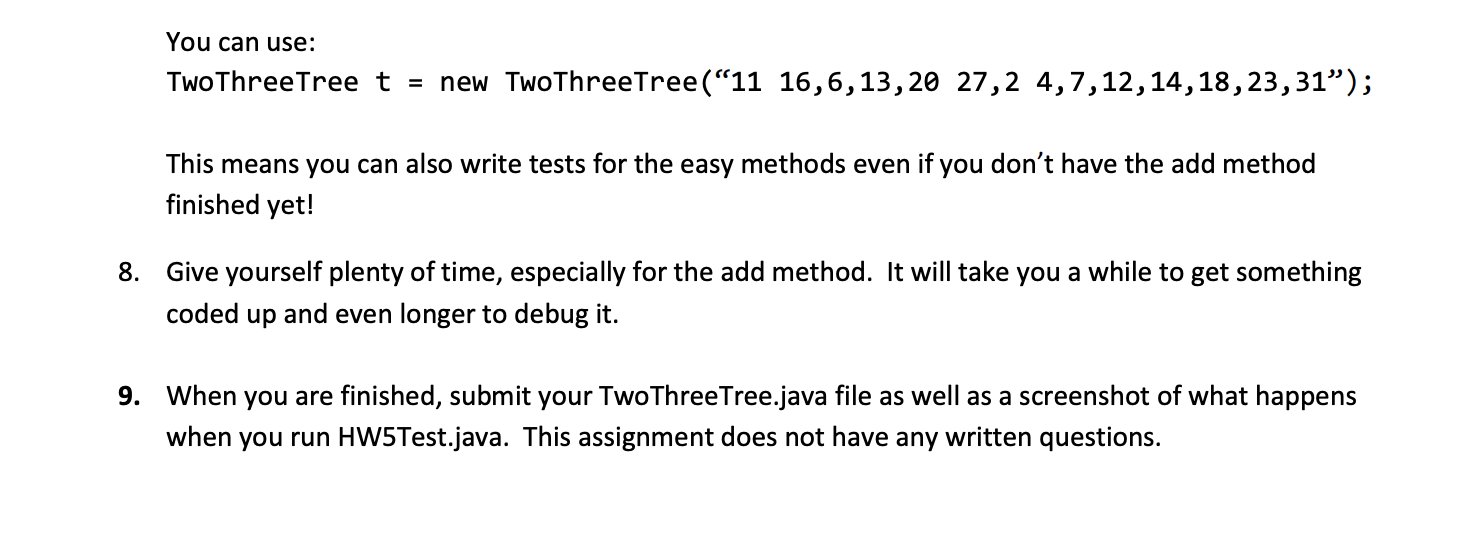
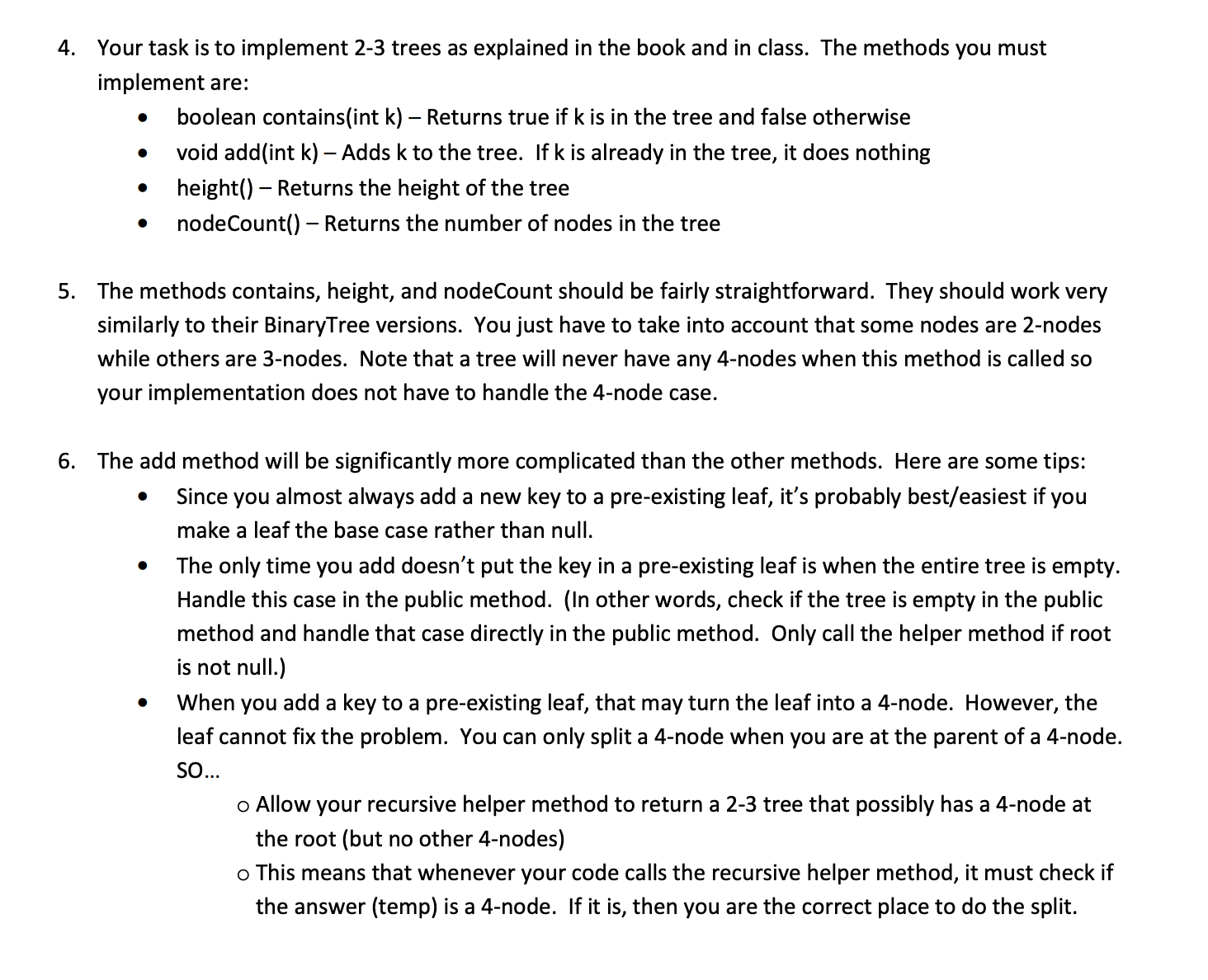
private Node root; public boolean contains (int k) { / / TODO throw new RuntimeException ("Not implemented" ) ; public void add (int k) / / TODO throw new RuntimeException ("Not implemented" ) ; public int height( ) { / / TODO throw new RuntimeException ("Not implemented" ) ; public int nodeCount( ) { / / TODO throw new RuntimeException ("Not implemented" ) ;* A method for testing. * Returns true if {@code this} tree and {@code otherTree} are identical * (i. e. have the same keys in the same positions). * @param otherTree the tree to compare against * @return {@code true} if {@code this} tree and {@code otherTree} are identical * / public boolean identical (TwoThreeTree otherTree) { return identicalH(this . root, otherTree. root) ; private boolean identicalH(Node thisNode, Node otherNode) { if (thisNode == null && otherNode == null) return true; if ( thisNode == null | | otherNode == null) return false; if ( thisNode. type != otherNode. type) return false; for(int i = 0; i
Step by Step Solution
There are 3 Steps involved in it

Get step-by-step solutions from verified subject matter experts
 Study Help