Question: page 1- write a 25 -word summary page 2- write a 25 -word summary page 4- Summarize your understanding of how to use Student Planning
page 1- write a 25 -word summary
page 2- write a 25 -word summary
page 4- Summarize your understanding of how to use Student Planning and how it can help you to achieve academic success 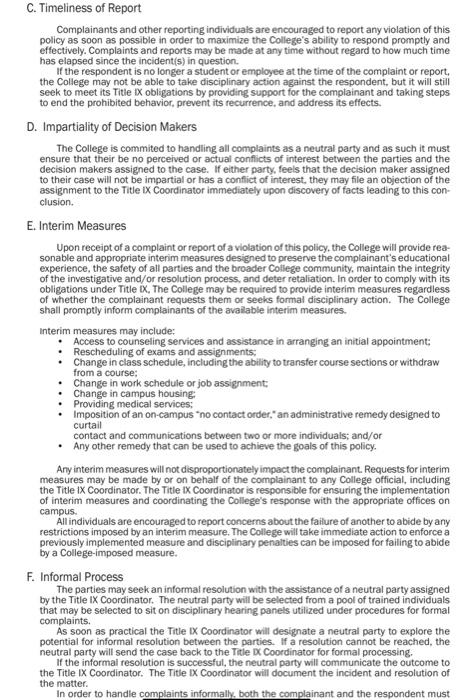
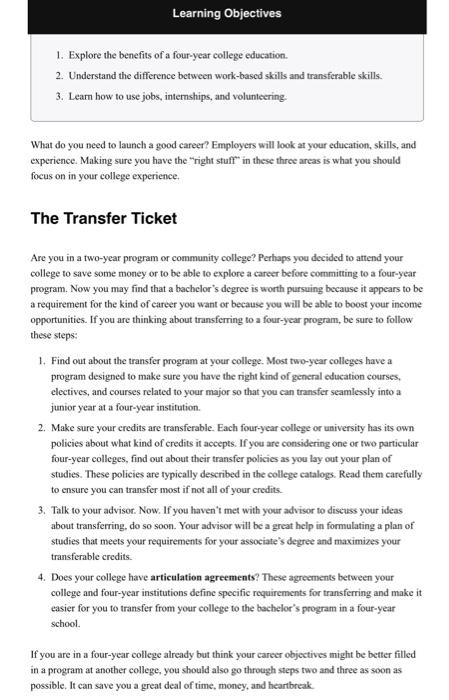
C. Timeliness of Report Complainants and other reporting individuals are encouraged to report any violation of this policy as soon as possible in order to maximize the College's ability to respond promptly and effectively. Complaints and reports may be made at any time without regard to how much time has elapsed since the incident(s) in question. If the respondent is no longer a student or employee at the time of the complaint or report, the College may not be able to take disciplinary action against the respondent, but it will still seek to meet its Title IX obligations by providing support for the complainant and taking steps to end the prohibited behavior, prevent its recurrence, and address its effects. D. Impartiality of Decision Makers The College is commited to handling all complaints as a neutral party and as such it must ensure that their be no perceived or actual conflicts of interest between the parties and the decision makers assigned to the case. If either party, feels that the decision maker assigned to their case will not be impartial or has a conflict of interest, they may file an objection of the assignment to the Title IX Coordinator immediately upon discovery of facts leading to this con- clusion. curtail E. Interim Measures Upon receipt of a complaint or report of a violation of this policy. the College will provide rea sonable and appropriate interim measures designed to preserve the complainant's educational experience, the safety of all parties and the broader College community, maintain the integrity of the investigative and/or resolution process, and deter retaliation. In order to comply with its obligations under Title IX, The College may be required to provide interim measures regardless of whether the complainant requests them or seeks formal disciplinary action. The College shall promptly inform complainants of the available interim measures. Interim measures may include: Access to counseling services and assistance in arranging an initial appointment: Change in class schedule, including the ability to transfer course sections or withdraw from a course: Change in work schedule or job assignment Change in campus housing Providing medical services: Imposition of an on-campus no contact order, an administrative remedy designed to contact and communications between two or more individuals; and/or Any other remedy that can be used to achieve the goals of this policy. Any interim measures will not disproportionately impact the complainant. Requests for interim measures may be made by or on behalf of the complainant to any College official, including the Title IX Coordinator. The Title IX Coordinator is responsible for ensuring the implementation of interim measures and coordinating the College's response with the appropriate offices on campus. All individuals are encouraged to report concerns about the failure of another to abide by any restrictions imposed by an interim measure. The College will take immediate action to enforce a previously implemented measure and disciplinary penalties can be imposed for failing to abide by a College-imposed measure. F. Informal Process The parties may seek an informal resolution with the assistance of a neutral party assigned by the Title IX Coordinator. The neutral party will be selected from a pool of trained individuals that may be selected to sit on disciplinary hearing panels utilized under procedures for formal complaints. As soon as practical the Title IX Coordinator will designate a neutral party to explore the potential for informal resolution between the parties. If a resolution cannot be reached, the neutral party will send the case back to the Title DX Coordinator for formal processing, If the informal resolution is successful, the neutral party will communicate the outcome to the Title IX Coordinator. The Title IX Coordinator will document the incident and resolution of the matter. In order to handle complaints informally, both the complainant and the respondent must Learning Objectives 1. Explore the benefits of a four-year college education 2. Understand the difference between work-based skills and transferable skills. 3. Learn how to use jobs, internships, and volunteering What do you need to launch a good career? Employers will look at your education, skills, and experience. Making sure you have the right stuff" in these three areas is what you should focus on in your college experience. The Transfer Ticket Are you in a two-year program or community college? Perhaps you decided to attend your college to save some money or to be able to explore a career before committing to a four-year program. Now you may find that a bachelor's degree is worth pursuing because it appears to be a requirement for the kind of career you want or because you will be able to boost your income opportunities. If you are thinking about transferring to a four-year program, be sure to follow these steps: 1. Find out about the transfer program at your college. Most two-year colleges have a program designed to make sure you have the right kind of general education courses, clectives, and courses related to your major so that you can transfer seamlessly into a junior year at a four-year institution. 2. Make sure your credits are transferable. Each four-year college or university has its own policies about what kind of credits it accepts. If you are considering one or two particular four-year colleges, find out about their transfer policies as you lay out your plan of studies. These policies are typically described in the college catalogs. Read them carefully to ensure you can transfer most if not all of your credits 3. Talk to your advisor. Now. If you haven't met with your advisor to discuss your ideas about transferring, do so soon. Your advisor will be a great help in formulating a plan of studies that meets your requirements for your associate's degree and maximizes your transferable credits 4. Does your college have articulation agreements? These agreements between your college and four-year institutions define specific requirements for transferring and make it easier for you to transfer from your college to the bachelor's program in a four-year school. If you are in a four-year college already but think your career objectives might be better filled in a program at another college, you should also go through steps two and three as soon as possible. It can save you a great deal of time, money, and heartbreak









 Study Help