







Question: page 65 attached p. 65 CHAPTER 3 GENERATING AND EXPLOITING NEW ENTRIES emerging industries Industries that have been newly formed and are growing first mover
page 65 attached
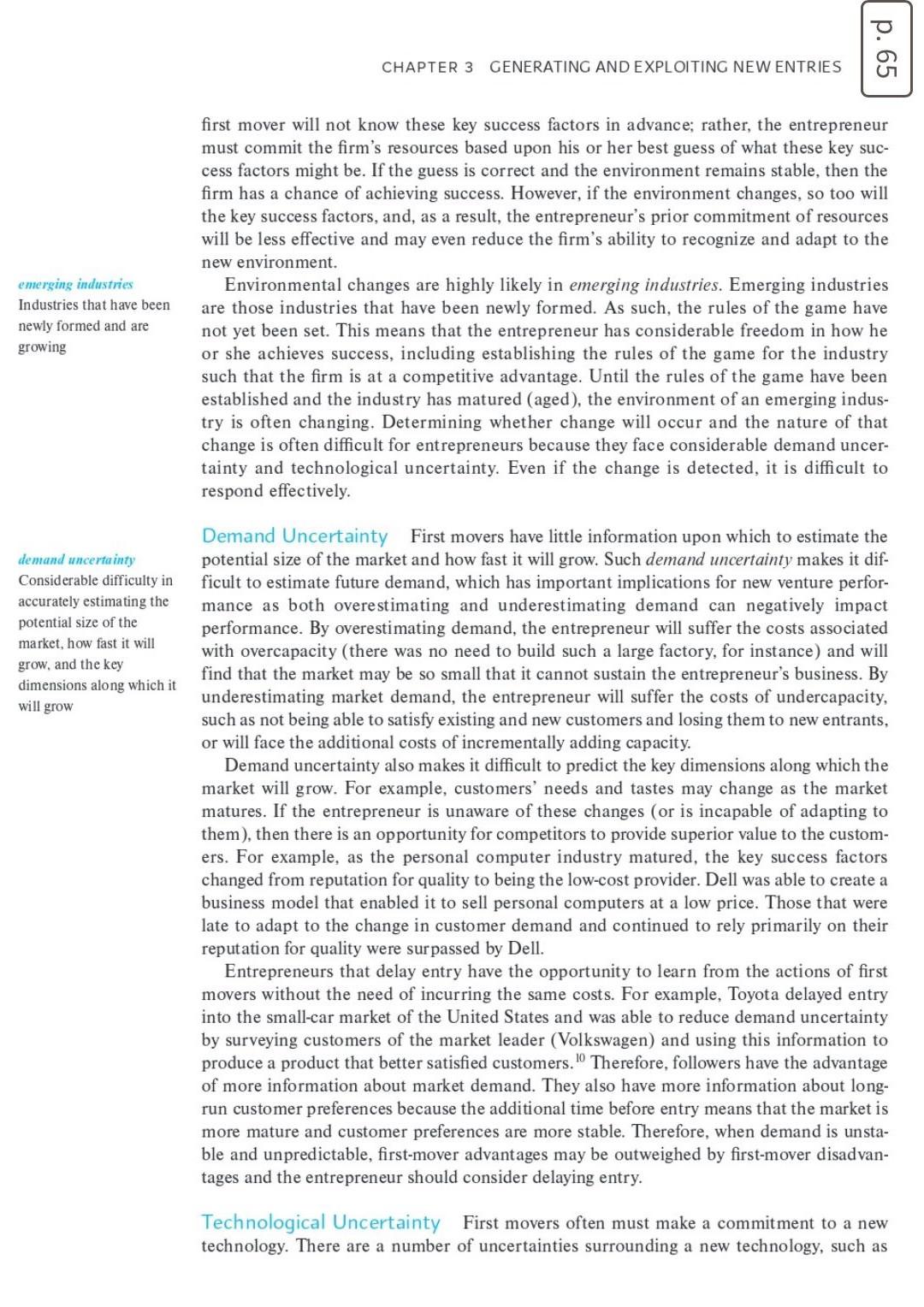
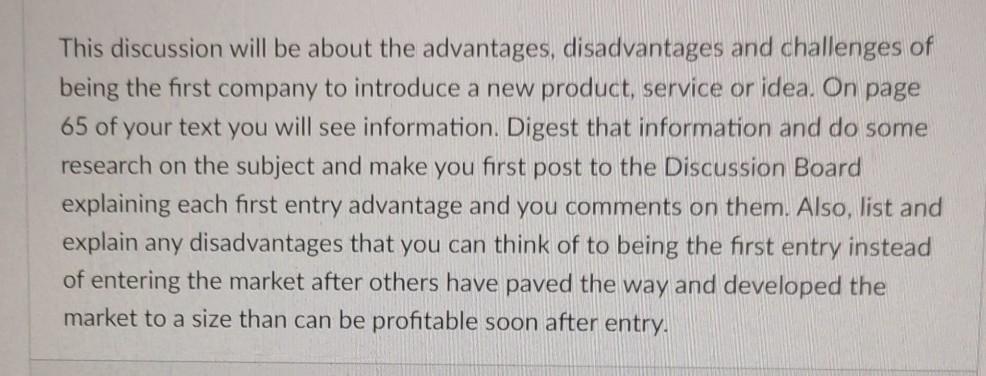
p. 65 CHAPTER 3 GENERATING AND EXPLOITING NEW ENTRIES emerging industries Industries that have been newly formed and are growing first mover will not know these key success factors in advance; rather, the entrepreneur must commit the firm's resources based upon his or her best guess of what these key suc- cess factors might be. If the guess is correct and the environment remains stable, then the firm has a chance of achieving success. However, if the environment changes, so too will the key success factors, and, as a result, the entrepreneur's prior commitment of resources will be less effective and may even reduce the firm's ability to recognize and adapt to the new environment. Environmental changes are highly likely in emerging industries. Emerging industries are those industries that have been newly formed. As such, the rules of the game have not yet been set. This means that the entrepreneur has considerable freedom in how he or she achieves success, including establishing the rules of the game for the industry such that the firm is at a competitive advantage. Until the rules of the game have been established and the industry has matured (aged), the environment of an emerging indus- try is often changing. Determining whether change will occur and the nature of that change is often difficult for entrepreneurs because they face considerable demand uncer- tainty and technological uncertainty. Even if the change is detected, it is difficult to respond effectively. demand uncertainty Considerable difficulty in accurately estimating the potential size of the market, how fast it will grow, and the key dimensions along which it will grow Demand Uncertainty First movers have little information upon which to estimate the potential size of the market and how fast it will grow. Such demand uncertainty makes it dif- ficult to estimate future demand, which has important implications for new venture perfor- mance as both overestimating and underestimating demand can negatively impact performance. By overestimating demand, the entrepreneur will suffer the costs associated with overcapacity (there was no need to build such a large factory, for instance) and will find that the market may be so small that it cannot sustain the entrepreneur's business. By underestimating market demand, the entrepreneur will suffer the costs of undercapacity, such as not being able to satisfy existing and new customers and losing them to new entrants, or will face the additional costs of incrementally adding capacity. Demand uncertainty also makes it difficult to predict the key dimensions along which the market will grow. For example, customers' needs and tastes may change as the market matures. If the entrepreneur is unaware of these changes (or is incapable of adapting to them), then there is an opportunity for competitors to provide superior value to the custom- ers. For example, as the personal computer industry matured, the key success factors changed from reputation for quality to being the low-cost provider. Dell was able to create a business model that enabled it to sell personal computers at a low price. Those that were late to adapt to the change in customer demand and continued to rely primarily on their reputation for quality were surpassed by Dell. Entrepreneurs that delay entry have the opportunity to learn from the actions of first movers without the need of incurring the same costs. For example, Toyota delayed entry into the small-car market of the United States and was able to reduce demand uncertainty by surveying customers of the market leader (Volkswagen) and using this information to produce a product that better satisfied customers. Therefore, followers have the advantage of more information about market demand. They also have more information about long- run customer preferences because the additional time before entry means that the market is more mature and customer preferences are more stable. Therefore, when demand is unsta- ble and unpredictable, first-mover advantages may be outweighed by first-mover disadvan- tages and the entrepreneur should consider delaying entry. Technological Uncertainty First movers often must make a commitment to a new technology. There are a number of uncertainties surrounding a new technology, such as This discussion will be about the advantages, disadvantages and challenges of being the first company to introduce a new product, service or idea. On page 65 of your text you will see information. Digest that information and do some research on the subject and make you first post to the Discussion Board explaining each first entry advantage and you comments on them. Also, list and explain any disadvantages that you can think of to being the first entry instead of entering the market after others have paved the way and developed the market to a size than can be profitable soon after entry
Step by Step Solution
There are 3 Steps involved in it

Get step-by-step solutions from verified subject matter experts
 Study Help