







Question: + [ Page view A Read aloud T Add text Draw 1. CONSUMER DEMAND. Consider a rational consumer that consumes two goods, 1 and x2.
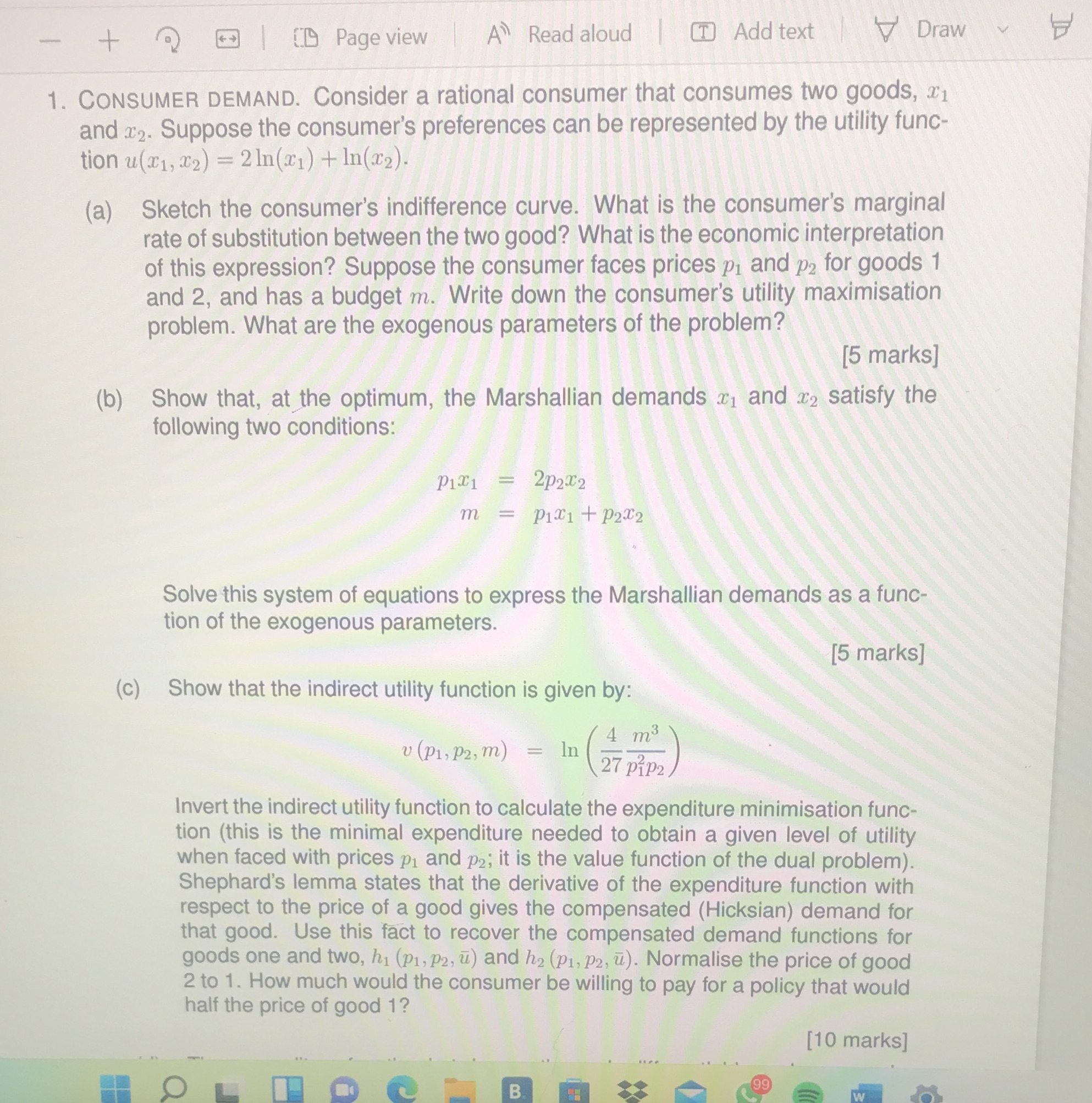
+ [ Page view A Read aloud T Add text Draw 1. CONSUMER DEMAND. Consider a rational consumer that consumes two goods, 1 and x2. Suppose the consumer's preferences can be represented by the utility func- tion u(X1, X2) = 2In(x1) + In(x2). (a) Sketch the consumer's indifference curve. What is the consumer's marginal rate of substitution between the two good? What is the economic interpretation of this expression? Suppose the consumer faces prices pi and p2 for goods 1 and 2, and has a budget m. Write down the consumer's utility maximisation problem. What are the exogenous parameters of the problem? [5 marks] (b) Show that, at the optimum, the Marshallian demands x, and x2 satisfy the following two conditions: PIT1 = 2p20'2 m = Pixi +P202 Solve this system of equations to express the Marshallian demands as a func- tion of the exogenous parameters. [5 marks] (c) Show that the indirect utility function is given by: v (P1, P2, m) = In 4 m 3 27 pip2 Invert the indirect utility function to calculate the expenditure minimisation func- tion (this is the minimal expenditure needed to obtain a given level of utility when faced with prices p1 and p2; it is the value function of the dual problem). Shephard's lemma states that the derivative of the expenditure function with respect to the price of a good gives the compensated (Hicksian) demand for that good. Use this fact to recover the compensated demand functions for goods one and two, hi (P1, P2, u) and h2 (P1, P2, u). Normalise the price of good 2 to 1. How much would the consumer be willing to pay for a policy that would half the price of good 1? [10 marks]
Step by Step Solution
There are 3 Steps involved in it

Get step-by-step solutions from verified subject matter experts
 Study Help