Paper: Construct a few page paper answering the two questions posed on page 277 The Art and Science of Leadership. And consider how you might apply the concepts from this week's readings and other materials to your own workplace. Please answer the 2 questions at the bottom of the page in the picture.
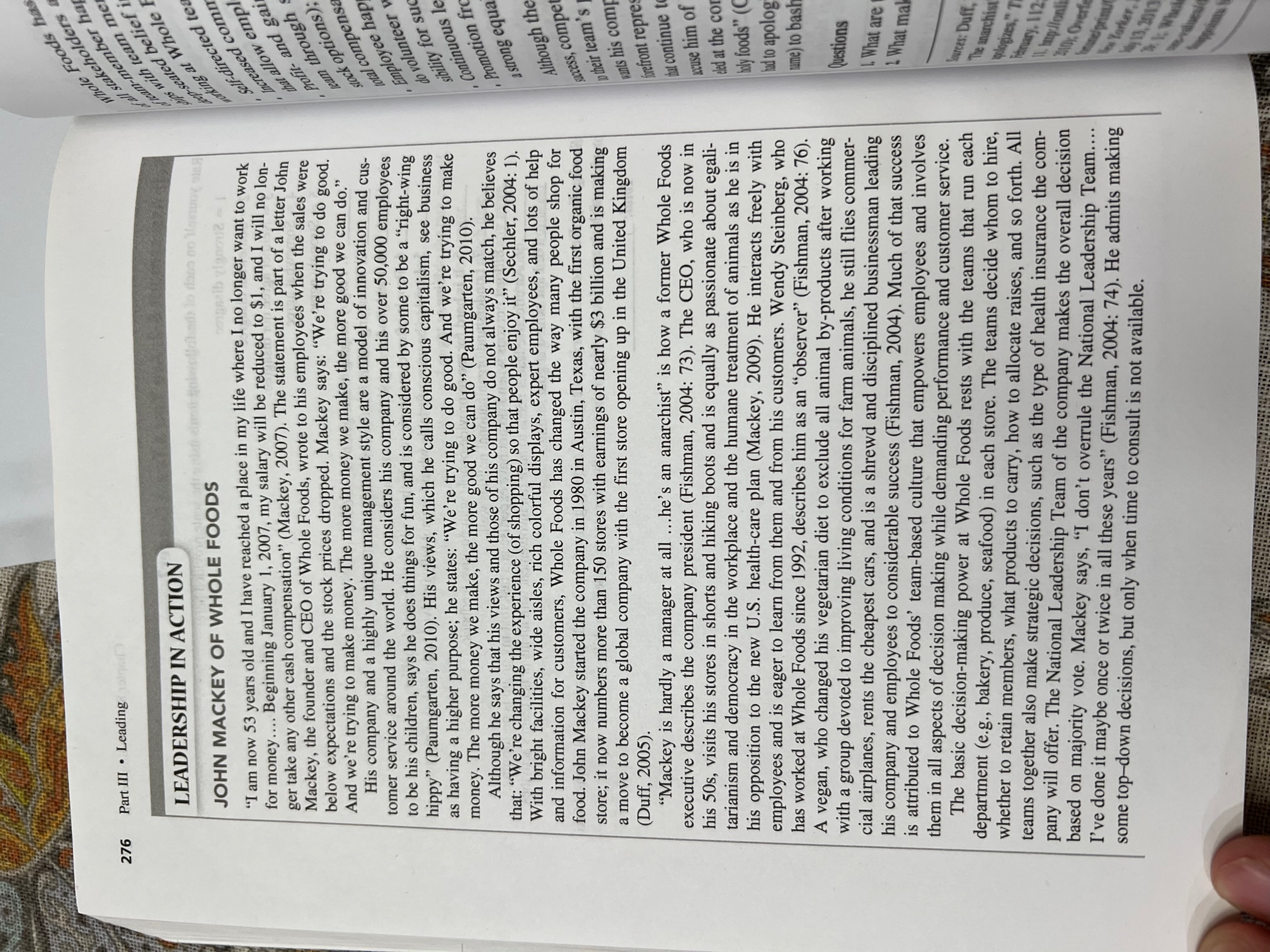
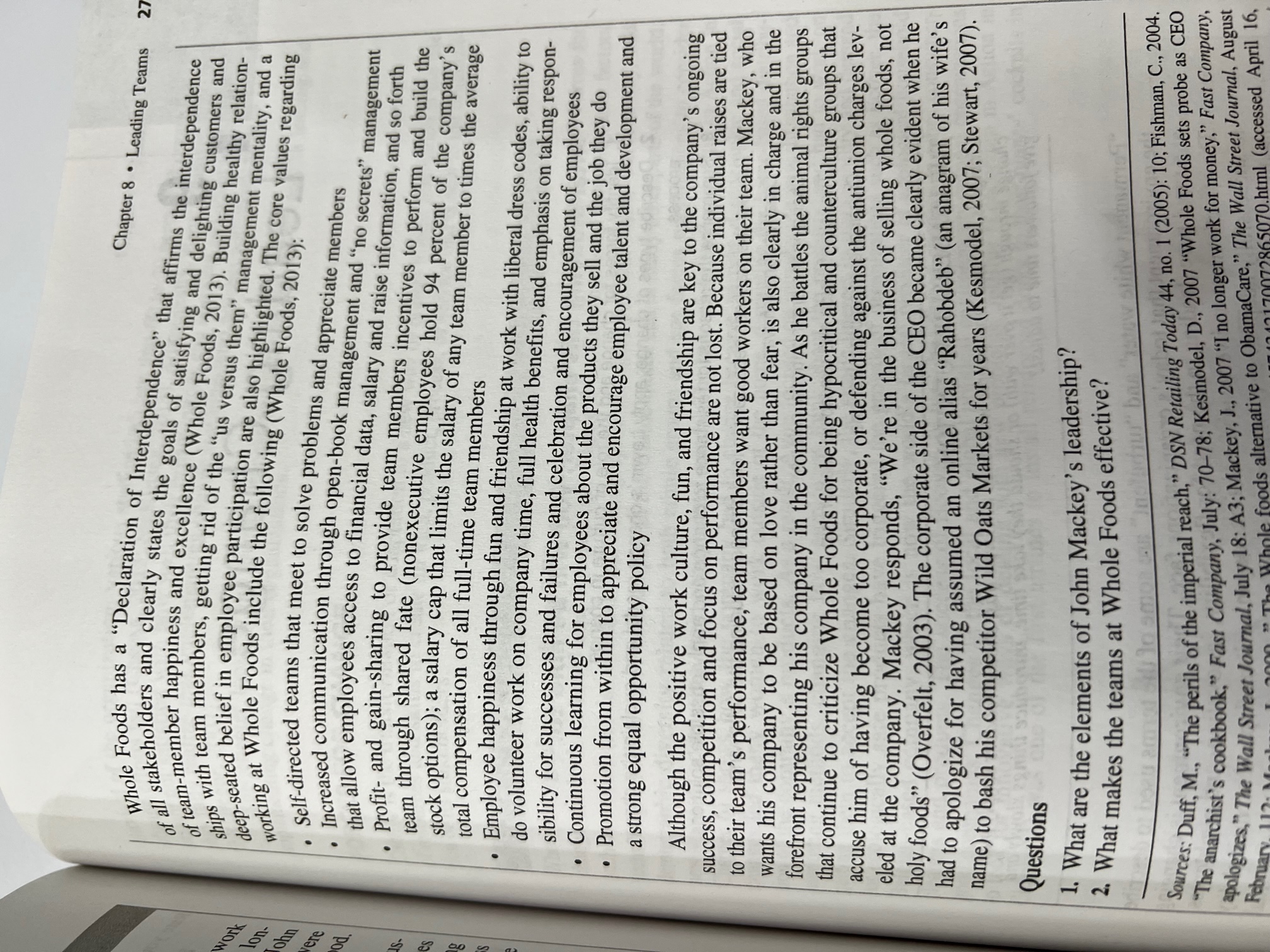
Whole Foods has fall stakeholders a team-member hap hips with team me deep-seated belief i working at Whole F Self-directed tea Increased comm that allow empl Profit- and gai through s stock options); team 276 Part III Leading te LEADERSHIP IN ACTION JOHN MACKEY OF WHOLE FOODS piwotjated to dana no Mercy osignalb vignon for money..... "I am now 53 years old and I have reached a place in my life where I no longer want to work Beginning January 1, 2007, my salary will be reduced to $1, and I will no lon- ger take any other cash compensation" (Mackey, 2007). The statement is part of a letter John Mackey, the founder and CEO of Whole Foods, wrote to his employees when the sales were below expectations and the stock prices dropped. Mackey says: "We're trying to do good. And we're trying to make money. The more money we make, the more good we can do." His company and a highly unique management style are a model of innovation and cus- tomer service around the world. He considers his company and his over 50,000 employees to be his children, says he does things for fun, and is considered by some to be a "right-wing hippy" (Paumgarten, 2010). His views, which he calls conscious capitalism, see business as having a higher purpose; he states: "We're trying to do good. And we're trying to make money. The more money we make, the more good we can do" (Paumgarten, 2010). Although he says that his views and those of his company do not always match, he believes that: "We're changing the experience (of shopping) so that people enjoy it" (Sechler, 2004: 1). With bright facilities, wide aisles, rich colorful displays, expert employees, and lots of help and information for customers, Whole Foods has changed the way many people shop for food. John Mackey started the company in 1980 in Austin, Texas, with the first organic food store; it now numbers more than 150 stores with earnings of nearly $3 billion and is making a move to become a global company with the first store opening up in the United Kingdom (Duff, 2005). "Mackey is hardly a manager at all ...he's an anarchist" is how a former Whole Foods executive describes the company president (Fishman, 2004: 73). The CEO, who is now in his 50s, visits his stores in shorts and hiking boots and is equally as passionate about egali- tarianism and democracy in the workplace and the humane treatment of animals as he is in his opposition to the new U.S. health-care plan (Mackey, 2009). He interacts freely with employees and is eager to learn from them and from his customers. Wendy Steinberg, who has worked at Whole Foods since 1992, describes him as an "observer" (Fishman, 2004: 76). A vegan, who changed his vegetarian diet to exclude all animal by-products after working with a group devoted to improving living conditions for farm animals, he still flies commer- cial airplanes, rents the cheapest cars, and is a shrewd and disciplined businessman leading his company and employees to considerable success (Fishman, 2004). Much of that success is attributed to Whole Foods' team-based culture that empowers employees and involves them in all aspects of decision making while demanding performance and customer service. The basic decision-making power at Whole Foods rests with the teams that run each department (e.g., bakery, produce, seafood) in each store. The teams decide whom to hire, whether to retain members, what products to carry, how to allocate raises, and so forth. All teams together also make strategic decisions, such as the type of health insurance the com- pany will offer. The National Leadership Team of the company makes the overall decision based on majority vote. Mackey says, "I don't overrule the National Leadership Team.... I've done maybe once or twice in all these years" (Fishman, 2004: 74). He admits making some top-down decisions, but only when time to consult is not available. total compensa Employee happ do volunteer w sibility for suc Continuous le Promotion fro a strong equa Although the success, compet to their team's wants his comp forefront repres that continue to accuse him of eled at the com holy foods" (C had to apolog name) to bash Questions L. What are 1 What mal Sources: Duff, The anarchist pologizes. T February, 1122 11.mp://onli 2010). Overfe New Yorker, 1 Whole pints work ohn od, S- 5 5 g Chapter 8 Leading Teams ships of all stakeholders and clearly states the goals of satisfying and delighting customers and Whole Foods has a "Declaration of Interdependence" that affirms the interdependence of team-member happiness and excellence (Whole Foods, 2013). Building healthy relation- working at Whole Foods include the following (Whole Foods, 2013): with team members, getting rid of the "us versus them" management mentality, and a deep-seated belief in employee participation are also highlighted. The core values regarding that allow employees Self-directed teams that meet to solve problems and appreciate members Increased communication through open-book management and "no secrets" management access to financial data, salary and raise information, and so forth Profit- and gain-sharing to provide team members incentives to perform and build the team through shared fate (nonexecutive employees hold 94 percent of the company's total compensation of all full-time team members stock options); a salary cap that limits the salary of any team member to times the average Employee happiness through fun and friendship at work with liberal dress codes, ability to do volunteer work on company time, full health benefits, and emphasis on taking respon- sibility for successes and failures and celebration and encouragement of employees Continuous learning for employees about the products they sell and the job they do a strong equal opportunity policy Promotion from within to appreciate and encourage employee talent and development and Although the positive work culture, fun, and friendship are key to the company's ongoing success, competition and focus on performance are not lost. Because individual raises are tied to their team's performance, team members want good workers on their team. Mackey, who wants his company to be based on love rather than fear, is also clearly in charge and in the forefront representing his company in the community. As he battles the animal rights groups that continue to criticize Whole Foods for being hypocritical and counterculture groups that accuse him of having become too corporate, or defending against the antiunion charges lev- eled at the company. Mackey responds, "We're in the business of selling whole foods, not holy foods" (Overfelt, 2003). The corporate side of the CEO became clearly evident when he had to apologize for having assumed an online alias "Rahobdeb" (an anagram of his wife's name) to bash his competitor Wild Oats Markets for years (Kesmodel, 2007; Stewart, 2007). sing Questions . What are the elements of John Mackey's leadership? 2. What makes the teams at Whole Foods effective? dur" bas sillo Sources: Duff, M., "The perils of the imperial reach," DSN Retailing Today 44, no. 1 (2005): 10; Fishman, C., 2004. "The anarchist's cookbook," Fast Company, July: 70-78; Kesmodel, D., 2007 "Whole Foods sets probe as CEO apologizes," The Wall Street Journal, July 18: A3; Mackey, J., 2007 "I no longer work for money," Fast Company, hole foods alternative to ObamaCare," The Wall Street Journal, August 70072865070.html (accessed April 16, Februar 27




