







Question: Paper Mall, Inc., is evaluating another proposed project, Project Peter, which lasts 3 years. The project is riskier than the average project for this firm.
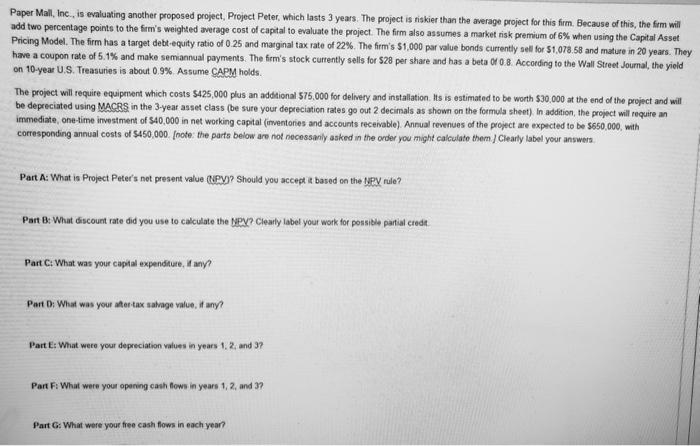
Paper Mall, Inc., is evaluating another proposed project, Project Peter, which lasts 3 years. The project is riskier than the average project for this firm. Because of this, the firm will add two percentage points to the firm's weighted average cost of capital to evaluate the project. The firm also assumes a market risk premium of 6% when using the Capital Asset Pricing Model. The firm has a target debt-equity ratio of 0.25 and marginal tax rate of 22%. The firm's 51,000 par value bonds currently sell for 51,078,58 and mature in 20 years. They have a coupon rate of 5.1% and make semiannual payments. The firm's stock currently sells for $28 per share and has a beta or 08. According to the Wall Street Joumal, the yield on 10-year U.S. Treasuries is about 0.9% Assume CAPM holds The project will require equipment which costs $425,000 plus an additional 575,000 for delivery and installation. Its is estimated to be worth $30,000 at the end of the project and will be depreciated using MACRS in the 3-year asset class (be sure your depreciation rates go out 2 decimals as shown on the formula sheet) In addition, the project will require an immediate, one time investment of S40,000 in net working capital (rwentories and accounts receivable). Annual revenues of the project are expected to be $650,000, with corresponding annual costs of 5450,000. (note the parts below are not necessarily asked in the order you might calculate them) Clearly label your answers Part A: What is Project Peter's not present value (NPV? Should you accept it based on the NPV rule? Part B: What discount rate did you use to calculate the Ney? Chewly label your work for possible partial credit Part C: What was your capital expenditure. If any? Part D: What was your her tax salvage value, if any Parte: What were your depreciation values in years 1.2 and 3? Part F: What were your oppring cash flows in years 1, 2 and 3? Part G: What were your free cash flows in each year
Step by Step Solution
There are 3 Steps involved in it

Get step-by-step solutions from verified subject matter experts
 Study Help