







Question: Par and face value mean the same thing - most likely par value though. Using semiannual compounding, find the prices of the following bonds: a.
Par and face value mean the same thing - most likely par value though.
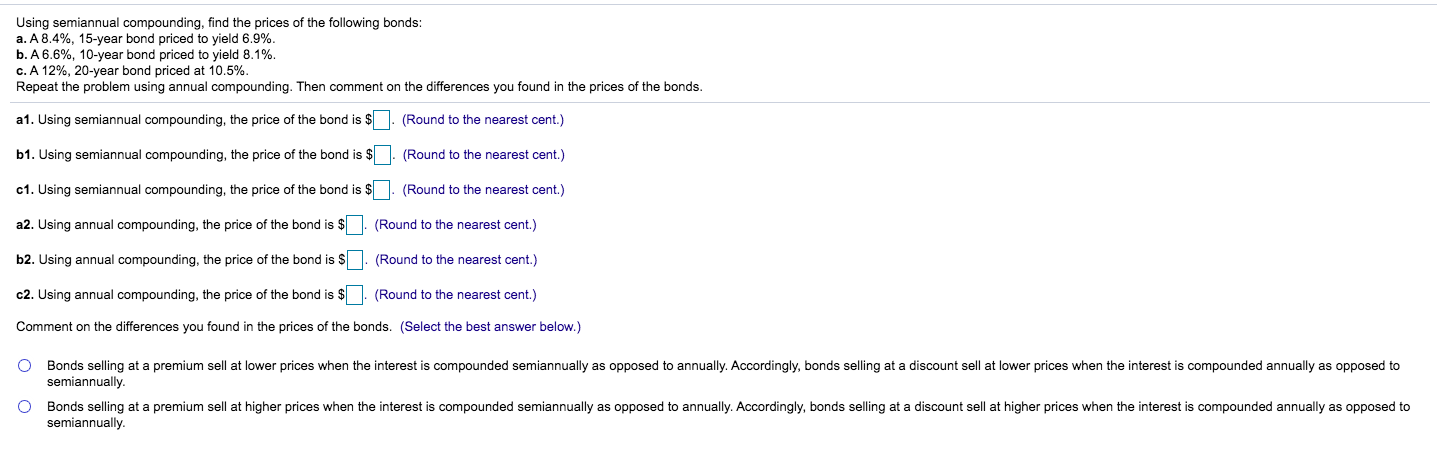
Using semiannual compounding, find the prices of the following bonds: a. A 8.4%, 15-year bond priced to yield 6.9%. b. A 6.6%, 10-year bond priced to yield 8.1%. c. A 12%, 20-year bond priced at 10.5%. Repeat the problem using annual compounding. Then comment on the differences you found in the prices of the bonds. a1. Using semiannual compounding, the price of the bond is $ (Round to the nearest cent.) b1. Using semiannual compounding, the price of the bond is $ . (Round to the nearest cent.) c1. Using semiannual compounding, the price of the bond is $. (Round to the nearest cent.) a2. Using annual compounding, the price of the bond is $17. (Round to the nearest cent.) b2. Using annual compounding, the price of the bond is $ . (Round to the nearest cent.) c2. Using annual compounding, the price of the bond is $ (Round to the nearest cent.) Comment on the differences you found in the prices of the bonds. (Select the best answer below.) O Bonds selling at a premium sell at lower prices when the interest is compounded semiannually as opposed to annually. Accordingly, bonds selling at a discount sell at lower prices when the interest is compounded annually as opposed to semiannually. O Bonds selling at a premium sell at higher prices when the interest is compounded semiannually as opposed to annually. Accordingly, bonds selling at a discount sell at higher prices when the interest is compounded annually as opposed to semiannually
Step by Step Solution
There are 3 Steps involved in it

Get step-by-step solutions from verified subject matter experts
 Study Help