







Question: Paragrah - 1 Affective computing is an interdisciplinary umbrella that comprises systems that recognize, interpret, process or simulate human feeling, emotion and mood. For example,
Paragrah
Affective computing is an interdisciplinary umbrella that comprises systems that recognize, interpret, process or simulate human feeling, emotion and mood. For example, some virtual assistants are programmed to speak conversationally or even to banter humorously; it makes them appear more sensitive to the emotional dynamics of human interaction, or to otherwise facilitate humancomputer interaction. However, this tends to give nave users an unrealistic conception of how intelligent existing computer agents actually are. Moderate successes related to affective computing include textual sentiment analysis and, more recently, multimodal sentiment analysis, wherein AI classifies the affects displayed by a videotaped subject
Paragrah
The simplest AI applications can be divided into two types: classifiers egif shiny then diamond" on one hand, and controllers egif diamond then pick up on the other hand. Classifiers are functions that use pattern matching to determine the closest match. They can be finetuned based on chosen examples using supervised learning. Each pattern also called an "observation" is labeled with a certain predefined class. All the observations combined with their class labels are known as a data set. When a new observation is received, that observation is classified based on previous experience.
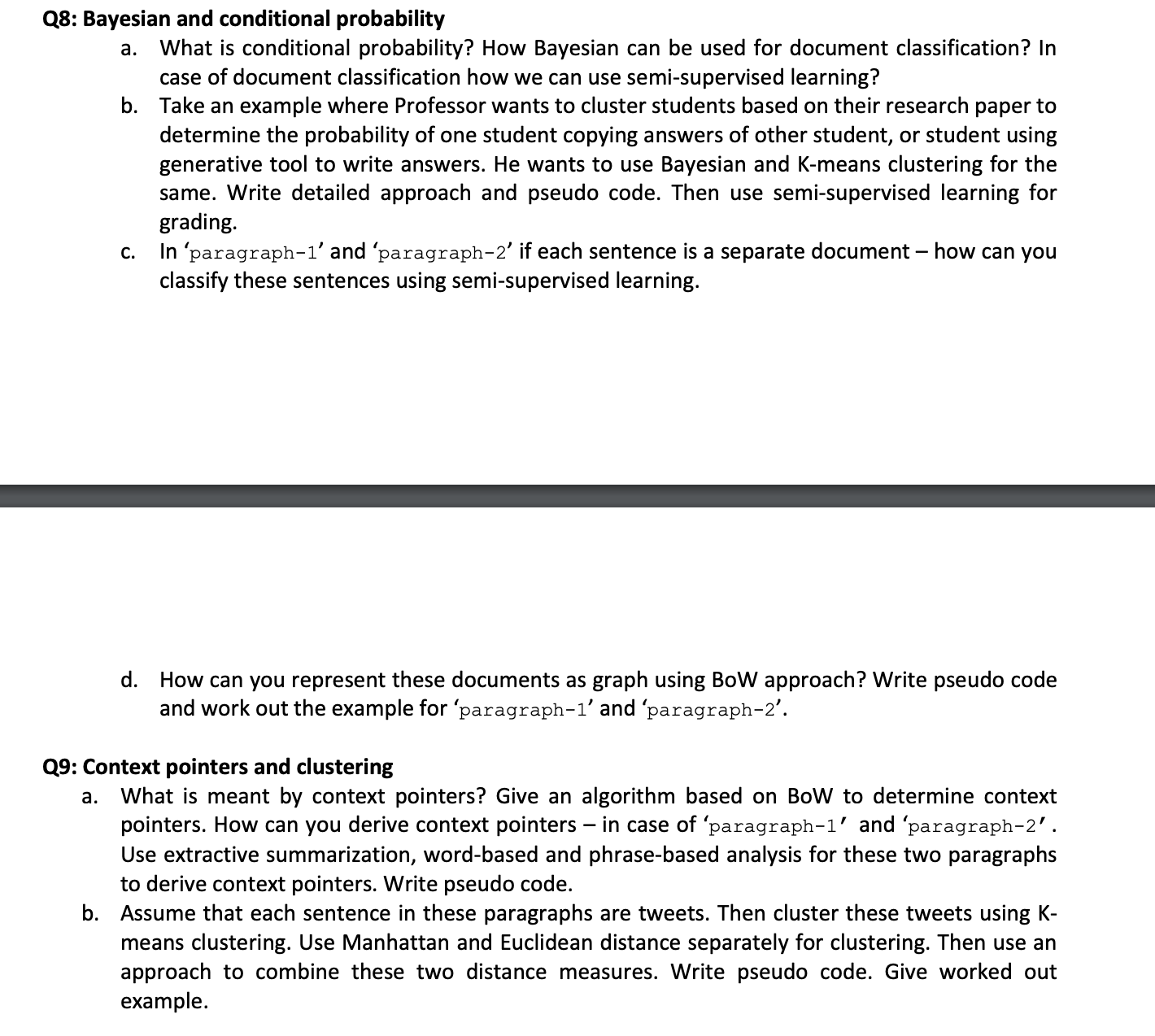
Q: Bayesian and conditional probability
a What is conditional probability? How Bayesian can be used for document classification? In
case of document classification how we can use semisupervised learning?
b Take an example where Professor wants to cluster students based on their research paper to
determine the probability of one student copying answers of other student, or student using
generative tool to write answers. He wants to use Bayesian and Kmeans clustering for the
same. Write detailed approach and pseudo code. Then use semisupervised learning for
grading.
c In 'paragraph and 'paragraph if each sentence is a separate document how can you
classify these sentences using semisupervised learning.
d How can you represent these documents as graph using BoW approach? Write pseudo code
and work out the example for 'paragraph and 'paragraph
Q: Context pointers and clustering
a What is meant by context pointers? Give an algorithm based on BoW to determine context
pointers. How can you derive context pointers in case of 'paragraph and 'paragraph
Use extractive summarization, wordbased and phrasebased analysis for these two paragraphs
to derive context pointers. Write pseudo code.
b Assume that each sentence in these paragraphs are tweets. Then cluster these tweets using K
means clustering. Use Manhattan and Euclidean distance separately for clustering. Then use an
approach to combine these two distance measures. Write pseudo code. Give worked out example.
Step by Step Solution
There are 3 Steps involved in it
1 Expert Approved Answer
Step: 1 Unlock

Question Has Been Solved by an Expert!
Get step-by-step solutions from verified subject matter experts
Step: 2 Unlock
Step: 3 Unlock
 Study Help