Question: Paragraph comment feedback on Johnathan's discussion post This policy establishes the standards for secure remote access to Red Clay Renovations' information systems, e.g., teleworker access
Paragraph comment feedback on Johnathan's discussion post
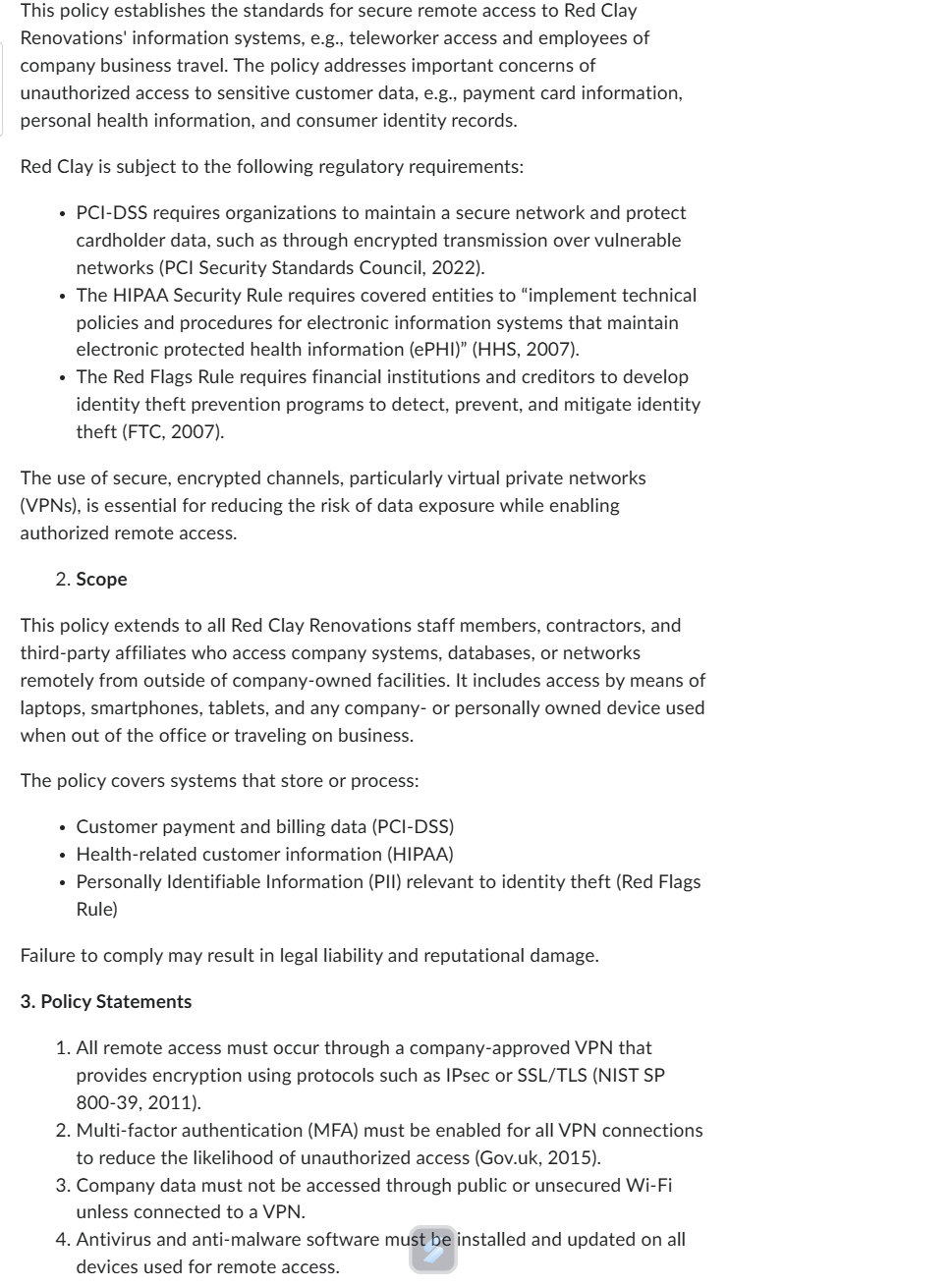
This policy establishes the standards for secure remote access to Red Clay Renovations' information systems, e.g., teleworker access and employees of company business travel. The policy addresses important concerns of unauthorized access to sensitive customer data, e.g., payment card information, personal health information, and consumer identity records. Red Clay is subject to the following regulatory requirements: PCI-DSS requires organizations to maintain a secure network and protect cardholder data, such as through encrypted transmission over vulnerable networks (PCI Security Standards Council, 2022). The HIPAA Security Rule requires covered entities to \"implement technical policies and procedures for electronic information systems that maintain electronic protected health information (ePHI)\" (HHS, 2007). The Red Flags Rule requires financial institutions and creditors to develop identity theft prevention programs to detect, prevent, and mitigate identity theft (FTC, 2007). The use of secure, encrypted channels, particularly virtual private networks (VPNs), is essential for reducing the risk of data exposure while enabling authorized remote access. 2. Scope This policy extends to all Red Clay Renovations staff members, contractors, and third-party affiliates who access company systems, databases, or networks remotely from outside of company-owned facilities. It includes access by means of laptops, smartphones, tablets, and any company- or personally owned device used when out of the office or traveling on business. The policy covers systems that store or process: * Customer payment and billing data (PCI-DSS) * Health-related customer information (HIPAA) * Personally Identifiable Information (Pll) relevant to identity theft (Red Flags Rule) Failure to comply may result in legal liability and reputational damage. 3. Policy Statements 1. All remote access must occur through a company-approved VPN that provides encryption using protocols such as IPsec or SSL/TLS (NIST SP 800-39, 2011). 2. Multi-factor authentication (MFA) must be enabled for all VPN connections to reduce the likelihood of unauthorized access (Gov.uk, 2015). 3. Company data must not be accessed through public or unsecured Wi-Fi unless connected to a VPN. 4. Antivirus and anti-malware software must be installed and updated on all devices used for remote access