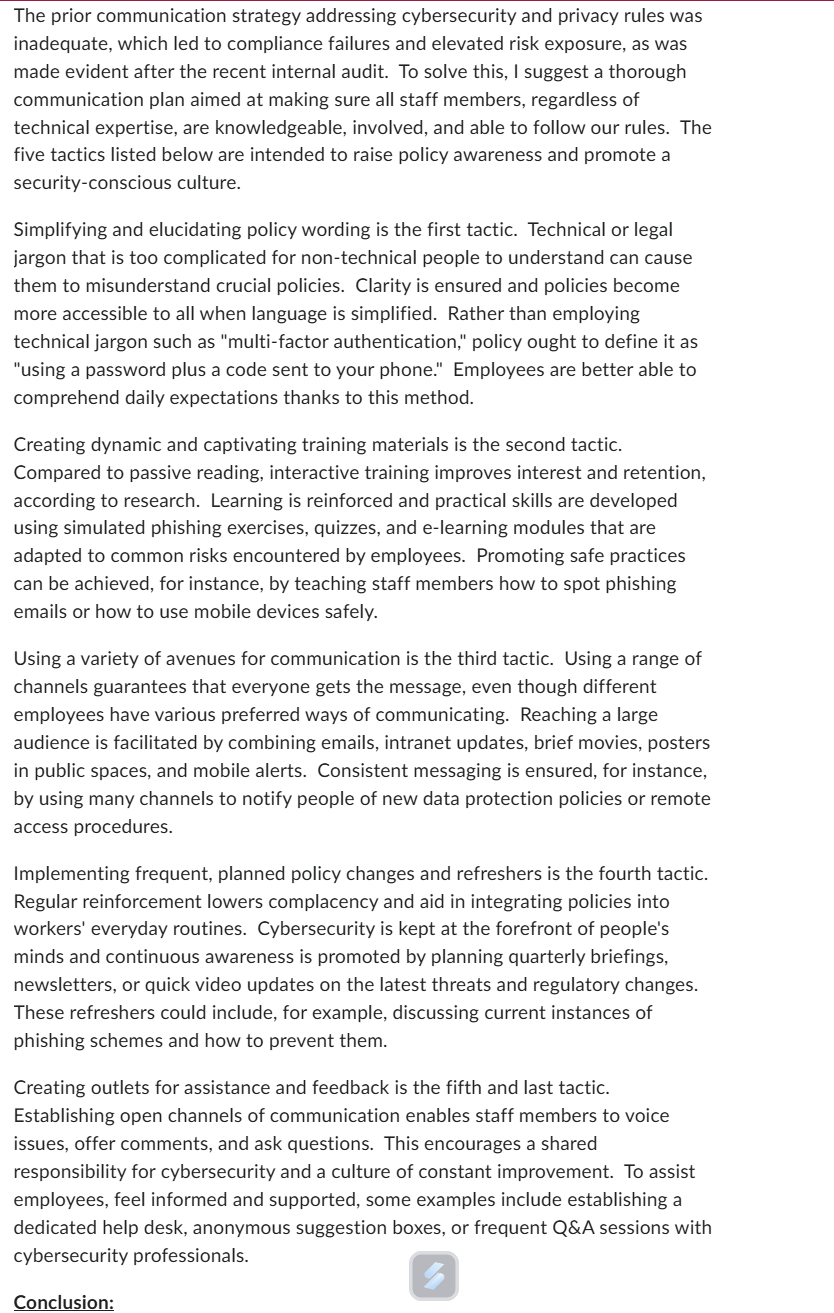
Question: Paragraph feedback comment to Jane's discussion post. The prior communication strategy addressing cybersecurity and privacy rules was inadequate, which led to compliance failures and elevated
Paragraph feedback comment to Jane's discussion post.
The prior communication strategy addressing cybersecurity and privacy rules was inadequate, which led to compliance failures and elevated risk exposure, as was made evident after the recent internal audit. To solve this, | suggest a thorough communication plan aimed at making sure all staff members, regardless of technical expertise, are knowledgeable, involved, and able to follow our rules. The five tactics listed below are intended to raise policy awareness and promote a security-conscious culture. Simplifying and elucidating policy wording is the first tactic. Technical or legal jargon that is too complicated for non-technical people to understand can cause them to misunderstand crucial policies. Clarity is ensured and policies become more accessible to all when language is simplified. Rather than employing technical jargon such as "multi-factor authentication,' policy ought to define it as \"using a password plus a code sent to your phone." Employees are better able to comprehend daily expectations thanks to this method. Creating dynamic and captivating training materials is the second tactic. Compared to passive reading, interactive training improves interest and retention, according to research. Learning is reinforced and practical skills are developed using simulated phishing exercises, quizzes, and e-learning modules that are adapted to common risks encountered by employees. Promoting safe practices can be achieved, for instance, by teaching staff members how to spot phishing emails or how to use mobile devices safely. Using a variety of avenues for communication is the third tactic. Using a range of channels guarantees that everyone gets the message, even though different employees have various preferred ways of communicating. Reaching a large audience is facilitated by combining emails, intranet updates, brief movies, posters in public spaces, and mobile alerts. Consistent messaging is ensured, for instance, by using many channels to notify people of new data protection policies or remote access procedures. Implementing frequent, planned policy changes and refreshers is the fourth tactic. Regular reinforcement lowers complacency and aid in integrating policies into workers' everyday routines. Cybersecurity is kept at the forefront of people's minds and continuous awareness is promoted by planning quarterly briefings, newsletters, or quick video updates on the latest threats and regulatory changes. These refreshers could include, for example, discussing current instances of phishing schemes and how to prevent them. Creating outlets for assistance and feedback is the fifth and last tactic. Establishing open channels of communication enables staff members to voice issues, offer comments, and ask questions. This encourages a shared responsibility for cybersecurity and a culture of constant improvement. To assist employees, feel informed and supported, some examples include establishing a dedicated help desk, anonymous suggestion boxes, or frequent Q&A sessions with cybersecurity professionals. Conclusion