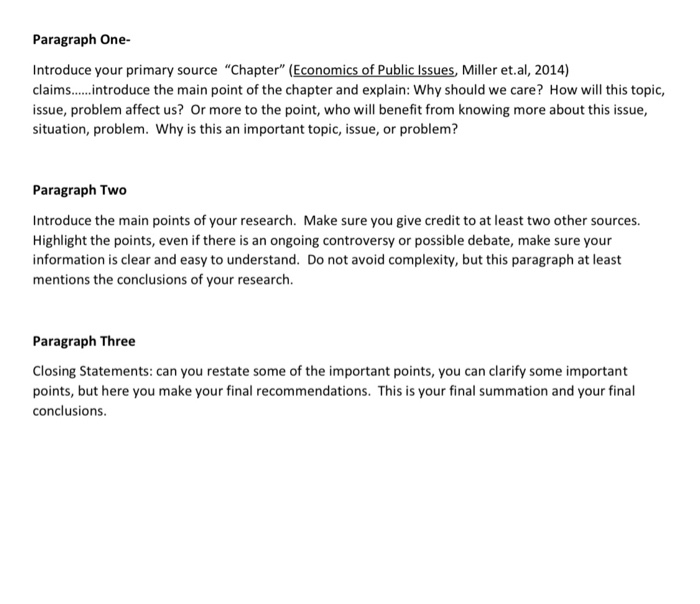
Question: Paragraph One- Introduce your primary source Chapter (Economics of Public Issues, Miller et.al, 2014) claims....introduce the main point of the chapter and explain: Why should
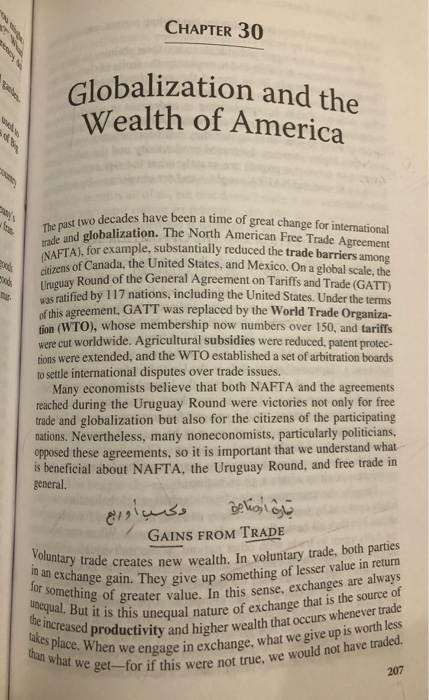
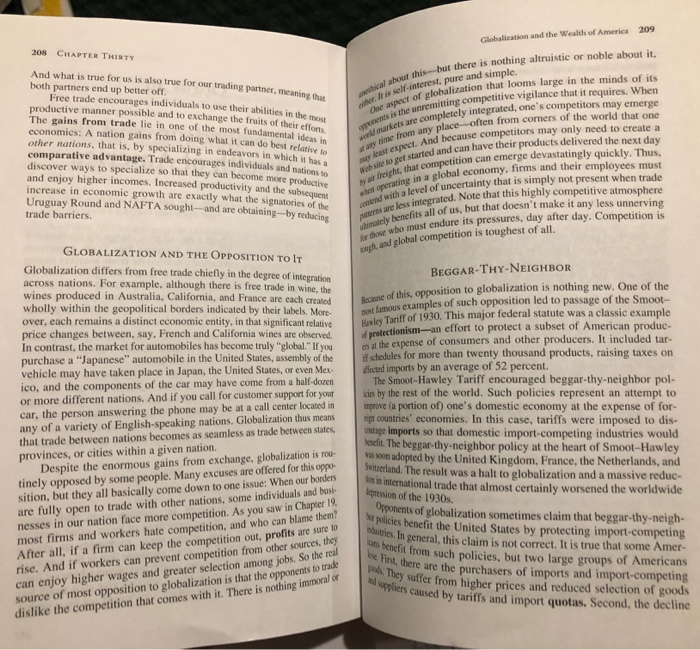
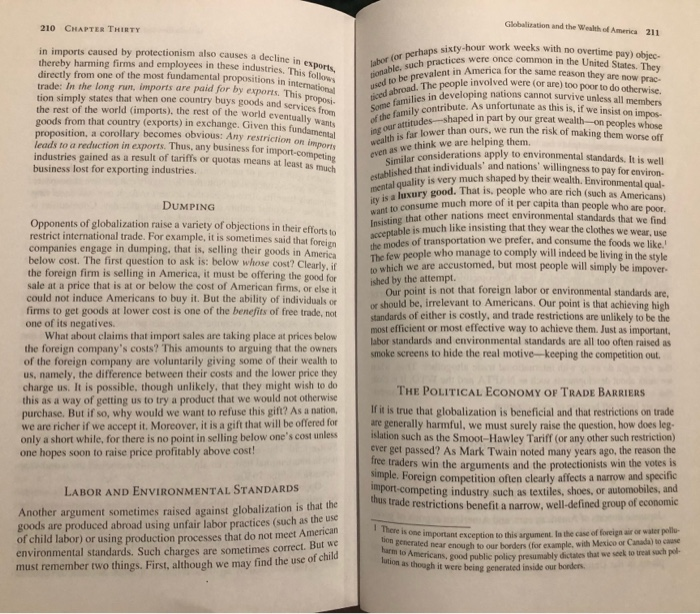
Paragraph One- Introduce your primary source "Chapter" (Economics of Public Issues, Miller et.al, 2014) claims....introduce the main point of the chapter and explain: Why should we care? How will this topic, issue, problem affect us? Or more to the point, who will benefit from knowing more about this issue, situation, problem. Why is this an important topic, issue, or problem? Paragraph Two Introduce the main points of your research. Make sure you give credit to at least two other sources. Highlight the points, even if there is an ongoing controversy or possible debate, make sure your information is clear and easy to understand. Do not avoid complexity, but this paragraph at least mentions the conclusions of your research. Paragraph Three Closing Statements can you restate some of the important points, you can clarify some important points, but here you make your final recommendations. This is your final summation and your final conclusions. 208 CHAPTER THIRTY And what is true for us is also true for our trading partner, meaning that both partners end up better off Free trade encourages individuals to use their abilities in the mou productive manner possible and to exchange the fruits of their efforts The gains from trade lie in one of the most fundamental ideas in economics: A nation gains from doing what it can do best relative to other nations, that is, by specializing in endeavors in which it has comparative advantage. Trade encourages individuals and nations to discover ways to specialize so that they can become more productive and enjoy higher incomes. Increased productivity and the subsequent increase in economic growth are exactly what the signatories of the Uruguay Round and NAFTA sought- and are obtaining-by reducing trade barriers. Globalization and the Wealth of America 209 ad about this--bur there is nothing altruistic or noble about it. One aspect of globalization that looms large in the minds of its is the unremitting competitive vigilance that it requires. When work markets are completely integrated, one's competitors may emerge ay time from any place often from corners of the world that one Website to get started and can have their products delivered the next day by ar freight, that competition can emerge devastatingly quickly. Thus. who operating in a global economy, firms and their employees must puters are less integrated. Note that this highly competitive atmosphere for those who must endure its pressures, day after day. Competition is uph and global competition is toughest of all. GLOBALIZATION AND THE OPPOSITION TO IT Globalization differs from free trade chiefly in the degree of integration across nations. For example, although there is free trade in wine, the wines produced in Australia, California, and France are each created wholly within the geopolitical borders indicated by their labels. More over, each remains a distinct economic entity, in that significant relative price changes between, say, French and California wines are observed. In contrast, the market for automobiles has become truly "global." If you purchase a "Japanese" automobile in the United States, assembly of the vehicle may have taken place in Japan, the United States, or even Mex ico, and the components of the car may have come from a half-dozen or more different nations. And if you call for customer support for your car, the person answering the phone may be at a call center located in any of a variety of English-speaking nations. Globalization thus means that trade between nations becomes as seamless as trade between states, provinces, or cities within a given nation. Despite the enormous gains from exchange, globalization is rou- tinely opposed by some people. Many excuses are offered for this oppo- sition, but they all basically come down to one issue: When our borders BEGGAR-THY-NEIGHBOR cause of this, opposition to globalization is nothing new. One of the ped famous examples of such opposition led to passage of the Smoot- Husley Tariff of 1930. This major federal statute was a classic example d protectionism-an effort to protect a subset of American produe- ce at the expense of consumers and other producers. It included tar- if schedules for more than twenty thousand products, raising taxes on affected imports by an average of 52 percent. The Smoot-Hawley Tariff encouraged beggar-thy-neighbor pol- icles by the rest of the world. Such policies represent an attempt to improve (a portion of one's domestic economy at the expense of for- eign countries' economies. In this case, tariffs were imposed to dis- courage imports so that domestic import-competing industries would benefit. The beggar thy neighbor policy at the heart of Smoot-Hawley was soon adopted by the United Kingdom, France, the Netherlands, and Switzerland. The result was a halt to globalization and a massive reduc- dan in international trade that almost certainly worsened the worldwide Opponents of globalization sometimes claim that beggar-thy-neigh- se policies benefit the United States by protecting import competing pression of the 1930s. are fully open to trade with other nations, some individuals and busi- nesses in our nation face more competition. As you saw in Chapter 19 most firms and workers hate competition, and who can blame them? After all, if a firm can keep the competition out, profits are sure to rise. And if workers can prevent competition from other sources, they can enjoy higher wages and greater selection among jobs. So the real source of most opposition to globalization is that the opponents to trade dislike the competition that comes with it. There is nothing immoral or Matrics. In general, this claim is not correct. It is true that some Amer- be. First, there are the purchasers of imports and import-competing pole. They suffer from higher prices and reduced selection of goods suppliers caused by tariffs and import quotas, Second, the decline Globalization and the wealth of America 211 210 CHAPTER THIRTY in imports caused by protectionism also causes a decline in exports, thereby harming firms and employees in these industries. This follows directly from one of the most fundamental propositions in international trade: In the long runt imports are paid for by exports. This propose tion simply states that when one country buys goods and services from the rest of the world (imports), the rest of the world eventually wants goods from that country (exports) in exchange. Given this fundamental proposition, a corollary becomes obvious: Any restriction on import leads to a reduction in exports. Thus, any business for import-competing industries gained as a result of tariffs or quotas means at least as much business lost for exporting industries. labor for perhaps sixty-hour work weeks with no overtime pay) objec used to be prevalent in America for the same reason they are now prac of the family contribute. As unfortunate as this is, if we insist on impos Some families in developing nations cannot survive unless all members wealth is far lower than ours, we run the risk of making them worse off ing our attitudes--shaped in part by our great wealth-on peoples whose Similar considerations apply to environmental standards. It is well established that individuals' and nations willingness to pay for environ mental quality is very much shaped by their wealth. Environmental qual ity is a luxury good. That is, people who are rich (such as Americans) want to consume much more of it per capita than people who are poor. Insisting that other nations meet environmental standards that we find acceptable is much like insisting that they wear the clothes we wear, use DUMPING Opponents of globalization raise a variety of objections in their efforts to restrict international trade. For example, it is sometimes said that foreign companies engage in dumping, that is, selling their goods in America below cost. The first question to ask is: below whose cost? Clearly, if the foreign firm is selling in America, it must be offering the good for sale at a price that is at or below the cost of American firms, or else it could not induce Americans to buy it. But the ability of individuals or firms to get goods at lower cost is one of the benefits of free trade, not one of its negatives What about claims that import sales are taking place at prices below the foreign company's costs? This amounts to arguing that the owners of the foreign company are voluntarily giving some of their wealth to us, namely, the difference between their costs and the lower price they charge us. It is possible, though unlikely, that they might wish to do this as a way of getting us to try a product that we would not otherwise purchase. But if so, why would we want to refuse this gift? As a nation, we are richer if we accept it. Moreover, it is a gift that will be offered for only a short while, for there is no point in selling below one's cost unless one hopes soon to raise price profitably above cost! the modes of transportation we prefer, and consume the foods we like. The few people who manage to comply will indeed be living in the style to which we are accustomed, but most people will simply be impover ished by the attempt. Our point is not that foreign labor or environmental standards are, or should be, irrelevant to Americans. Our point is that achieving high standards of either is costly, and trade restrictions are unlikely to be the most efficient or most effective way to achieve them. Just as important, labor standards and environmental standards are all too often raised as smoke screens to hide the real motive-keeping the competition out. THE POLITICAL ECONOMY OF TRADE BARRIERS If it is true that globalization is beneficial and that restrictions on trade are generally harmful, we must surely raise the question, how does leg. islation such as the Smoot-Hawley Tariff (or any other such restriction) ever get passed? As Mark Twain noted many years ago, the reason the free traders win the arguments and the protectionists win the votes is simple. Foreign competition often clearly affects a narrow and specific import-competing industry such as textiles, shoes, or automobiles, and thus trade restrictions benefit a narrow, well-defined group of economic There is one important exception to this argument. In the case of foreign air or water pollo form to Americans, good public policy presumably dictates that we seek to trem suah pel- lution as though it were being generated inside our borders LABOR AND ENVIRONMENTAL STANDARDS Another argument sometimes raised against globalization is that the goods are produced abroad using unfair labor practices (such as the use of child labor) or using production processes that do not meet American environmental standards. Such charges are sometimes correct. But we must remember two things. First, although we may find the use of child 212 CHAPTER THIRTY 1 Ai 3. Fa nu yo Ar 4. Ur on so agents. For example, restrictions on imports of Japanese automobiles try-General Motors, Ford, and Chrysler. Similarly, long-standing quo- tas on the imports of sugar benefit a handful of large American sugar steel imports in 2002, an even smaller number of American steelmakers and their employees benefited. Because of the concentrated benefits that accrue when Congress votes in favor of trade restrictions, sufficient lob. bying and campaign funds can be raised in those industries to convince members of Congress to impose those restrictions. The eventual reduction in exports that must follow is normally spread in small doses throughout all export industries. Thus, no spe cific group of workers, managers, or shareholders in export industries will feel that it should contribute money to convince Congress to reduce barriers to globalization. Furthermore, although consumers of imports and import-competing goods lose due to trade restrictions, they too are typically a diffuse group of individuals, none of whom will be indi- vidually affected much because of any single import restriction. It is the simultaneous existence of concentrated benefits and diffuse costs that led to Mark Twain's conclusion that the protectionists would often win the votes. (Concentrated benefits and dispersed costs are at the heart of Chapters 22 and 27 in explaining some U.S. domestic policies.) Of course, the protectionists don't win all the votes-after all, roughly one-sixth of the U.S. economy is based on international trade. Despite the opposition to globalization that comes from many quarters, its benefits to the economy as a whole are so great that it is unthinkable that we might do away with international trade altogether. Thus, when we think about developments such as NAFTA and the WTO, it is clear that both economic theory and empirical evidence indicate that Ameri- cans are better off because of globalization. Jay dri on Ar ex 5. Th Ar uc 6. W tio Discussion QUESTIONS 1. During the late 1980s and early 1990s, American automobile man ufacturers greatly increased the quality of the cars they produced relative to the quality of the cars produced in other nations. What effect do you think this had on American imports of Japanese cars. Japanese importe









 Study Help