







Question: Parallel Processing 2. Consider again the global sum problem mentioned in #1, in which my_x is computed from function compute_next_value(..). Assume that the computation time
Parallel Processing
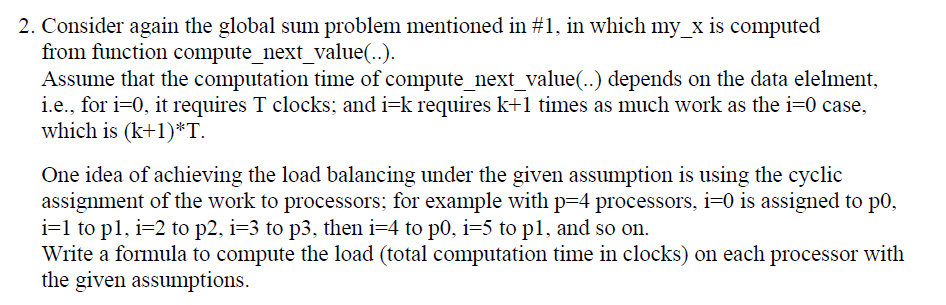
2. Consider again the global sum problem mentioned in \#1, in which my_x is computed from function compute_next_value(..). Assume that the computation time of compute_next_value(..) depends on the data elelment, i.e., for i=0, it requires T clocks; and i=k requires k+1 times as much work as the i=0 case, which is (k+1)T. One idea of achieving the load balancing under the given assumption is using the cyclic assignment of the work to processors; for example with p=4 processors, i=0 is assigned to p0, i=1 to p1,i=2 to p2,i=3 to p3, then i=4 to p0,i=5 to p1, and so on. Write a formula to compute the load (total computation time in clocks) on each processor with the given assumptions
Step by Step Solution
There are 3 Steps involved in it

Get step-by-step solutions from verified subject matter experts
 Study Help