



Question: parameter population For Questions 6 - 13, refer to the following scenario: Dr. Babcock studied the effectiveness of two different types of incentives (rewards) for
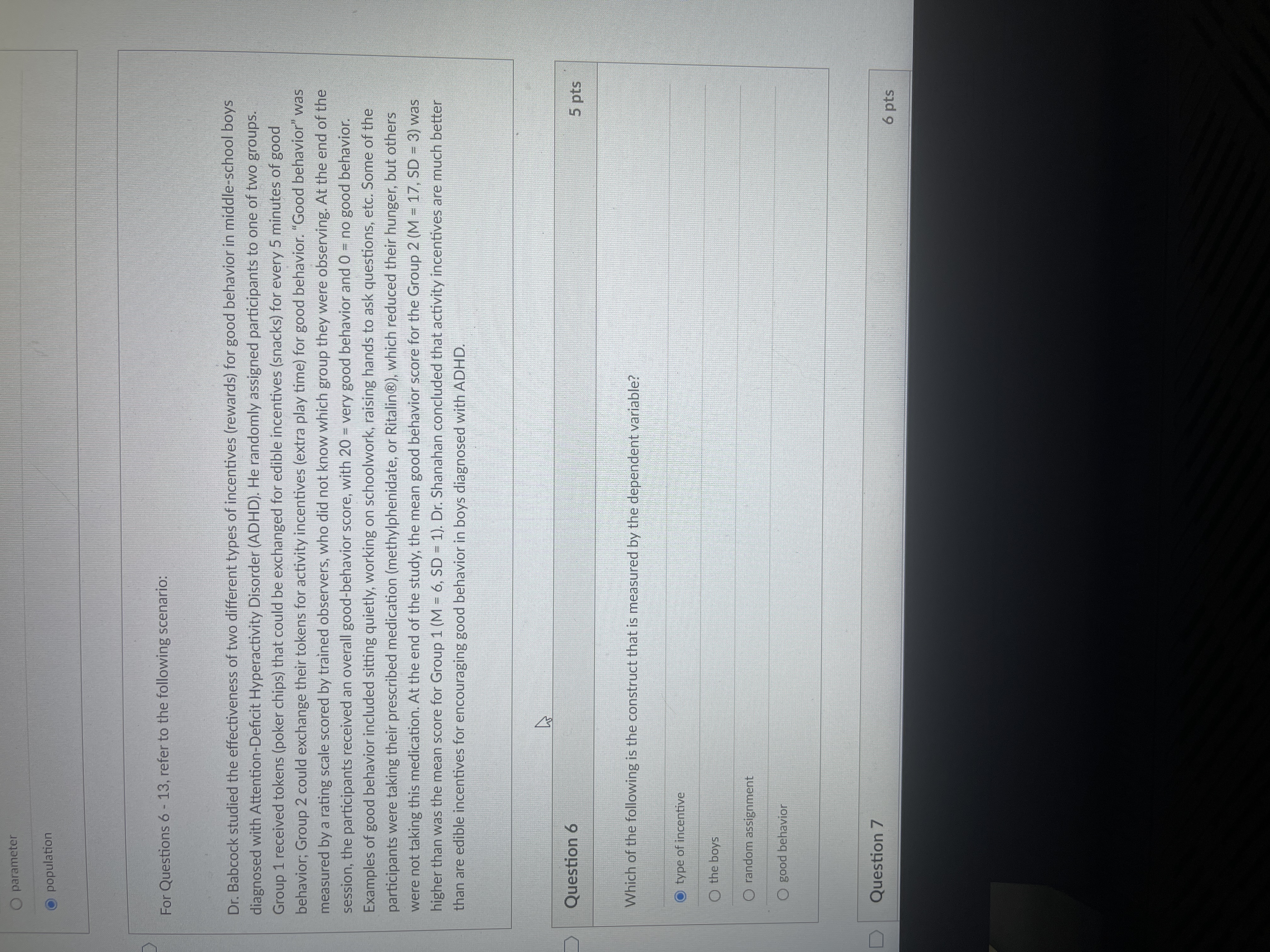
parameter population For Questions 6 - 13, refer to the following scenario: Dr. Babcock studied the effectiveness of two different types of incentives (rewards) for good behavior in middle-school boys diagnosed with Attention-Deficit Hyperactivity Disorder (ADHD). He randomly assigned participants to one of two groups. Group 1 received tokens (poker chips) that could be exchanged for edible incentives (snacks) for every 5 minutes of good behavior; Group 2 could exchange their tokens for activity incentives (extra play time) for good behavior. "Good behavior" was measured by a rating scale scored by trained observers, who did not know which group they were observing. At the end of the session, the participants received an overall good-behavior score, with 20 - very good behavior and 0 - no good behavior. Examples of good behavior included sitting quietly, working on schoolwork, raising hands to ask questions, etc. Some of the participants were taking their prescribed medication (methylphenidate, or Ritalin@), which reduced their hunger, but others were not taking this medication. At the end of the study, the mean good behavior score for the Group 2 (M - 17, SD = 3) was higher than was the mean score for Group 1 (M = 6, SD = 1). Dr. Shanahan concluded that activity incentives are much better than are edible incentives for encouraging good behavior in boys diagnosed with ADHD. Question 6 5 pts Which of the following is the construct that is measured by the dependent variable? O type of incentive the boys random assignment good behavior D Question 7 6 pts
Step by Step Solution
There are 3 Steps involved in it

Get step-by-step solutions from verified subject matter experts