







Question: Part 1 (20 Points) The first module you will work on appears to be based on a Fibonacci sequence. Recall that Fibonacci numbers are calculated
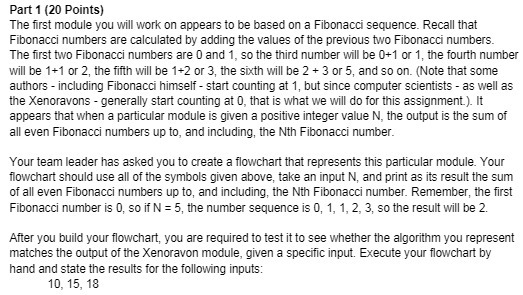
Part 1 (20 Points) The first module you will work on appears to be based on a Fibonacci sequence. Recall that Fibonacci numbers are calculated by adding the values of the previous two Fibonacci numbers. The first two Fibonacci numbers are 0 and 1, so the third number will be 0+1 or 1, the fourth number will be 1+1 or 2, the fifth will be 1+2 or 3, the sixth will be 2 + 3 or 5, and so on. (Note that some authors - including Fibonacci himself - start counting at 1, but since computer scientists - as well as the Xenoravons - generally start counting at 0, that is what we will do for this assignment ). It appears that when a particular module is given a positive integer value N, the output is the sum of all even Fibonacci numbers up to, and including, the Nth Fibonacci number. Your team leader has asked you to create a flowchart that represents this particular module. Your flowchart should use all of the symbols given above, take an input N, and print as its result the sum of all even Fibonacci numbers up to, and including, the Nth Fibonacci number. Remember, the first Fibonacci number is 0, so if N = 5, the number sequence is 0, 1, 1, 2, 3, so the result will be 2. After you build your flowchart, you are required to test it to see whether the algorithm you represent matches the output of the Xenoravon module, given a specific input. Execute your flowchart by hand and state the results for the following inputs: 10, 15, 18
Step by Step Solution
There are 3 Steps involved in it

Get step-by-step solutions from verified subject matter experts
 Study Help