







Question: Part 1: A random sample of cross-section, observational data was collected. The vari- ables X; and Y, are measured in units. Consider the following sample
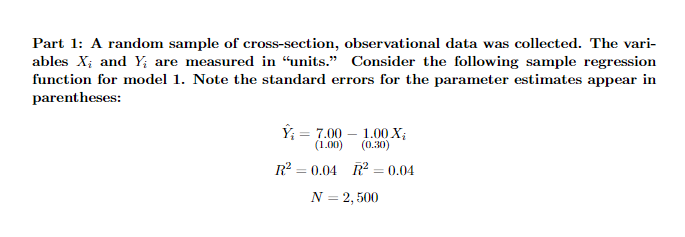
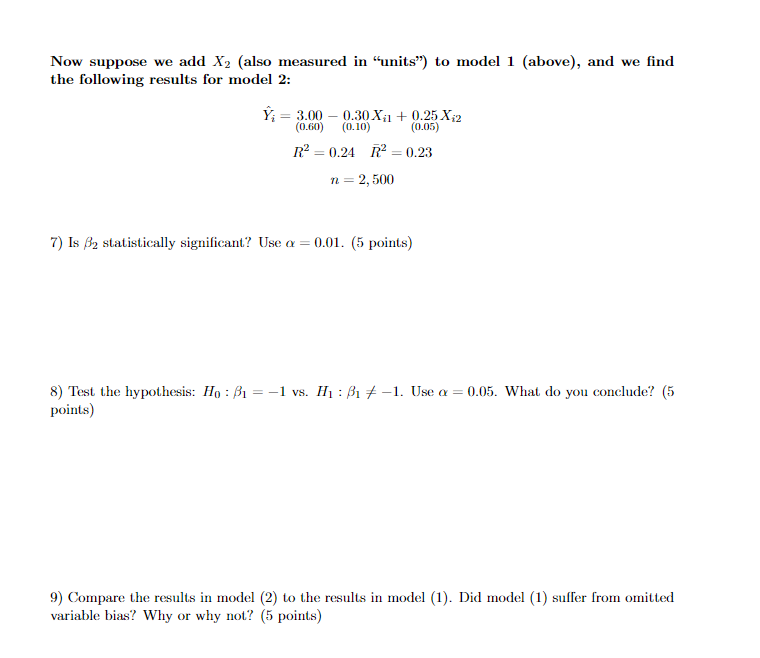
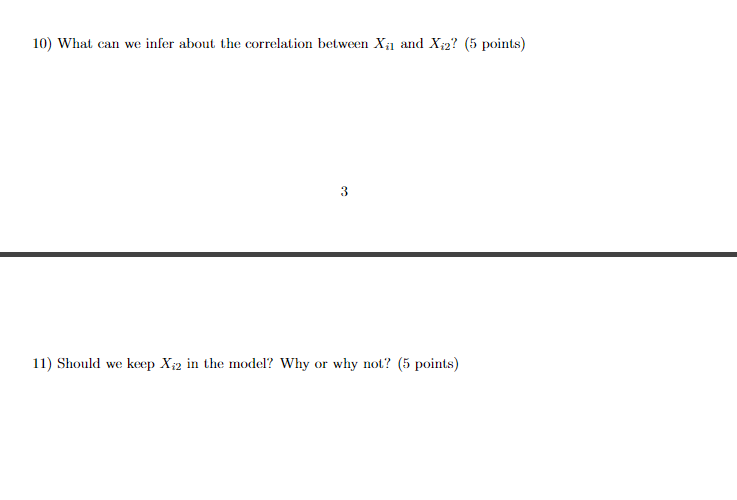
Part 1: A random sample of cross-section, observational data was collected. The vari- ables X; and Y, are measured in "units." Consider the following sample regression function for model 1. Note the standard errors for the parameter estimates appear in parentheses: YA= 7.00 - 1.00 X; (1.00) (0.30) R2 = 0.04 R- = 0.04 N = 2,500Now suppose we add X2 (also measured in "units") to model 1 (above), and we find the following results for model 2: Y = 3.00 - 0.30 Xa + 0.25 X;2 (0.60) (0.10) (0.05) R- = 0.24 R= = 0.23 n = 2, 500 7) Is 82 statistically significant? Use o = 0.01. (5 points) 8) Test the hypothesis: Ho : 81 = -1 vs. H1 : B1 4 -1. Use a = 0.05. What do you conclude? (5 points) 9) Compare the results in model (2) to the results in model (1). Did model (1) suffer from omitted variable bias? Why or why not? (5 points)10) What can we infer about the correlation between Xa and Xi2? (5 points) 3 11) Should we keep Xi in the model? Why or why not? (5 points)
Step by Step Solution
There are 3 Steps involved in it

Get step-by-step solutions from verified subject matter experts
 Study Help