Question: Part 1. Download and complete the forms (ATTACHED BELOW) 5. Compare your Management style with the Typical Behaviors, Potential Uses, and Limitations on the document
Part 1. Download and complete the forms (ATTACHED BELOW) 5. Compare your Management style with the Typical Behaviors, Potential Uses, and Limitations on the document titled "Conflict Style: Different Strokes for Different Folks Retyped and Revised." Part 2: Reflect on Your Results After completing both assessments, reflect on your results and consider the following (just reflect): 1. What did you learn about your conflict management style? How do typically handle conflict in the workplace? 2. What leadership characteristics were highlighted in your assessment? Do these align with how you see yourself as a leader? 3. How do conflict management and leadership styles complement each other? Are there areas where they may clash? 4. In what ways do qualifications and characteristics support your effectiveness as an early childhood administrator? 5. What areas for growth and improvement have you identified? Part 3: a Personal Narrative Craft a personal narrative that creatively presents your insights from Part 2. Your narrative should be engaging and reflective, integrating your assessment results with personal experiences and future goals. Use one of the following formats to express your narrative: A Letter to Your Future Self: a letter to yourself five years from now, describing how you envision your growth as a leader and conflict manager as you integrate your assessment results and reflections from Part 2.
1. Include an introduction that provides context for your narrative2. Integrate key findings from both assessments with specific examples3. Reflect on your strengths, challenges, and future goals as a leader4. Use a creative format to present your edited narrative
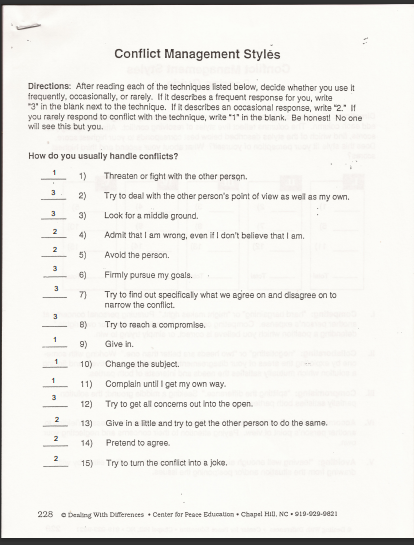
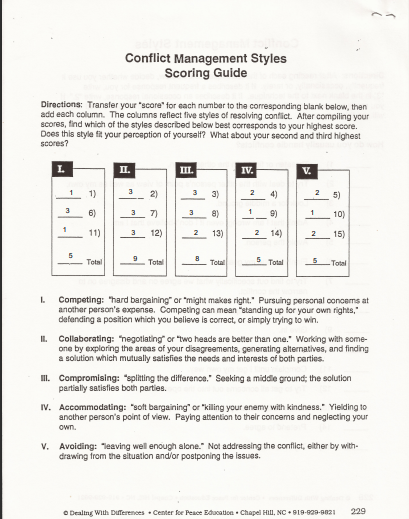
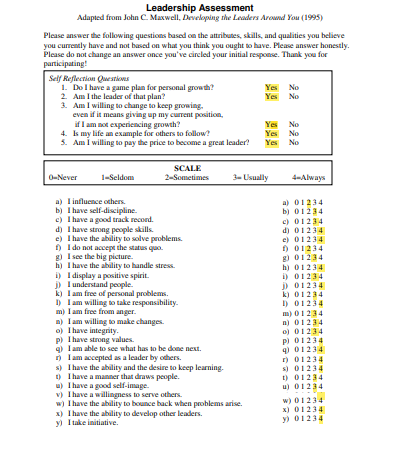
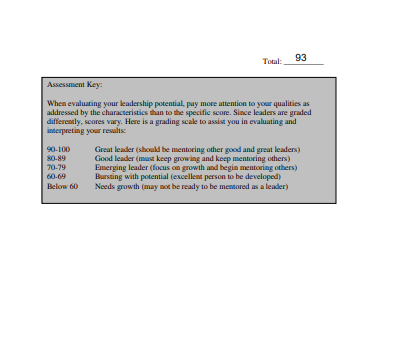
Conflict Management Styles Directions: After reading each of the techniques listed below, decide whether you use it frequently, cocasionally, or rarely. If it describes a frequent response for you, write "" in the blank next to the technique. If it describes an occasional response, write "2." I you rarely respond to conflict with the technique, write "1" in the blank, Be honest! No one will see this but you. How do you usually handle conflicts? 1) Threaten or fight with the other person. 3 Try to deal with the other person's point of view as well as my own. E Look for a middle ground. 4) Admit that I am wrong, even if I don't believe that I am. 2 Avold the person. 3 61 Firmly pursue my goals. 3 Try to find out specifically what we agree on and disagree on to narrow the conflict. 3 Try to reach a compromise. 1 Give in. 10) Change the subject. 11) Complain until I get my own way. 3 12) Try to get all concerns out Into the open. 2 13) Give in a little and try to get the other parson to do the same, 2 14) Pretend to agree. 2 15) Try to tum the conflict into a joke. 228 a bonding With Duferences . Center for Peace Education . Chapel Hill, NC . 919-029-0821Conflict Management Styles Scoring Guide Directions: Transfer your "score" for each number to the corresponding blank below, then add each column. The columns reflect five styles of resolving conflict. After compiling your scores, find which of the styles described below best corresponds to your highest score. Does this style fit your perception of yourself? What about your second and third highest scores? L. II. III. IV. V. 21 51 10 11) 3 12' 2 2 2 15) 5 Total Total Total 5 Total -Total Competing: "hard bargaining" or "might makes right." Pursuing personal concerns at another person's expense. Competing can mean "standing up for your own rights," defending a position which you believe is correct, or simply trying to win. Collaborating: "negotiating" or "two heads are better than one." Working with some- one by exploring the areas of your disagreements, generating alternatives, and finding A solution which mutually satisfies the needs and interests of both parties. III. Compromising: "splitting the difference." Seeking a middle ground; the solution partially satisfies both parties. IV. Accommodating: "soft bargaining" or "kiling your enemy with kindness." Yielding to another person's point of view. Paying attention to their concerns and neglecting your own. V. Avoiding: "leaving well enough alone." Not addressing the conflict, ether by with- drawing from the situation and/or postponing the issues. @ Dealing With Differences . Center for Peace Education . Chapel Hill. NC + 919-909-8031 229Leadership Assessment Adapted from John C. Maxwell, Developing the Leaders Around You (1995) Please answer the following questions based on the attributes, skills, and qualities you believe you currently have and not based on what you think you ought to have. Please answer honestly. Please do not change an answer once you've circled your initial response. Thank you for participating! Self Reflection (wearlous 1. Do I have a game plan for personal growth? No 2. Am I the leader of that plan? Yes No 3. Am I willing to change to keep growing. even if it means giving up my current position, if I am not expenencing growth? Ye No 4. Is my life an example for others to follow? Ye No 5. Am I willing to pay the price to become a great leader? Ye No SCALE O-Never 1-Seldom 2 Sometimes 3- Usually 4-Always a) I influence others. 0) 01234 bj I have self-discipline. bj 01234 c) I have a good track record. 0 01234 dj I have strong people skills. dj 01234 e) I have the ability to solve problems. 2 01234 f) I do not accept the status quo. 6 01234 ") I see the big picture. 2) 01234 hj I have the ability to handle stress. hi 01234 i I display a positive spirit. 0 01234 Iunderstand people. 1 01234 kj I am free of personal problems. kj 01234 I am willing to take responsibility. 1 01234 m) I am free from anger. m101234 n) Iam willing to make changes. nj 01234 of I have integrity. 0) 01234 pl I have strong values. pi 01234 ql I am able to see what has to be done next. q1 01234 ") I am accepted as a leader by others. 1 01234 I have the ability and the desire to keep learning. 5) 01234 I have a manner that draws people. 1 01234 I have a good self-image. uj 01234 v) I have a willingness to serve others. wj I have the ability to bounce back when problems arise. w) 01234 x) I have the ability to develop other leaders. x) 01234 y) I take initiative. y0 01234Total: 93 Assessment Key: When evaluating your leadership potential, pay more attention to your qualities is addressed by the characteristics than to the specific score. Since leaders are graded differently, scores vary. Here is a grading scale to assist you in evaluating and interpreting your results: 90-100 Great leader (should be mentoring other good and great leaders) 80-84 Good leader (need keep growing and keep mentoring others) TO.79 Emerging leader (focus on growth and begin mentoring others) 60.64 Bursting with potential (excellent person to be developed) Below to Needs growth (may not be ready to be mentored as a leader)
Step by Step Solution
There are 3 Steps involved in it
1 Expert Approved Answer
Step: 1 Unlock
Question Has Been Solved by an Expert!
Get step-by-step solutions from verified subject matter experts
Step: 2 Unlock
Step: 3 Unlock
Students Have Also Explored These Related General Management Questions!









 Study Help