







Question: Part 1. For each question below, develop a relational schema clearly showing the tables, primary key/s, foreign key/s, and maximum cardinality constraints on both sides
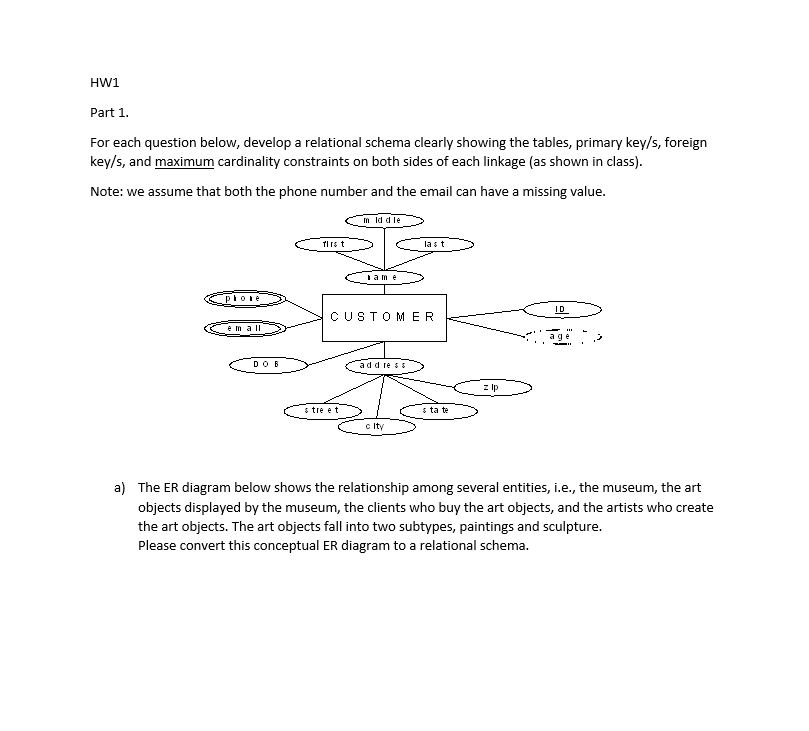
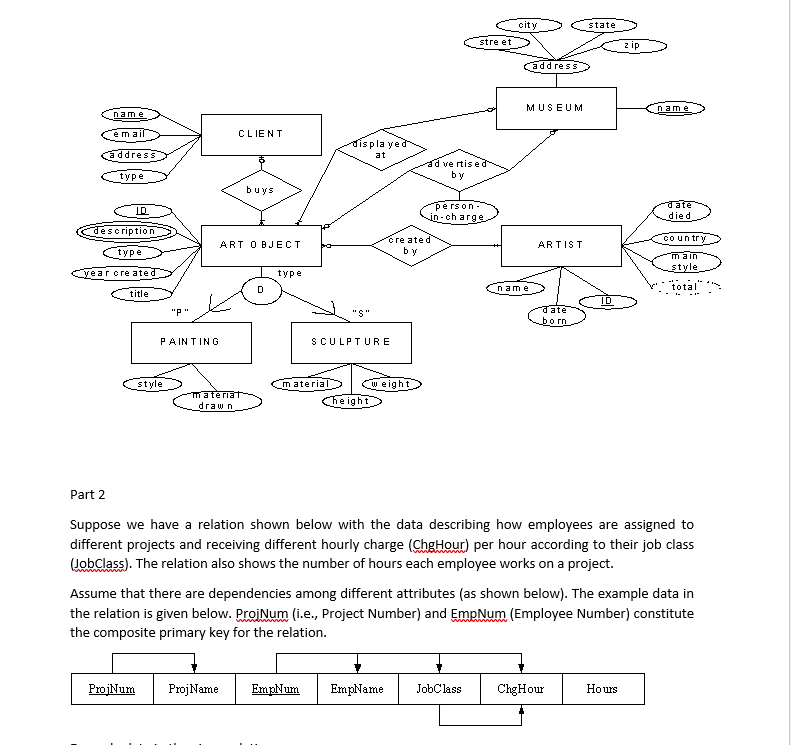
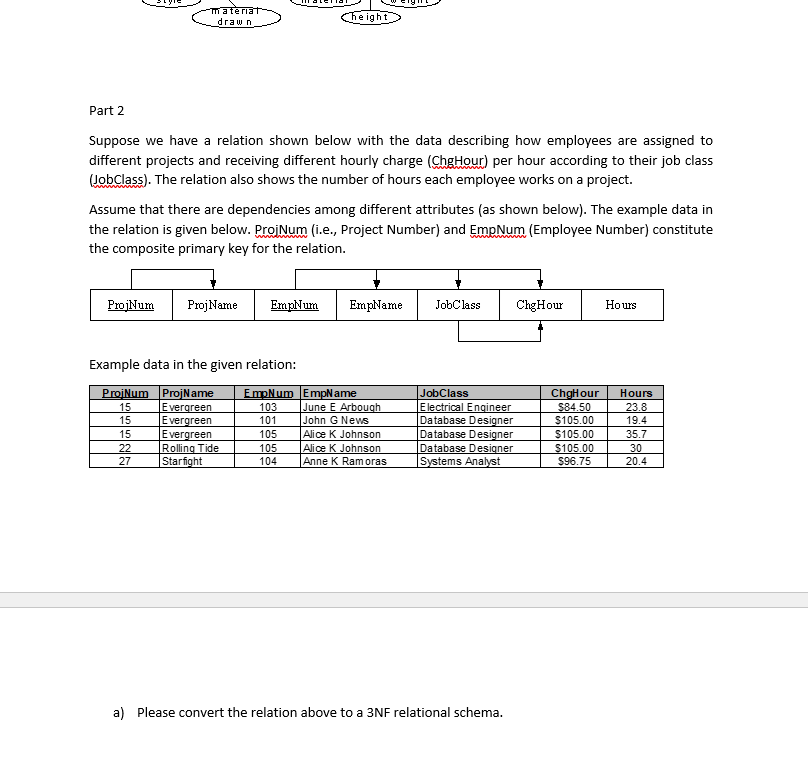
Part 1. For each question below, develop a relational schema clearly showing the tables, primary key/s, foreign key/s, and maximum cardinality constraints on both sides of each linkage (as shown in class). Note: we assume that both the phone number and the email can have a missing value. a) The ER diagram below shows the relationship among several entities, i.e., the museum, the art objects displayed by the museum, the clients who buy the art objects, and the artists who create the art objects. The art objects fall into two subtypes, paintings and sculpture. Please convert this conceptual ER diagram to a relational schema. Part 2 Suppose we have a relation shown below with the data describing how employees are assigned to different projects and receiving different hourly charge (ChgHour) per hour according to their job class (JobClass). The relation also shows the number of hours each employee works on a project. Assume that there are dependencies among different attributes (as shown below). The example data in the relation is given below. ProjNum (i.e., Project Number) and EmpNum (Employee Number) constitute the composite primary key for the relation. Part 2 Suppose we have a relation shown below with the data describing how employees are assigned to different projects and receiving different hourly charge ( ChgHHur ) per hour according to their job class (JobClass). The relation also shows the number of hours each employee works on a project. Assume that there are dependencies among different attributes (as shown below). The example data in the relation is given below. ProjNum (i.e., Project Number) and EmpNum (Employee Number) constitute the composite primary key for the relation. Example data in the given relation: a) Please convert the relation above to a 3 NF relational schema
Step by Step Solution
There are 3 Steps involved in it

Get step-by-step solutions from verified subject matter experts
 Study Help