







Question: Part 1: Force Buoyancy vs. Acceleration due to gravity 1 Open the simulation Force Buoyancy Lab 2. Start your experiment on the Earth with a
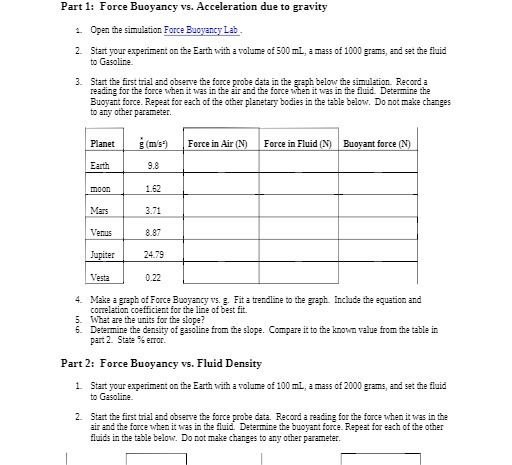
Part 1: Force Buoyancy vs. Acceleration due to gravity 1 Open the simulation Force Buoyancy Lab 2. Start your experiment on the Earth with a volume of 500 mL, a mass of 1000 grams, and get the fluid to Gasoline. Start the first trial and observe the force probe data in the graph below the simulation. Record a reading for the force when it was in the air and the force when it was in the fluid. Determine the Buoyant force. Repeat for each of the other planetary bodies in the table below. Do not make changes to any other parameter. Planet g (m/3)) Force in Air (N) Force in Fluid (N) Buoyant force (N) Earth 9.8 moon 1.62 Mars 3.71 Venus 8.87 Jupiter 24.79 Vesta 0.22 4. Make a graph of Force Buoyancy vs. g. Fit a trendline to the graph. Include the equation and comelation coefficient for the line of best fit. What are the units for the slope? Determine the density of gasoline from the slope. Compare it to the known value from the table in part 2. State %% error. Part 2: Force Buoyancy vs. Fluid Density 1. Start your experiment on the Earth with a volume of 100 mL, a mass of 2000 grams, and set the fluid to Gasoline. Start the first trial and observe the force probe data. Record a reading for the force when it was in the air and the force when it was in the fluid. Determine the buoyant force. Repeat for each of the other fluids in the table below. Do not make changes to any other parameter
Step by Step Solution
There are 3 Steps involved in it

Get step-by-step solutions from verified subject matter experts
 Study Help