







Question: Part 1 : if - statement Open the part 1 . cpp file. In the main ( ) function, prompt for 3 integers, and report
Part : ifstatement
Open the partcpp file. In the main function, prompt for integers, and report whether one of the numbers is the product of the other two, as shown in the following examples:
Enter integers separated by spaces:
None of the integers is the product of th e other two
Enter integers separated by spaces: is the product of and
Enter integers separated by spaces:
is the product of and
Enter integers separated by spaces:
is the product of and
Part : whileloop
Open the partcpp file. In the main function, prompt once for an arbitrary number of numeric grades separated by white space, where the grades are terminated with a negative value:
Enter grades separated by white space and ending with a negative value:
The minimum grade is
The maximum grade is
The average grade is
White space means one or more space, tab, carriage return, andor newline characters. The latter is produced by the Enter key. Hence, the grades can be placed on a single or multiple lines. If no value appears on a line, the program will keep attempting to read a value. Make sure you confirm all these input possibilities. If no actual grades are entered only a negative value is typed then the minimummaximumaverage should not be displayed.
A while loop is appropriate, which requires a read from before the loop starts and again as the last operation within the loop. The initial read from is called the priming read because it starts the repetition. The loop
its when a negative value is read.
Part : forloop
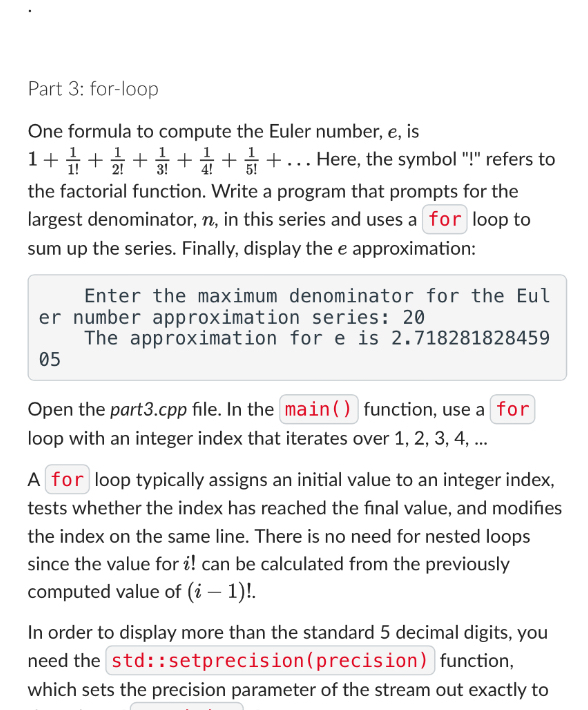
One formula to compute the Euler number, is dots Here, the symbol refers to the factorial function. Write a program that prompts for the largest denominator, in this series and uses a loop to sum up the series. Finally, display the approximation:
Open the partcpp file. In the function, use a for loop with an integer index that iterates over dots
A loop typically assigns an initial value to an integer index, tests whether the index has reached the final value, and modifies the index on the same line. There is no need for nested loops since the value for can be calculated from the previously computed value of
In order to display more than the standard decimal digits, you need the s function, which sets the precision parameter of the stream out exactly to
Step by Step Solution
There are 3 Steps involved in it
1 Expert Approved Answer
Step: 1 Unlock

Question Has Been Solved by an Expert!
Get step-by-step solutions from verified subject matter experts
Step: 2 Unlock
Step: 3 Unlock
 Study Help