







Question: Part 1 Implement the following public methods: 1. boolean offer(E e) 2. boolean add(E e) 3. E poll() 4. E remove() 5. E peek() 6.
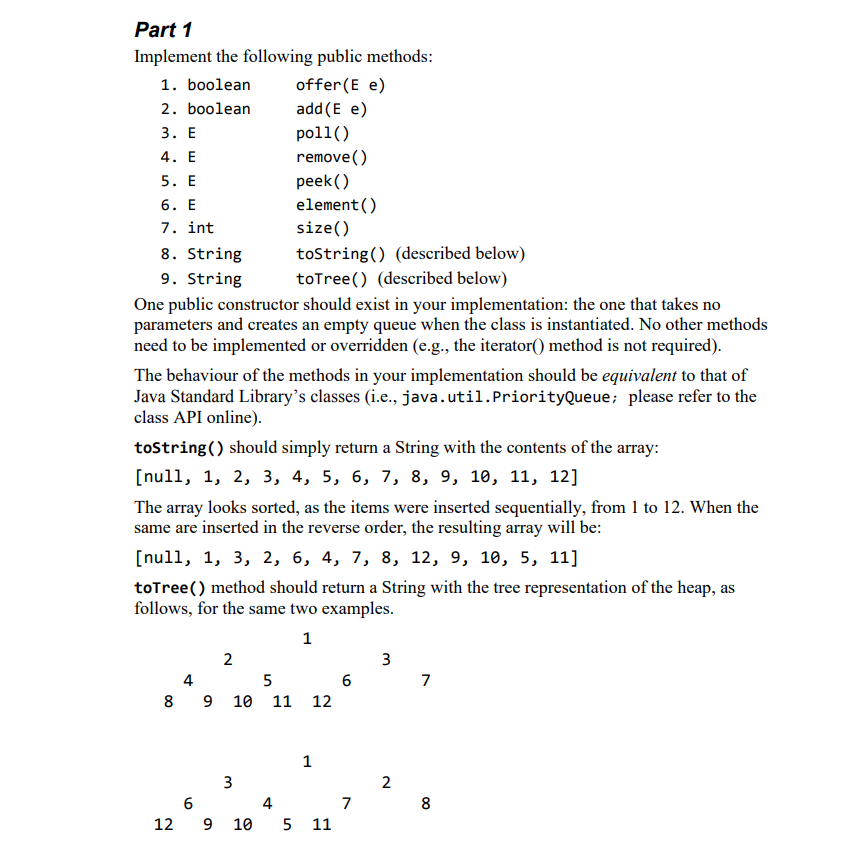
Part 1 Implement the following public methods: 1. boolean offer(E e) 2. boolean add(E e) 3. E poll() 4. E remove() 5. E peek() 6. E element() 7. int size() 8. String toString() (described below) 9. String toTree() (described below) One public constructor should exist in your implementation: the one that takes no parameters and creates an empty queue when the class is instantiated. No other methods need to be implemented or overridden (e.g., the iterator() method is not required). The behaviour of the methods in your implementation should be equivalent to that of Java Standard Library's classes (i.e., java.util.PriorityQueue; please refer to the class API online). toString() should simply return a String with the contents of the array: [null, 1, 2, 3, 4, 5, 6, 7, 8, 9, 10, 11, 12] The array looks sorted, as the items were inserted sequentially, from 1 to 12. When the same are inserted in the reverse order, the resulting array will be: [null, 1, 3, 2, 6, 4, 7, 8, 12, 9, 10, 5, 11] toTree() method should return a String with the tree representation of the heap, as follows, for the same two examples. 1 2 3 4 5 6 7 8 9 10 11 12 4 1 3 N 7 00 6 4 12 9 10 5 11 Part 1 Implement the following public methods: 1. boolean offer(E e) 2. boolean add(E e) 3. E poll() 4. E remove() 5. E peek() 6. E element() 7. int size() 8. String toString() (described below) 9. String toTree() (described below) One public constructor should exist in your implementation: the one that takes no parameters and creates an empty queue when the class is instantiated. No other methods need to be implemented or overridden (e.g., the iterator() method is not required). The behaviour of the methods in your implementation should be equivalent to that of Java Standard Library's classes (i.e., java.util.PriorityQueue; please refer to the class API online). toString() should simply return a String with the contents of the array: [null, 1, 2, 3, 4, 5, 6, 7, 8, 9, 10, 11, 12] The array looks sorted, as the items were inserted sequentially, from 1 to 12. When the same are inserted in the reverse order, the resulting array will be: [null, 1, 3, 2, 6, 4, 7, 8, 12, 9, 10, 5, 11] toTree() method should return a String with the tree representation of the heap, as follows, for the same two examples. 1 2 3 4 5 6 7 8 9 10 11 12 4 1 3 N 7 00 6 4 12 9 10 5 11
Step by Step Solution
There are 3 Steps involved in it

Get step-by-step solutions from verified subject matter experts
 Study Help